Ramadan is not one long stretch of identical days. Allah ﷻ has divided this blessed month into three distinct spiritual stages, each with its own theme, purpose, and dua. The first of these stages is called Ashra-e-Rehmat the ten days of mercy. And at the heart of this stage stands the pehla ashra ki dua, a supplication drawn directly from the Holy Quran.
The ramzan ka pehla ashra ki dua is not just a formula to memorize and repeat. It is a heartfelt plea that connects the believer to two of Allah’s greatest attributes His forgiveness and His mercy. When you truly understand what you are saying, the dua transforms your entire first ten days.
What Is Ashra? Understanding the Three Stages of Ramadan
The word Ashra (عشرة) is an Arabic term meaning “ten.” Ramadan’s 29 or 30 days are divided into three ten-day stages:
| Ashra | Days | Theme | Arabic Name |
|---|---|---|---|
| 1st Ashra | Day 1–10 | Mercy (Rehmat) | عشرہ رحمت |
| 2nd Ashra | Day 11–20 | Forgiveness (Maghfirah) | عشرہ مغفرت |
| 3rd Ashra | Day 21–30 | Salvation from Fire (Nijat) | عشرہ نجات |
This division is referenced in a well-known narration attributed to the Prophet ﷺ in which Ramadan is described as a month whose beginning is mercy, whose middle is forgiveness, and whose end is freedom from the Fire. Scholars have graded this narration as weak (da’if), but its thematic framework is supported by the broader Quranic and Sunnah teachings on mercy, repentance, and salvation during Ramadan. Many respected scholars continue to use it as a motivational framework for worship.
Pehla Ashra Ki Dua: Complete Supplication
The ramadan first ashra dua most widely recited by Muslims worldwide is taken directly from the Holy Quran:
Arabic:
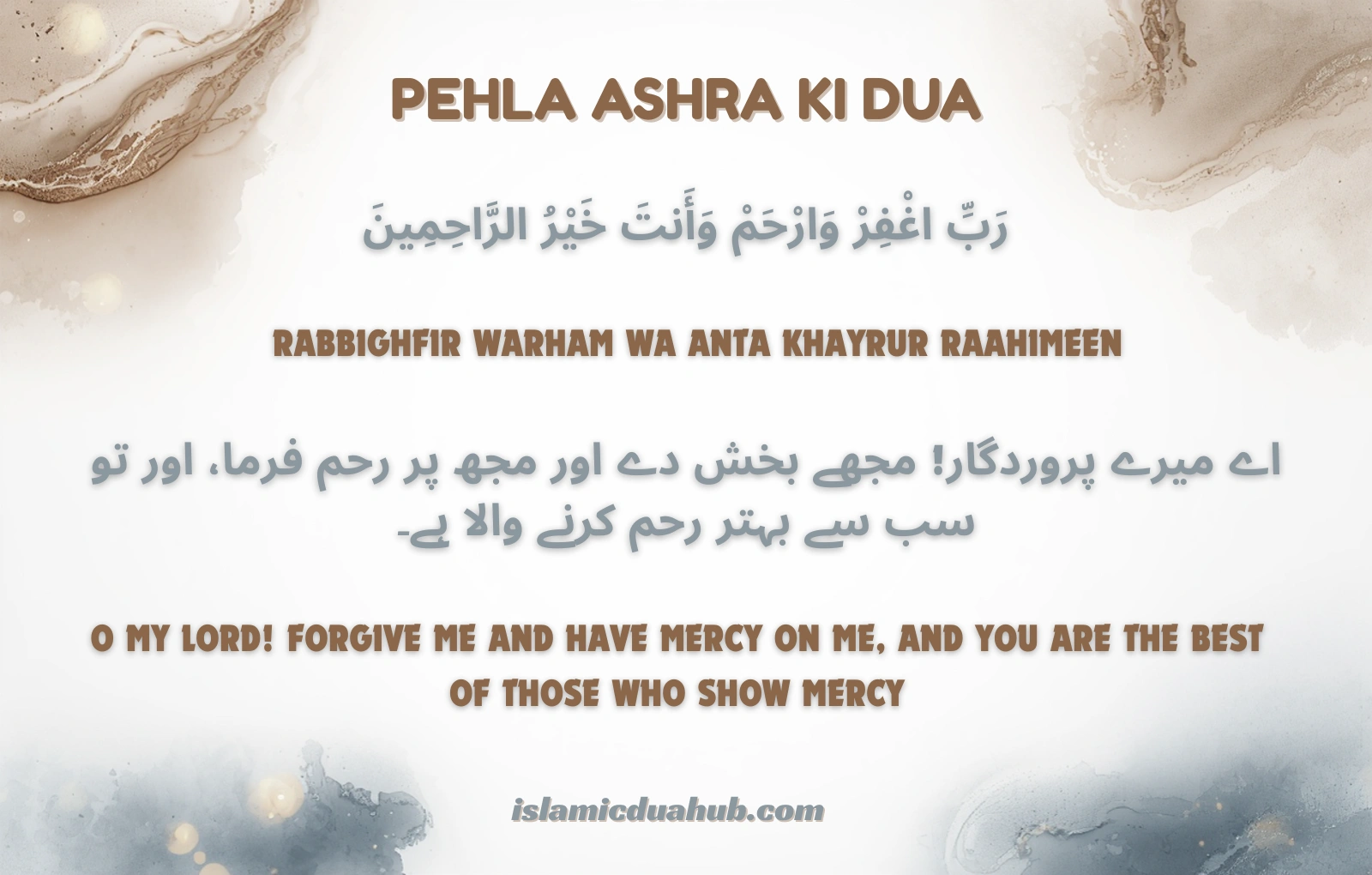
رَبِّ اغْفِرْ وَارْحَمْ وَأَنتَ خَيْرُ الرَّاحِمِينَ
Transliteration:
Rabbighfir warham wa anta khayrur raahimeen
Urdu Meaning:
اے میرے پروردگار! مجھے بخش دے اور مجھ پر رحم فرما، اور تو سب سے بہتر رحم کرنے والا ہے۔
English Meaning:
“O my Lord! Forgive me and have mercy on me, and You are the Best of those who show mercy.”
Source: Surah Al-Muminoon, Chapter 23, Verse 118 Holy Quran
This is a Quranic verse, which makes it among the most reliable and powerful supplications a Muslim can recite. Its Credibility is beyond question.
Why This Dua Was Chosen for the First Ashra
The first ashra dua in urdu and Arabic both carry the same essential plea: forgiveness and mercy. The scholars’ choice of this verse for the first ashra is deeply fitting because:
1. It begins with Rabb (رَبِّ) “My Lord.”
This word establishes a direct, personal relationship with Allah. You are not addressing a distant power. You are speaking to your Creator, your Sustainer, the One who knows your every state.
2. It asks for Maghfirah (forgiveness) before Rahmah (mercy).
This reflects a spiritual wisdom one must first be cleansed of sins before fully receiving divine mercy. Even in a single sentence, the Quran teaches us the order of spiritual priorities.
3. It closes with the greatest divine affirmation.
Saying “You are the Best of those who show mercy” is not flattery it is an act of Tawakkul (reliance on Allah). You are anchoring your hope in His infinite capacity to forgive and embrace.
How and When to Recite the Pehla Ashra Ki Dua
Reciting the ramadan 1st ashra dua at the right moments amplifies its spiritual effect.
Best times to recite:
- After every Fard (obligatory) Salah
- During Sehri (pre-dawn meal), before or after eating
- At the time of Iftar, just before breaking the fast
- During Tahajjud (night prayer)
- After completing Taraweeh
- In moments of personal reflection and quiet
How to recite it: Recite slowly and deliberately. Pause after Rabbighfir and feel the weight of asking for forgiveness. Pause again after warham and feel what it means to ask for Allah’s mercy. These are not words to rush through they are words to inhabit.
Related Duas for the First Ashra
While the pehla ashra ki dua is the main supplication, Islamic scholarship recommends supplementing it with additional authentic duas during the first ten days. Below are verified supplications from the Quran and Sunnah that align perfectly with the theme of mercy:
Dua 1: For Allah’s Mercy (From Surah Al-A’raf)
وَرَحْمَتِي وَسِعَتْ كُلَّ شَيْءٍ
(Wa rahmati wasi’at kulla shay’)
“My mercy encompasses all things.”
Surah Al-A’raf, 7:156
Recite this verse to remind yourself of the infinite scope of Allah’s mercy during these ten days.
Dua 2: For Forgiveness and Mercy (Quranic)
رَبَّنَا ظَلَمْنَا أَنفُسَنَا وَإِن لَّمْ تَغْفِرْ لَنَا وَتَرْحَمْنَا لَنَكُونَنَّ مِنَ الْخَاسِرِينَ
(Rabbana zalamna anfusana wa illam taghfir lana wa tarhamna lanakunanna minal khasirin)
“Our Lord! We have wronged ourselves. If You do not forgive us and have mercy on us, we will certainly be among the losers.”
Surah Al-A’raf, 7:23
This is the dua of Prophet Adam (عليه السلام) and his wife the first human beings to seek Allah’s forgiveness. It is deeply appropriate for the first ashra.
Dua 3: Seeking Allah’s Mercy in All Affairs
رَبِّ إِنِّي لِمَا أَنزَلْتَ إِلَيَّ مِنْ خَيْرٍ فَقِيرٌ
(Rabbi inni lima anzalta ilayya min khayrin faqeer)
“My Lord! I am truly in need of whatever good You may send down to me.”
Surah Al-Qasas, 28:24
This is the dua of Prophet Musa (عليه السلام). Reciting it in the first ashra expresses complete dependence on Allah’s grace and mercy.
Dua 4: General Supplication for Mercy (From Sunnah)
اللَّهُمَّ إِنِّي أَسْأَلُكَ رَحْمَتَكَ
(Allahumma inni as’aluka rahmataka)
“O Allah! I ask You for Your mercy.”
This short but powerful dua can be repeated throughout the day. It is consistent with the prophetic teaching to make frequent, sincere supplication.
Dua 5: For Acceptance of Worship (Quranic)
رَبَّنَا تَقَبَّلْ مِنَّا إِنَّكَ أَنتَ السَّمِيعُ الْعَلِيمُ
(Rabbana taqabbal minna innaka antas-Sami’ul Aleem)
“Our Lord! Accept this from us. Indeed You are the All-Hearing, All-Knowing.”
Surah Al-Baqarah, 2:127
This is the dua of Prophet Ibrahim (عليه السلام) and Prophet Ismail (عليه السلام). Recite it after every act of worship during the first ashra to ask Allah to accept your efforts.
Read Also: Eid Ka Chand Dekhne Ki Dua
The Spiritual Benefits of the First Ashra
The ramadan first ashra dua is not just words it initiates a spiritual transformation if accompanied by sincere intention and action.
Mercy opens when you show mercy. The Prophet ﷺ said: “Those who show mercy will be shown mercy by the Most Merciful. Be merciful to those on earth, and the One in the heavens will be merciful to you.” (Abu Dawud, Tirmidhi Sahih)
This means that the first ashra is not only about receiving mercy it is equally about giving it. Forgive those who wronged you. Be patient with those who test you. Give to those in need. These actions open the doors of divine mercy in ways that no supplication alone can.
Practical actions to accompany the first ashra dua:
- Increase Sadaqah (charity) even a small amount given consistently
- Read Quran with reflection, especially Surah Ar-Rahman (the chapter of mercy)
- Reconcile broken relationships before the first ten days pass
- Lower the gaze, guard the tongue fast with your entire body, not just your stomach
A Note on the Ashra Division
Scholarly integrity demands honesty: the specific hadith dividing Ramadan into three named ashras is graded da’if (weak) by hadith scholars. However, the themes of mercy, forgiveness, and salvation from the Fire are all strongly established in authentic narrations about Ramadan as a whole.
The pehla ashra ki dua itself being a Quranic verse (23:118) is completely authentic. You can recite it with full confidence. What you should avoid is claiming the ashra framework is established by a sahih (sound) hadith, as that would be inaccurate.
This distinction matters not to reduce your enthusiasm for Ramadan, but to ensure your worship is built on a solid foundation of knowledge.
Common Mistakes to Avoid During the First Ashra
Even the most motivated worshippers make avoidable errors during Ramadan’s opening days:
Rushing the dua: Treat the pehla ashra ki dua as a conversation with Allah, not a task to tick off.
Reciting without understanding: Memorize the meaning. Knowing what you say deepens your sincerity.
Waiting until Ramadan to start good habits: The first ashra is most powerful when you arrive already in a state of spiritual readiness.
Ignoring the connection between dua and action: Seeking mercy while continuing harmful behavior creates a contradiction your heart will feel.
Conclusion
The pehla ashra ki dua is one of the most beautiful and profound supplications in Islamic tradition not because scholars invented it, but because Allah Himself placed it in His Book. When you say Rabbighfir warham wa anta khayrur raahimeen, you are repeating words that Allah revealed. That alone should fill every recitation with weight and wonder.
The first ten days of Ramadan will not return until next year. They are ten windows of divine mercy, ten opportunities to reset your relationship with your Creator, and ten chances to become someone who genuinely shows mercy to others before asking for it above.
Do not let these days pass in Ramadan logistics the shopping, the cooking, the sleep schedules. Let them pass in the company of this dua, in the shade of the Quran, and in acts of mercy that give the supplication its full meaning.
May Allah ﷻ accept the worship of all Muslims in the first ashra, grant His mercy abundantly, and make the remaining days of Ramadan a continuous ascent toward His pleasure.
? FAQs About Pehla Ashra Ki Dua
Q: Pehla ashra ki dua kaunsi hai?
The main dua is: رَبِّ اغْفِرْ وَارْحَمْ وَأَنتَ خَيْرُ الرَّاحِمِينَ taken from Surah Al-Muminoon (23:118). It means: “O my Lord! Forgive me and have mercy on me, and You are the Best of those who show mercy.”
Q: Pehla ashra ki dua kab se kab tak parhni chahiye?
This dua is recited throughout the first ten days of Ramadan from the 1st to the 10th. It should be read after every Salah, at Sehri, at Iftar, and as much as possible throughout the day.
Q: Kya pehla ashra ki dua Ramzan ke baad bhi parh sakte hain?
Yes. Since it is a Quranic verse, you may recite it at any time of the year as a personal supplication for mercy and forgiveness. Its significance is highest in Ramadan but it carries no restriction outside of it.
Q: Is the three-ashra framework mentioned in Sahih Hadith?
The specific hadith that divides Ramadan into three named ashras is classified as da’if (weak) by hadith scholars. However, the dua for the first ashra comes from the Quran itself (23:118) and is completely authentic to recite.
Q: Pehla ashra ki dua Arabic mein kaise likhi jati hai?
In Arabic: رَبِّ اغْفِرْ وَارْحَمْ وَأَنتَ خَيْرُ الرَّاحِمِينَ
Transliteration: Rabbighfir warham wa anta khayrur raahimeen
Q: Pehle ashra mein kaun si surah ziyada parhni chahiye?
Scholars particularly recommend Surah Ar-Rahman during the first ashra for its focus on Allah’s mercy. Surah Al-Muminoon (from which the first ashra dua is taken) is also highly suitable.
Q: Kya first ashra dua mein apni zaban mein bhi dua kar sakte hain?
Absolutely. You may make personal duas in your own language in addition to the Arabic supplication. Allah hears every language. The Arabic dua holds special spiritual weight because it is directly from the Quran.
Q: Ramadan ki pehli raat se hi first ashra ki dua shuru karni chahiye?
Yes. As soon as the crescent moon is sighted and Ramadan begins, the first ashra starts. Begin reciting the pehla ashra ki dua from the very first night and continue through the tenth day.
Written by: Ahmad Raza
Credentials: Islamic Studies Content Writer
 Read More duas for daily life at The Dua For You