The Rabbi Jalni Dua is one of the most meaningful supplications found in the Holy Quran. This dua was made by Prophet Ibrahim (AS) and is a heartfelt request to Allah to be counted among those who establish Salah (prayer) and whose supplications are accepted.
Muslims recite this dua to ask Allah for steadfastness in prayer, righteousness in their offspring, and forgiveness from their Lord. It carries deep spiritual weight and is particularly loved by those who wish to strengthen their connection with Salah and seek the mercy of Allah.
This prayer appears in Surah Ibrahim (Chapter 14), verses 40–41, and reflects the sincerity and humility of one of the greatest Prophets of Islam.
Rabbi Jalni Dua in Arabic
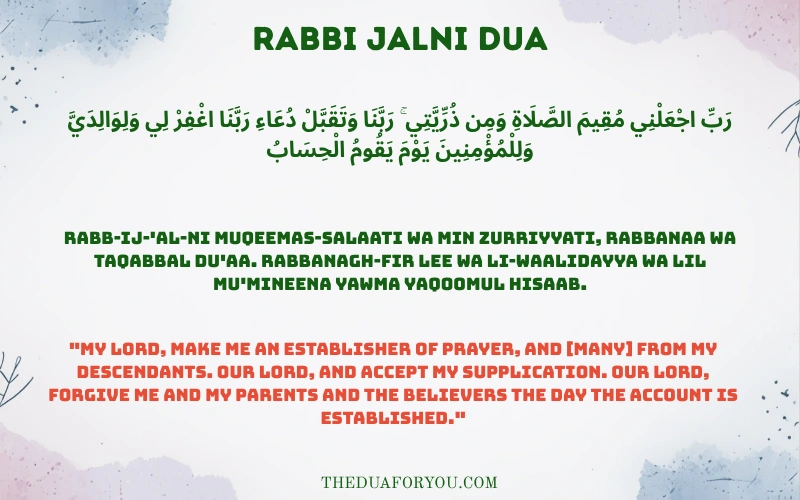
رَبِّ اجْعَلْنِي مُقِيمَ الصَّلَاةِ وَمِن ذُرِّيَّتِي ۚ رَبَّنَا وَتَقَبَّلْ دُعَاءِ رَبَّنَا اغْفِرْ لِي وَلِوَالِدَيَّ وَلِلْمُؤْمِنِينَ يَوْمَ يَقُومُ الْحِسَابُ
(Surah Ibrahim, 14:40–41)
Transliteration
Rabb-ij-‘al-ni muqeemas-salaati wa min zurriyyati, Rabbanaa wa taqabbal du’aa. Rabbanagh-fir lee wa li-waalidayya wa lil mu’mineena yawma yaqoomul hisaab.
This rabi ja al ni dua is straightforward to memorise due to its rhythmic and clear structure. Repeating it regularly helps embed it into daily worship.
Dua Meaning in English
“My Lord, make me an establisher of prayer, and [many] from my descendants. Our Lord, and accept my supplication. Our Lord, forgive me and my parents and the believers the Day the account is established.”
Dua Meaning in Urdu (Rabbi Jalni Dua Tarjuma)
“اے میرے رب! مجھے نماز قائم کرنے والا بنا دے اور میری اولاد میں سے بھی۔ اے ہمارے رب! اور میری دعا قبول فرما۔ اے ہمارے رب! مجھے اور میرے والدین کو اور تمام مومنوں کو اس دن بخش دے جب حساب قائم ہو گا۔”
This rabbi jalni dua with Urdu translation beautifully captures the full depth of what Prophet Ibrahim (AS) was asking not just for himself, but for his family, his descendants, and all believers.
Disclaimer:
The content presented in this article is intended for general Islamic educational and informational purposes only. All duas, Arabic texts, transliterations, and translations have been provided to the best of our knowledge and research, based on the Holy Quran and widely accepted Islamic references.
Quranic Reference
This dua comes from the Quran, Surah Ibrahim (سورة إبراهيم), verses 40 and 41. It is part of a longer supplication that Prophet Ibrahim (AS) made after completing the construction of the Kaaba. Having fulfilled such a monumental act of worship, he still turned to Allah with complete humility, asking to remain steadfast in Salah and seeking forgiveness for himself and his parents.
This context makes the rabbi jalni dua even more moving a Prophet of such great stature, yet still asking Allah to keep him firm in prayer. It is a powerful reminder that no matter where one stands in their spiritual journey, turning to Allah in dua is always necessary.
Explanation of the Dua
The rabi ja al ni dua contains three essential requests:
1. Steadfastness in Prayer The first part asks Allah to make the reciter among those who establish Salah consistently. The word “muqeemas-salaati” does not just mean performing prayer but establishing it praying on time, with proper focus, and with continuity throughout one’s life.
2. Righteous Descendants The dua extends this request to one’s offspring. Ibrahim (AS) prayed not only for himself but for future generations. This reflects the Islamic principle that a believer’s concern goes beyond personal worship it extends to raising a family that remains connected to Allah.
3. Forgiveness for Self, Parents, and All Believers The closing lines of the dua are especially broad in their mercy. The Prophet asked for forgiveness not just for himself, but for his parents and for all believers on the Day of Judgment. This is a remarkable example of selfless prayer in Islam.
The rabbi jalni dua in English captures these three layers personal righteousness, family legacy, and communal forgiveness making it a deeply complete supplication.
When to Read This Dua
This dua can be recited at any time, but there are certain moments when it holds special significance:
After Salah (Prayer): Reciting it after completing your five daily prayers is an excellent practice. It reinforces the purpose of the prayer itself remaining an establisher of Salah.
During Sujood (Prostration): The Prophet Muhammad (ﷺ) encouraged making personal dua during Sujood, as this is the position of greatest closeness to Allah.
In Tahajjud (Night Prayer): The late-night hours are a blessed time for dua, and reciting the rabbi jalni dua in this setting carries great spiritual weight.
When Making Dua for Children: Parents who wish for their children to remain connected to Salah and to righteous living will find this dua especially fitting.
On Fridays: Friday holds a special hour of acceptance for dua, making it an ideal day to include this supplication.
Benefits of Rabbi Jalni Dua
The benefits of this dua are rooted in its Quranic origin and its meaning:
Strengthens the Connection to Salah By regularly asking Allah to make you “an establisher of prayer,” you are actively inviting His help in maintaining one of Islam’s most essential pillars. The dua serves as both a request and a reminder of the importance of Salah in a believer’s life.
A Prayer for Future Generations In an age where parents worry deeply about their children drifting away from faith, this dua from the Quran is a timeless resource. Ibrahim (AS) made the same concern central to his supplication. Any parent reciting this dua with sincerity is following the way of the Prophets.
Seeking Forgiveness for Parents Islam places immense value on respect and kindness toward parents. Asking Allah for forgiveness on behalf of one’s parents including after their passing is considered a highly honourable act. This dua provides a structured way to do so.
Includes All Believers The broad nature of this dua covering all Muslims on the Day of Judgment means that every time it is recited, the person praying is making dua for the entire Ummah. This reflects the collective spirit of Islam.
Teaches Humility Prophet Ibrahim (AS) was a Khalilullah a close friend of Allah. Yet he still asked for steadfastness in prayer and forgiveness. This teaches every Muslim that humility in worship is the mark of true faith, regardless of one’s level of devotion.
The Rabi Ja Al Ni Dua in Context of Daily Life
Many Muslims incorporate the rabi ja al ni dua in English meaning into their daily reflection. Simply understanding what you are asking to be a person who establishes prayer, to have a righteous family, and to receive forgiveness can transform how you approach your Salah each day.
When life feels busy or prayer feels like a routine, returning to this dua helps reconnect with the deeper purpose of worship. It is not just about going through the motions it is about being an establisher of prayer, someone for whom Salah is a living, breathing part of their existence.
Read Also: Naya Kapda Pahnane Ki Dua
Conclusion
The rabbi jalni dua is a gem from the Quran that carries within it the essence of what every Muslim wishes for steadiness in worship, a righteous legacy, and the mercy of Allah on the Day of Judgment. Rooted in the prayer of one of Islam’s greatest Prophets, it is a supplication that remains as relevant today as it was thousands of years ago.
Whether recited after Salah, during Sujood, or in the quiet hours of Tahajjud, this rabi ja al ni dua is a sincere conversation with Allah about the things that matter most. Memorising it, understanding its rabbi jalni dua tarjuma, and reciting it with full awareness of its meaning can become a transformative part of any Muslim’s spiritual life.
May Allah make us all among those who establish Salah, grant us righteous offspring, and forgive us and our parents on the Day when all accounts will be settled. Ameen.
? FAQs About Rabbi Jalni Dua
Q1: What is the rabbi jalni dua?
The rabbi jalni dua is a supplication from the Quran (Surah Ibrahim 14:40–41) made by Prophet Ibrahim (AS). It asks Allah to make the reciter steadfast in prayer, for righteous descendants, and for forgiveness for oneself, parents, and all believers.
Q2: Where is the rabbi jalni dua in the Quran?
It is found in Surah Ibrahim, verses 40 and 41.
Q3: What is the rabbi jalni dua with Urdu translation?
The Urdu tarjuma means: “Aey mere Rab! Mujhe namaz qaim karne wala bana de, aur meri aulad mein se bhi. Aey hamare Rab! Meri dua qabool farma. Aur mujhe, mere walidain ko, aur tamam momineen ko us din bakhsh de jab hisab qaim hoga.”
Q4: Can this dua be recited after every Salah?
Yes, it is perfectly suitable to recite after each of the five daily prayers. Many scholars recommend including Quranic duas in one’s post-prayer supplications.
Q5: Is this the same as rabi ja al ni dua?
Yes. “Rabi ja al ni dua” and “rabbi jalni dua” are different transliterations of the same Arabic phrase رَبِّ اجْعَلْنِي which means “My Lord, make me.”
Q6: Can I recite this dua for my children?
Absolutely. The dua itself includes a request for one’s descendants, making it entirely appropriate to recite with the intention that your children and future generations remain steadfast in Salah.
Q7: What does “muqeemas-salaati” mean?
It means “an establisher of prayer” someone who not only performs Salah but maintains it consistently with proper focus and dedication.
Written by: Ahmad Raza
Credentials: Islamic Studies Content Writer
 Read More duas for daily life at The Dua For You