Among the many supplications taught by the Prophet Muhammad ﷺ, the Allahummaghfirli Dua holds a very special place. It is a short yet deeply powerful prayer that asks Allah for His forgiveness, mercy, guidance, good health, and provision. This dua was regularly recited by the Prophet ﷺ himself during Salah, and he also personally taught it to new Muslims as one of the first supplications they should know.
The word “Allahummaghfirli” means “O Allah, forgive me.” This opening phrase sets the tone of the entire supplication humility before Allah, acknowledgment of one’s shortcomings, and complete reliance on His mercy. It is a dua that every Muslim, regardless of their level of knowledge, can recite with sincerity and full understanding.
What makes this dua so beloved among scholars and everyday Muslims alike is its comprehensiveness. In just a few words, a person asks for everything that truly matters forgiveness, mercy, guidance, health, and sustenance. These five blessings, when granted by Allah, leave nothing lacking in a person’s life.
Allahummaghfirli Dua in Arabic
The full Allahummaghfirli Warhamni Wa Afini Wahdini Warzuqni dua in Arabic is:
اَللَّهُمَّ اِغْفِرْ لِي، وَارْحَمْنِي، وَاهْدِنِي، وَعَافِنِي، وَارْزُقْنِي
Allahummaghfirli Dua Transliteration
Allahummaghfir li, warhamni, wahdini, wa ‘afini, warzuqni
Allahummaghfirli Meaning in English
“O Allah, forgive me, have mercy on me, guide me, grant me health and well-being, and provide me with sustenance.”
This is the translation reported in the hadith narrated by Ibn Abbas (رضي الله عنه) and recorded by Abu Dawud, At-Tirmidhi, and authenticated by Al-Hakim in Al-Mustadrak.
Word-by-Word Meaning
| Arabic | Transliteration | Meaning |
|---|---|---|
| اَللَّهُمَّ | Allahumma | O Allah |
| اِغْفِرْ لِي | Ighfir li | Forgive me |
| وَارْحَمْنِي | Warhamni | Have mercy on me |
| وَاهْدِنِي | Wahdini | Guide me |
| وَعَافِنِي | Wa ‘afini | Grant me well-being |
| وَارْزُقْنِي | Warzuqni | Provide me sustenance |
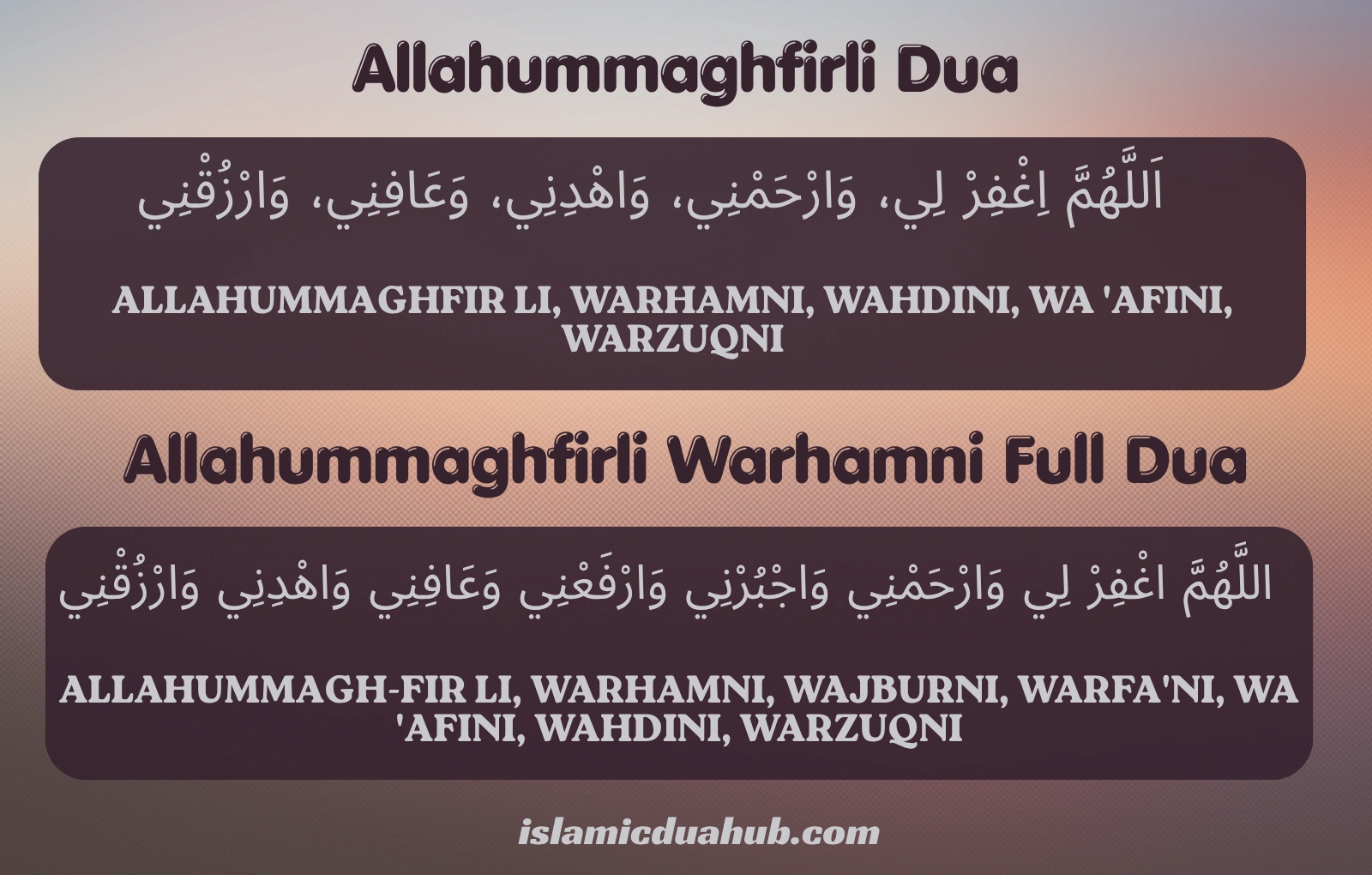
The Full Dua – Allahummaghfirli Warhamni Full Dua
There is also a longer version of this dua, combining all phrases narrated across multiple hadith reports. Scholars consider it the most complete form:
اللَّهُمَّ اغْفِرْ لِي وَارْحَمْنِي وَاجْبُرْنِي وَارْفَعْنِي وَعَافِنِي وَاهْدِنِي وَارْزُقْنِي
Transliteration:
Allahummagh-fir li, warhamni, wajburni, warfa’ni, wa ‘afini, wahdini, warzuqni
Meaning:
“O Allah, forgive me, have mercy on me, console me, raise my rank, grant me well-being, guide me, and provide for me.”
This comprehensive version adds two more beautiful requests wajburni (console me and restore what is broken in me) and warfa’ni (raise my status). Together, these seven phrases form what Islamic scholars consider the most complete form of this Prophetic supplication.
Hadith Reference – Where Does This Dua Come From?
The Allahummaghfirli Warhamni dua is not just a general supplication. It is directly narrated from the Prophet Muhammad ﷺ in several authentic hadith collections.
Hadith 1 – Jami’ At-Tirmidhi (No. 284):
Ibn Abbas (رضي الله عنه) narrated: “Between the two prostrations, the Prophet ﷺ would say: Allahummaghfir li, warhamni, wajburni, wahdini, warzuqni.” (Graded Sahih)
Hadith 2 – Abu Dawud (No. 850):
The Prophet ﷺ used to say between the two prostrations: “Allahumma ighfir li, warhamni, wahdini, wa ‘afini, warzuqni – O Allah, forgive me, have mercy on me, guide me, grant me health and well-being, and provide sustenance for me.” (Al-Hakim graded it Sahih in Al-Mustadrak)
Hadith 3 – Sahih Muslim (Riyad as-Salihin No. 1469):
Tariq bin Ashyam (رضي الله عنه) reported: “Whenever a man entered the fold of Islam, the Prophet ﷺ would show him how to perform Salat and then direct him to supplicate: Allahumm-aghfir li, warhamni, wa-hdini, wa ‘afini, warzuqni – O Allah, forgive me, have mercy on me, guide me, guard me against harm, and provide me with sustenance.”
These three narrations together confirm that this dua is firmly established in the Sunnah and was a regular part of the Prophet’s ﷺ worship.
Explanation of the Dua
The Allahummaghfirli Dua covers five fundamental needs that every human being has in this world and for the Hereafter. Understanding what each part means makes the recitation more heartfelt and meaningful.
Allahummaghfirli – O Allah, Forgive Me
Seeking forgiveness is the first and most important step in a Muslim’s relationship with Allah. No matter how righteous a person may be, every human commits sins. The Prophet ﷺ himself sought forgiveness more than seventy times a day, as reported in Sahih Bukhari. Beginning this dua with a request for forgiveness reflects the highest form of humility before Allah.
Warhamni – Have Mercy on Me
After seeking forgiveness, the believer asks for Allah’s mercy. Allah’s mercy encompasses all things as mentioned in the Quran. It is this mercy that grants a person ease in hardship, comfort in grief, and success in both worlds. Without Allah’s mercy, no good deed alone can guarantee salvation.
Wahdini – Guide Me
Guidance (Hidayah) is among the greatest blessings Allah can grant a person. A guided person walks a straight path in life, makes righteous decisions, avoids wrongdoing, and ultimately enters Jannah. Every Muslim asks for guidance in Surah Al-Fatiha during every Salah, and asking for it again between the two prostrations shows how central this need is.
Wa ‘afini – Grant Me Well-Being
This phrase asks for ‘Afiyah a comprehensive term that includes physical health, mental well-being, protection from harm, and being saved from trials. The Prophet ﷺ said in a hadith reported by At-Tirmidhi: “Ask Allah for ‘Afiyah, for no one is given a better gift after certainty of faith than ‘Afiyah.”
Warzuqni – Provide Me with Sustenance
This is a request for rizq which includes not only food and wealth, but also knowledge, righteous children, a good spouse, and all forms of blessings Allah provides. Asking for rizq in Salah is a reminder that all provision ultimately comes from Allah alone.
When to Read the Allahummaghfirli Dua
During Salah – Between the Two Prostrations (Sujood)
The primary time established by the Sunnah for this dua is the sitting position between the two sajdahs (prostrations) in every unit of prayer. After completing the first sujood, a Muslim rises and sits briefly before going into the second sujood. This sitting is called the “Jalsa” and it is in this moment that the Prophet ﷺ regularly recited the Allahummaghfirli Warhamni dua.
This applies in every rakah of every Salah whether Fajr, Dhuhr, Asr, Maghrib, or Isha. Reciting it consistently means a person is making this powerful supplication between 17 and 34 times every single day across all five prayers.
At Any Time of Day
While the dua is specifically narrated as a Salah supplication, there is no restriction on reciting it at any time. A Muslim can say it in the morning, before sleeping, during personal dua sessions, or whenever seeking forgiveness and Allah’s blessings.
When Teaching New Muslims
As established in the hadith from Sahih Muslim, the Prophet ﷺ taught this dua to every person who newly embraced Islam. This shows that it is considered one of the foundational supplications of a Muslim’s daily worship.
Read Also: Rabbi Zidni Ilma Full Dua
Benefits of the Allahummaghfirli Dua
Covering All Essential Needs in One Prayer
One of the most remarkable aspects of this dua is that it encompasses every category of human need spiritual (forgiveness), emotional (mercy), directional (guidance), physical (well-being), and material (sustenance). A person who recites this dua sincerely has asked for everything truly essential in life.
A Prophetic Supplication with Direct Reward
Because this is a dua directly narrated from the Prophet ﷺ and recited in Salah, it carries the reward of following the Sunnah. Every act of Sunnah brings a believer closer to Allah and increases their rank in the Hereafter.
Seeking Forgiveness Regularly Removes Sins
The Prophet ﷺ said in a hadith: “Whoever says Astaghfirullah regularly, Allah will relieve him of every worry, find a way out for him from every hardship, and provide for him from sources he never expected.” (Abu Dawud). Beginning this dua with Allahummaghfirli aligns with this great virtue of consistent repentance.
A Protection Against Arrogance
Reciting this dua between the prostrations in the most humble physical posture of prayer keeps a Muslim grounded in the awareness of their need for Allah. It is a built-in daily reminder that no matter what a person achieves in this world, they remain dependent on Allah’s forgiveness, mercy, and guidance.
Consistency Brings Lasting Spiritual Benefit
Because this dua is tied to a daily obligatory act of worship, reciting it consistently requires no extra effort beyond what every Muslim already does five times a day. This makes it among the easiest and most rewarding habits a Muslim can build.
Read Also: Rabbana Atina Dua
Conclusion
The Allahummaghfirli Dua is a gift from the Prophet ﷺ to his entire Ummah a brief, powerful, and comprehensive supplication that fits naturally into the daily rhythm of Salah. In a few short phrases, a Muslim asks for the five things that matter most in this life and the next: forgiveness, mercy, guidance, health, and provision.
The fact that the Prophet ﷺ recited this dua in every prayer and also personally taught it to every new Muslim speaks volumes about its importance and completeness. It is not just a formula of words it is an expression of complete dependence on Allah and trust in His mercy.
Beginning to recite the Allahummaghfirli Warhamni dua between the two sajdahs is one of the simplest and most rewarding Sunnahs a Muslim can revive. Each time a person sits between the two prostrations and whispers these words with a present heart, they are following in the footsteps of the Prophet ﷺ and turning directly to Allah with the most essential human needs.
May Allah grant us all forgiveness, mercy, guidance, health, and abundant provision. Ameen.
? FAQs About Allahummaghfirli Dua
Q: What does Allahummaghfirli mean?
It means “O Allah, forgive me.” It is the opening of a Prophetic dua asking for forgiveness, mercy, guidance, health, and sustenance.
Q: What is the full Allahummaghfirli Warhamni dua?
Allahummaghfir li, warhamni, wahdini, wa ‘afini, warzuqni “O Allah, forgive me, have mercy on me, guide me, grant me well-being, and provide for me.”
Q: When should the Allahummaghfirli dua be read?
Between the two sajdahs (prostrations) in every rakah of Salah. It can also be read at any time as a personal supplication.
Q: Is this dua from the Quran or Hadith?
It is from authentic Hadith narrated in Tirmidhi (No. 284), Abu Dawud (No. 850), and Sahih Muslim.
Q: What is the meaning of Allahummaghfirli Warhamni Wa Afini Wahdini Warzuqni?
“O Allah, forgive me, have mercy on me, grant me well-being, guide me, and provide me with sustenance.”
Q: Can this dua be recited outside of Salah?
Yes. There is no restriction. It can be recited at any time of the day or night.
Q: Does forgetting this dua make the Salah invalid?
No. It is Sunnah (mustahabb), not obligatory. Missing it does not invalidate the prayer.
Q: What is the difference between Rabbighfirli and Allahummaghfirli?
Both ask Allah for forgiveness. “Rabbighfirli” means “My Lord, forgive me.” “Allahummaghfirli” means “O Allah, forgive me.” Both are narrated from the Prophet ﷺ and can be combined.