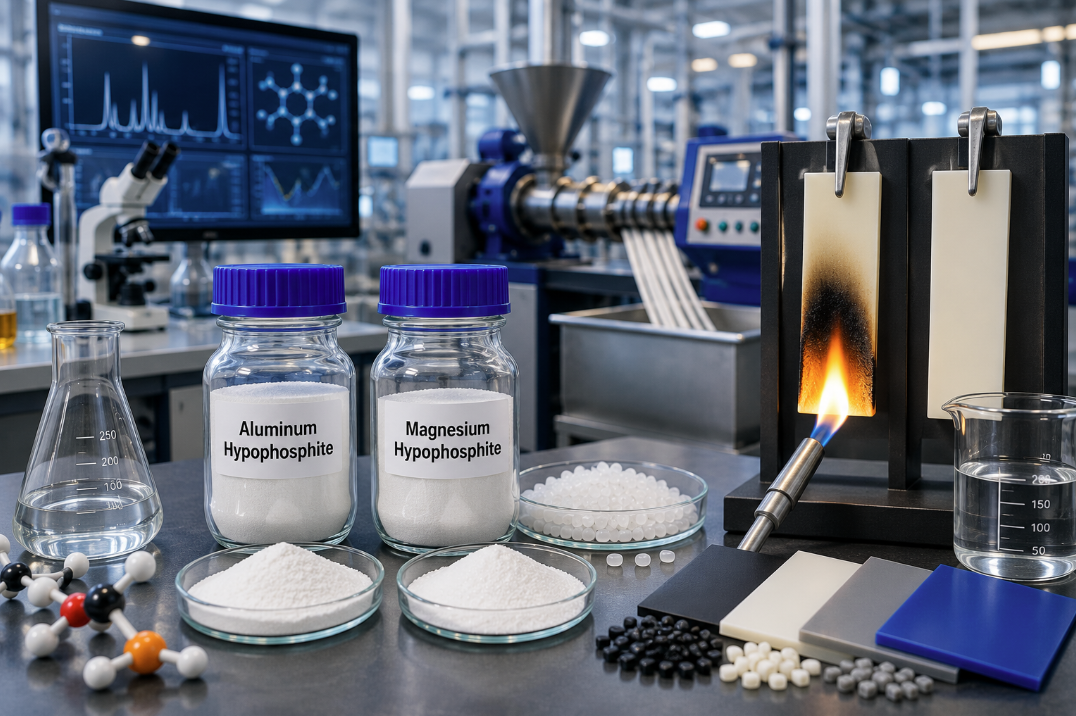
In flame-retardant polymer engineering, Aluminum Hypophosphite is evaluated less as an additive and more as a thermal decomposition-controlled system component that must survive compounding conditions before activating at end-use temperatures. In most engineering plastics, its usable processing window sits below approximately 280°C–300°C, which is what makes it compatible with polymers like PA6, PA66, PET, and PBT, where melt temperatures typically remain within a controlled extrusion range.
At typical flame-retardant loading levels of 10–20%, Aluminum Hypophosphite contributes to UL94 V-0 performance not by inert filling, but by triggering a phosphorus-based char formation mechanism during combustion. If the compound begins decomposing prematurely inside a twin-screw extruder, it does not simply lose efficiency—it releases gaseous byproducts, destabilizes melt viscosity, and can reduce molecular weight in sensitive polymers like polyamides.
This is why processing temperature control is not optional. Once thermal decomposition begins inside the compounding stage instead of the fire stage, the entire formulation system fails structurally rather than functionally.
Magnesium Hypophosphite in real compounding systems
Magnesium Hypophosphite behaves differently inside polymer systems even though it belongs to the same hypophosphite family. Its primary role is not standalone flame resistance but synergy within phosphorus-based additive packages where controlled char formation and thermal stabilization must occur simultaneously.
In practice, it is commonly introduced into systems such as:
-
glass-filled PA6 and PA66 engineering compounds
-
PBT-based electrical housings requiring flame resistance
-
TPU systems where flexibility must be retained under thermal stress
Unlike aluminum-based systems, magnesium variants tend to be more sensitive to dispersion uniformity than pure thermal thresholds. In twin-screw extrusion, poor distribution leads to localized additive clustering, which creates uneven burn behavior during flame testing—one of the most common reasons UL94 inconsistencies appear between lab and production batches.
A typical failure mode in real plants is not chemical incompatibility but moisture-related agglomeration before extrusion. Even low-level humidity exposure during storage can alter powder flow behavior, resulting in inconsistent feed rates and non-uniform additive dispersion inside the melt.
What actually breaks flame-retardant performance in production
In real compounding environments, failures rarely come from chemical design. They come from process mismatch.
Three recurring industrial issues define most flame-retardant failures:
1. Thermal overshoot in extrusion zones
When barrel zones exceed controlled thresholds, Aluminum Hypophosphite begins partial decomposition inside the extruder rather than in the fire zone. This leads to gas formation, viscosity instability, and reduced mechanical strength in the final polymer.
2. Poor dispersion in twin-screw systems
If Magnesium Hypophosphite is not uniformly distributed across melt flow, flame resistance becomes location-dependent instead of system-wide. This is why screw design and mixing energy matter as much as formulation.
3. Incorrect loading balance (10–20% rule deviation)
Below functional loading levels, char network formation is incomplete. Above optimal ranges, mechanical properties drop sharply, especially impact strength in PA and PBT systems.
Why formulation behavior matters more than chemistry
In industrial flame-retardant design, the chemical identity of hypophosphite-based additives is secondary to how they behave under:
-
shear stress inside extrusion systems
-
thermal gradients across barrel zones
-
humidity exposure during storage and feeding
-
compatibility with reinforcing fillers like glass fiber
Two compounds that are chemically similar can behave completely differently once introduced into a dynamic melt system operating at industrial scale.
Final engineering reality
Aluminum Hypophosphite and Magnesium Hypophosphite are not interchangeable flame-retardant additives—they are process-dependent thermal systems embedded inside polymer matrices, where performance is defined not at the chemical level but at the extrusion and combustion interface.