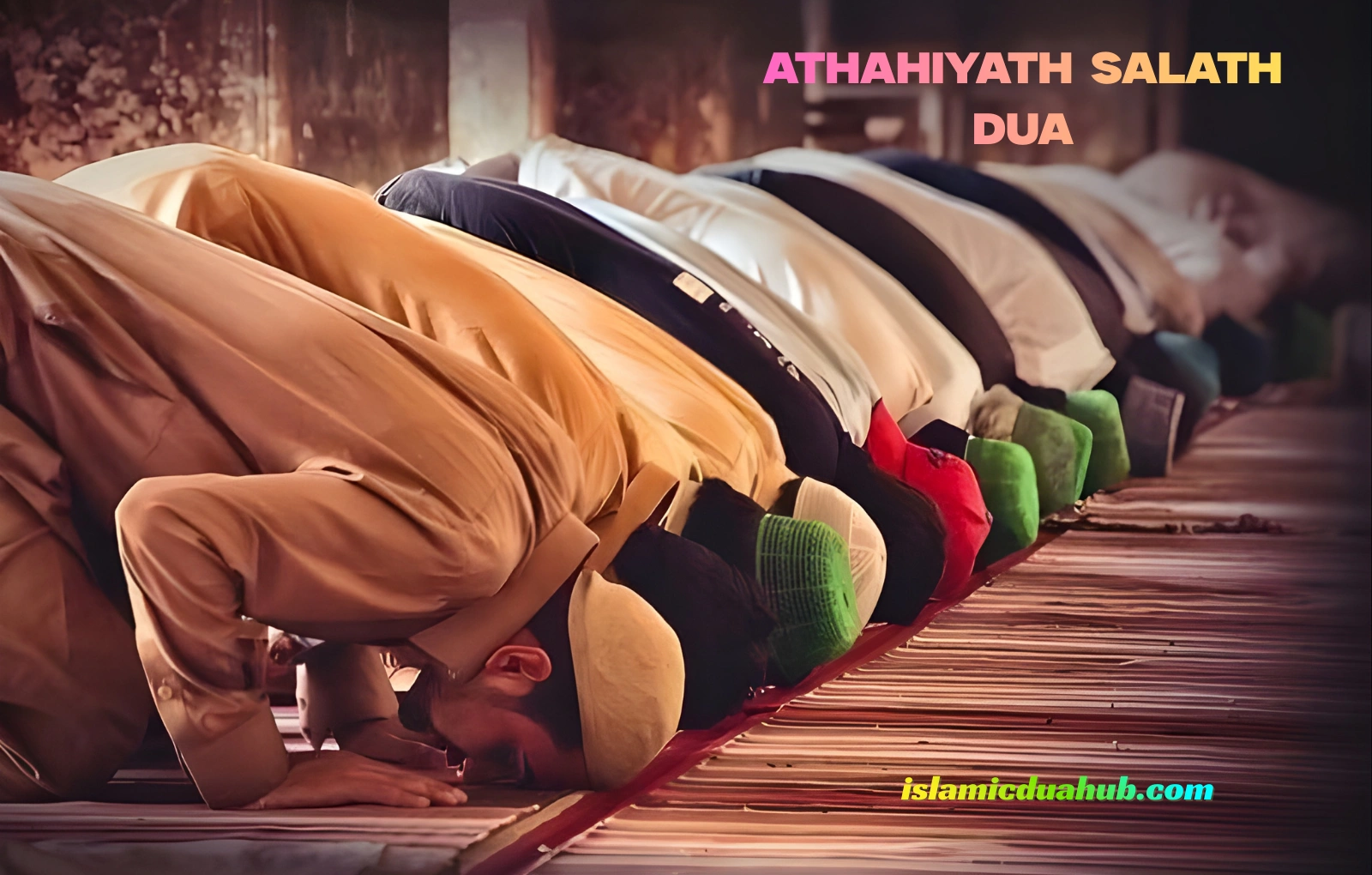
Every day, millions of Muslims sit during their namaz and recite words that echo a conversation from the heavens themselves. Yet how many truly grasp the weight of what they’re saying? The athahiyath salath dua full isn’t just another recitation it’s your direct participation in the blessed dialogue between Allah and His Messenger ﷺ that occurred beyond the seven heavens.
If you’ve been rushing through this sitting supplication or struggling with its pronunciation, you’re missing one of namaz’s most spiritually transformative moments. This supplication carries the testimony of faith, extends peace to the Prophet ﷺ, and acknowledges Allah’s supreme authority all within a few powerful sentences.
Whether you’re correcting years of mispronunciation or teaching a child their first words of attahiyat in English script, what you’re about to read will reshape how you approach every sitting in namaz.
What Exactly Is Athahiyath?
Athahiyath (also spelled at-tahiyyat, tashahhud, or tahiyat) refers to the compulsory supplication recited while sitting during namaz.
The Arabic root word “تحية” (tahiyyah) means “greeting” or “salutation.” When you say “attahiyat,” you’re literally offering all forms of greetings, honors, and salutations exclusively to Allah.
Critical timing in namaz:
- First sitting: After completing 2nd rakah in 3 or 4 rakah namaz
- Final sitting: Before giving salam to conclude namaz
Physical position matters: Sit on your left foot, keep right foot upright, place right hand on right thigh with index finger pointing during “illallah,” and left hand flat on left thigh.
Missing athahiyath renders your namaz invalid according to the majority of scholars that’s how essential this supplication is.
Disclaimer: This article presents verified Islamic supplications from established hadith collections. For specific fiqh rulings or personal religious guidance, consult qualified scholars in your madhab tradition.
The Heavenly Origin
During Isra wal Mi’raj (the night journey), Prophet Muhammad ﷺ ascended through the seven heavens to meet Allah. When he reached the divine presence, this extraordinary exchange occurred:
The Prophet ﷺ said: “All greetings, all forms of worship, and all good deeds belong to Allah.”
Allah responded: “Peace be upon you, O Prophet, and Allah’s mercy and blessings.”
The Prophet ﷺ replied: “Peace be upon us and upon all righteous servants of Allah.”
The angels proclaimed: “I testify that none deserves worship except Allah, and I testify that Muhammad is His servant and messenger.”
This wasn’t a scripted ritual it was a living conversation. When you recite athahiyath salath dua full in your namaz, you’re reliving that blessed moment, standing in the same testimony the angels gave.
Why this matters for your namaz: You’re not just reciting memorized words. You’re participating in a dialogue that transcends time and space, connecting your sitting position to the highest heaven.
Athahiyath Salath Dua Full
Arabic
التَّحِيَّاتُ لِلَّهِ وَالصَّلَوَاتُ وَالطَّيِّبَاتُ، السَّلَامُ عَلَيْكَ أَيُّهَا النَّبِيُّ وَرَحْمَةُ اللَّهِ وَبَرَكَاتُهُ، السَّلَامُ عَلَيْنَا وَعَلَى عِبَادِ اللَّهِ الصَّالِحِينَ، أَشْهَدُ أَنْ لَا إِلَهَ إِلَّا اللَّهُ وَأَشْهَدُ أَنَّ مُحَمَّدًا عَبْدُهُ وَرَسُولُهُ
Transliteration (Attahiyat in English)
At-tahiyyatu lillahi was-salawatu wat-tayyibatu, as-salamu ‘alayka ayyuhan-nabiyyu wa rahmatullahi wa barakatuhu, as-salamu ‘alayna wa ‘ala ‘ibadillahis-salihin, ash-hadu an la ilaha illallahu wa ash-hadu anna Muhammadan ‘abduhu wa rasuluhu.
Word-by-Word Meaning
- At-tahiyyatu lillah = All verbal greetings are for Allah
- Was-salawatu = And all forms of worship/prayers
- Wat-tayyibatu = And all good/pure deeds
- As-salamu ‘alayka = Peace be upon you
- Ayyuhan-nabiyyu = O Prophet
- Wa rahmatullahi = And Allah’s mercy
- Wa barakatuhu = And His blessings
- As-salamu ‘alayna = Peace be upon us
- Wa ‘ala ‘ibadillahis-salihin = And upon all righteous servants of Allah
- Ash-hadu = I bear witness/testify
- An la ilaha illallah = That there is no deity except Allah
- Wa ash-hadu = And I bear witness
- Anna Muhammadan = That Muhammad
- ‘Abduhu = Is His servant
- Wa rasuluhu = And His messenger
Complete Translation
“All compliments, all physical and financial worship, and all good things are for Allah alone. Peace be upon you, O Prophet, and the mercy of Allah and His blessings. Peace be upon us and upon all righteous servants of Allah. I bear witness that there is no deity worthy of worship except Allah, and I bear witness that Muhammad is His servant and messenger.”
Read Also: Wazu Ke Baad Ki Dua
Reliable Variations From Sahih Hadith
The Prophet ﷺ taught athahiyath to different companions with slight textual differences all equally valid.
1. Ibn Mas’ud’s Edition
This is the Edition presented above.
Source: Sahih Bukhari (831, 6230), Sahih Muslim (402)
Usage: Hanafi, Maliki, and Hanbali schools primarily use this.
2. Ibn Abbas’s Edition
التَّحِيَّاتُ المُبَارَكَاتُ الصَّلَوَاتُ الطَّيِّبَاتُ لِلَّهِ، السَّلَامُ عَلَيْكَ أَيُّهَا النَّبِيُّ وَرَحْمَةُ اللَّهِ وَبَرَكَاتُهُ، السَّلَامُ عَلَيْنَا وَعَلَى عِبَادِ اللَّهِ الصَّالِحِينَ، أَشْهَدُ أَنْ لَا إِلَهَ إِلَّا اللَّهُ وَأَشْهَدُ أَنَّ مُحَمَّدًا رَسُولُ اللَّهِ
Transliteration: At-tahiyyatul-mubarakatussalawatut-tayyibatu lillah, as-salamu ‘alayka ayyuhan-nabiyyu wa rahmatullahi wa barakatuhu, as-salamu ‘alayna wa ‘ala ‘ibadillahis-salihin, ash-hadu an la ilaha illallahu wa ash-hadu anna Muhammadan rasulullah.
Key difference: Adds “al-mubarakaat” (the blessed ones) and ends with “Rasulullah” instead of “‘abduhu wa rasuluhu.”
Source: Sahih Muslim (403)
3. Umar bin Khattab’s Edition (Shafi’i School)
التَّحِيَّاتُ الطَّيِّبَاتُ الصَّلَوَاتُ لِلَّهِ، السَّلَامُ عَلَيْكَ أَيُّهَا النَّبِيُّ وَرَحْمَةُ اللَّهِ وَبَرَكَاتُهُ، السَّلَامُ عَلَيْنَا وَعَلَى عِبَادِ اللَّهِ الصَّالِحِينَ، أَشْهَدُ أَنْ لَا إِلَهَ إِلَّا اللَّهُ وَأَشْهَدُ أَنَّ مُحَمَّدًا عَبْدُهُ وَرَسُولُهُ
Transliteration: At-tahiyyatut-tayyibatussalawatu lillah, as-salamu ‘alayka ayyuhan-nabiyyu wa rahmatullahi wa barakatuhu, as-salamu ‘alayna wa ‘ala ‘ibadillahis-salihin, ash-hadu an la ilaha illallahu wa ash-hadu anna Muhammadan ‘abduhu wa rasuluhu.
Key difference: Omits “al-mubarakaat” and places “at-tayyibat” earlier.
Source: Muwatta Imam Malik
Related Supplications After Athahiyath
Durood Ibrahim (Compulsory in Final Sitting)
After completing athahiyath in the final sitting, you must recite Durood Ibrahim:
اللَّهُمَّ صَلِّ عَلَى مُحَمَّدٍ وَعَلَى آلِ مُحَمَّدٍ كَمَا صَلَّيْتَ عَلَى إِبْرَاهِيمَ وَعَلَى آلِ إِبْرَاهِيمَ إِنَّكَ حَمِيدٌ مَجِيدٌ، اللَّهُمَّ بَارِكْ عَلَى مُحَمَّدٍ وَعَلَى آلِ مُحَمَّدٍ كَمَا بَارَكْتَ عَلَى إِبْرَاهِيمَ وَعَلَى آلِ إِبْرَاهِيمَ إِنَّكَ حَمِيدٌ مَجِيدٌ
Transliteration: Allahumma salli ‘ala Muhammadin wa ‘ala ali Muhammadin kama sallayta ‘ala Ibrahima wa ‘ala ali Ibrahima innaka Hamidun Majid. Allahumma barik ‘ala Muhammadin wa ‘ala ali Muhammadin kama barakta ‘ala Ibrahima wa ‘ala ali Ibrahima innaka Hamidun Majid.
Meaning: “O Allah, send blessings upon Muhammad and the family of Muhammad as You sent blessings upon Ibrahim and the family of Ibrahim. Indeed, You are Praiseworthy, Glorious. O Allah, bless Muhammad and the family of Muhammad as You blessed Ibrahim and the family of Ibrahim. Indeed, You are Praiseworthy, Glorious.”
Source: Sahih Bukhari (3370, 6357), Sahih Muslim (406)
Dua Before Salam (Highly Recommended)
اللَّهُمَّ إِنِّي أَعُوذُ بِكَ مِنْ عَذَابِ جَهَنَّمَ، وَمِنْ عَذَابِ الْقَبْرِ، وَمِنْ فِتْنَةِ الْمَحْيَا وَالْمَمَاتِ، وَمِنْ شَرِّ فِتْنَةِ الْمَسِيحِ الدَّجَّالِ
Transliteration: Allahumma inni a’udhu bika min ‘adhabi jahannama, wa min ‘adhabil-qabr, wa min fitnatil-mahya wal-mamat, wa min sharri fitnatil-masihid-dajjal.
Meaning: “O Allah, I seek refuge in You from the punishment of Hell, from the punishment of the grave, from the trials of life and death, and from the evil of the trial of the False Messiah.”
Source: Sahih Bukhari (1377), Sahih Muslim (588)
When to recite: After Durood Ibrahim, before giving salam.
Step-by-Step: Perfect Your Sitting Position
Common mistakes that reduce spiritual focus:
- Sitting casually without proper foot positioning
- Keeping both hands motionless
- Racing through words without reflection
- Pointing finger throughout (only point during “illallah”)
Correct method:
- Foot position: Sit on left foot tucked under you, right foot upright with toes pointing toward qiblah
- Hand placement: Right hand on right thigh with fingers closed, left hand flat on left thigh
- Index finger movement: Raise and point index finger when saying “illallah” (some scholars say keep it raised, others say move it gently)
- Eye focus: Keep eyes on lap or where forehead touches ground in sujood
- Recitation pace: Clear, measured pronunciation not rushed
First Sitting vs Final Sitting
| Aspect | First Sitting (Qa’dah Ula) | Final Sitting (Qa’dah Akhirah) |
|---|---|---|
| When | After 2nd rakah in 3/4 rakah namaz | Before salam to conclude namaz |
| Recitation | Athahiyath only up to “as-salihin” | Complete athahiyath + Durood + optional dua |
| Duration | Shorter (5-10 seconds) | Longer (30-60 seconds) |
| Followed by | Standing for 3rd rakah | Tasleem (salam right and left) |
Warning: Many people skip the first sitting or recite the full athahiyath there. Both are incorrect. In the first sitting of Zuhr, Asr, Maghrib, or Isha, stop after “was-salihin” and immediately stand up.
Athahiyath Editions
| Feature | Ibn Mas’ud | Ibn Abbas | Umar |
|---|---|---|---|
| “Al-Mubarakaat” | ✗ | ✓ | ✗ |
| Ending phrase | ‘Abduhu wa rasuluhu | Rasulullah | ‘Abduhu wa rasuluhu |
| Used by madhabs | Hanafi, Maliki, Hanbali | Some Shafi’i | Shafi’i primary |
| Hadith grading | Sahih (Bukhari & Muslim) | Sahih (Muslim) | Sahih (Muwatta) |
| Word count | 26 words | 27 words | 25 words |
Conclusion
The athahiyath salath dua transforms from mere memorized words into a living conversation when you grasp its origin, meaning, and significance. You’re not just fulfilling a ritual requirement you’re standing in the testimony the angels gave, reliving the dialogue from Mi’raj, and sending greetings that reach the Prophet ﷺ himself.
Your next namaz awaits. When you sit after that second rakah, you’ll no longer rush through syllables. You’ll pause, reflect, and truly mean every word because you now know you’re participating in the most blessed conversation ever held.
Practice the pronunciation daily. Teach it to your children with the full story. Correct your sitting position. And watch how this small shift in awareness ripples through your entire spiritual life.
The angels are waiting to convey your salutations. Make them count.
? FAQs About Athahiyath Salath Dua
Q1: Is athahiyath compulsory in namaz?
Yes. All four madhabs agree that skipping athahiyath intentionally invalidates your namaz. It’s wajib (compulsory) according to Hanafi and Hanbali schools, and fard (obligatory) according to Shafi’i and Maliki schools.
Q2: Can I recite athahiyath in my native language?
No. Athahiyath must be recited in Arabic for namaz validity. If you’re learning, use transliteration until you memorize the Arabic properly. Practice daily outside namaz.
Q3: When exactly do I raise my index finger?
Raise your index finger when you say “illallah” (except Allah) during the testimony portion. Some madhabs keep it raised throughout athahiyath, others only during “illallah.” Follow your teacher’s method.
Q4: What’s the difference between first and final sitting?
In the first sitting (after 2nd rakah in 3-4 rakah namaz), recite only up to “as-salihin” then stand up. In the final sitting, recite complete athahiyath plus Durood Ibrahim before salam.
Q5: What if I forget athahiyath during namaz?
Immediately sit back down and recite it if you’ve already stood up. After completing namaz, perform sujood sahw (prostration of forgetfulness) before the final salam to correct the mistake.
Written by: Ahmad Raza
Credentials: Islamic Studies Content Writer
 Read More duas for daily life at The Dua For You