Dua e Masura in English is a supplication associated with seeking well-being, forgiveness, protection, and Allah’s mercy. This guide provides the Arabic text, English transliteration, English translation, and meaning of Dua e Masura in a clear format.
You will also find the commonly recited Allahummaghfirli supplication, information about when Dua e Masura is recited in prayer, its key meanings, and practical tips for learning and memorizing it.
Whether you are searching for Dua e Masura in English, its transliteration, or its meaning, this page brings the essential information together in one place.
Disclaimer: This content is for informational and educational purposes. For religious guidance and authenticity, please consult a qualified Islamic scholar.
What Is Dua e Masura? Meaning and Background
Dua e Masura refers to a prophetic supplication that is commonly associated with seeking well-being, forgiveness, protection, and safety in this world and the hereafter. It is especially discussed in connection with supplication during prayer and is also recited as a personal dua outside salah.
The phrase “Dua e Masura” is commonly used by Muslims when referring to narrated or transmitted supplications. Because people search for this dua using several variations, including “Dua Masura,” “Dua e Masura in English,” and “Dua Masura transliteration,” it is helpful to present the Arabic text, transliteration, translation, and meaning together.
Dua e Masura Hadith References
The supplications discussed on this page are found in well-known Islamic hadith collections. The relevant narrations include references to Sunan Ibn Majah, Sunan Abu Dawood, Musnad Ahmad, and Sahih Muslim for the Allahummaghfirli supplication.
For religious accuracy, individual hadith references should be checked against a reliable edition or scholarly source before publication. Avoid broad statements such as “Islamic scholars unanimously accept its authenticity” unless the claim is supported by a specific scholarly reference.
- Sunan Ibn Majah (Hadith 3851)
- Sunan Abu Dawood (Hadith 1482)
- Musnad Ahmad (Hadith 24428)
Islamic scholars unanimously accept its authenticity, making it a reliable and recommended supplication for all Muslims.
Dua e Masura in Arabic, Transliteration and English Translation
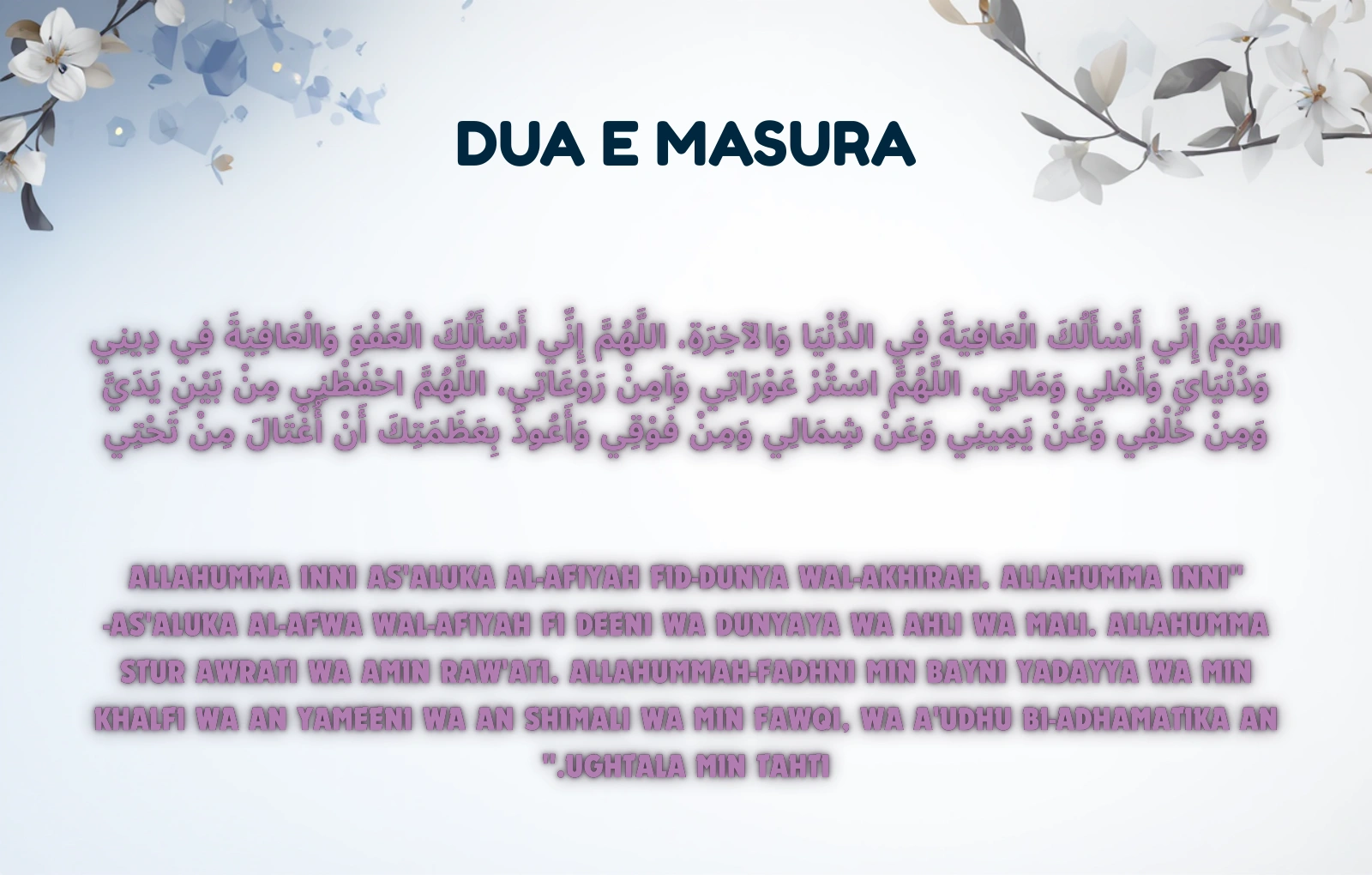
Primary Supplication
Dua e Masura in Arabic Text:
اللَّهُمَّ إِنِّي أَسْأَلُكَ الْعَافِيَةَ فِي الدُّنْيَا وَالآخِرَةِ، اللَّهُمَّ إِنِّي أَسْأَلُكَ الْعَفْوَ وَالْعَافِيَةَ فِي دِينِي وَدُنْيَايَ وَأَهْلِي وَمَالِي، اللَّهُمَّ اسْتُرْ عَوْرَاتِي وَآمِنْ رَوْعَاتِي، اللَّهُمَّ احْفَظْنِي مِنْ بَيْنِ يَدَيَّ وَمِنْ خَلْفِي وَعَنْ يَمِينِي وَعَنْ شِمَالِي وَمِنْ فَوْقِي وَأَعُوذُ بِعَظَمَتِكَ أَنْ أُغْتَالَ مِنْ تَحْتِي
Dua e Masura in English Transliteration:
“Allahumma inni as’aluka al-afiyah fid-dunya wal-akhirah. Allahumma inni as’aluka al-afwa wal-afiyah fi deeni wa dunyaya wa ahli wa mali. Allahumma-stur awrati wa amin raw’ati. Allahummah-fadhni min bayni yadayya wa min khalfi wa an yameeni wa an shimali wa min fawqi, wa a’udhu bi-adhamatika an ughtala min tahti.”
Dua e Masura in English Translation:
“O Allah, I ask You for well-being in this world and the hereafter. O Allah, I ask You for forgiveness and well-being in my religion, my worldly affairs, my family, and my wealth. O Allah, conceal my faults and calm my fears. O Allah, guard me from in front of me and behind me, from my right and my left, and from above me. I seek refuge in Your Greatness from being unexpectedly destroyed from beneath me.”
Allahummaghfirli Dua: Arabic, Transliteration and Meaning
Another commonly recited version of dua e masura focuses specifically on seeking forgiveness the “Allahummaghfirli” supplication.
Allahummaghfirli in Arabic:
اللَّهُمَّ اغْفِرْ لِي ذَنْبِي كُلَّهُ، دِقَّهُ وَجِلَّهُ، وَأَوَّلَهُ وَآخِرَهُ، وَعَلَانِيَتَهُ وَسِرَّهُ
Allahummaghfirli Transliteration:
“Allahummaghfir li dhanbi kullahu, diqqahu wa jillahu, wa awwalahu wa akhirahu, wa alaniyatahu wa sirrahu.”
Allahummaghfirli English Translation:
“O Allah, forgive all my sins the minor and the major, the first and the last, the apparent and the hidden.”
This particular formulation is recorded in Sahih Muslim (Hadith 483), where the Prophet (ﷺ) would recite it during his prostrations in prayer.
Read Also: Rabbish Rahli Sadri Dua
When to Recite Dua e Masura in Namaz
Dua e Masura is discussed particularly in relation to supplication during sujood. The article should distinguish clearly between what is established in the relevant narration and other occasions when Muslims may make dua.
Dua e Masura During Sujood
Sujood is an important time for making dua in salah. The supplication can be understood as asking Allah for well-being, forgiveness, protection, and safety.
- Tahajjud (night prayers): The original context in which it was taught
- Nafl (voluntary prayers): Any optional prayers throughout the day
- After obligatory prayers: During extra prostrations for spiritual connection
Islamic scholars note that prostration is the position where a servant is closest to Allah, making it the ideal moment for heartfelt supplication.
Dua e Masura After Tashahhud
Some people also recite shorter versions after completing the tashahhud (sitting position) before giving salam, though the primary narration emphasizes sujood.
Morning and Evening Adhkar
The comprehensive version asking for protection from all directions is also recommended as part of morning and evening remembrance routines, even outside formal prayer.
Dua e Masura in Tahajjud
The narration discussed on this page connects the supplication with the context of night prayer. Tahajjud is therefore an important context to mention when explaining its use.
Dua e Masura Outside Salah
The wording of a supplication can also be studied, memorized, and used as personal dua outside formal prayer, subject to the applicable rules of making dua.
Dua e Masura Meaning and Benefits
The meaning of Dua e Masura centers on several important requests: well-being in this world and the hereafter, forgiveness, protection, concealment of faults, and safety from harm.
Understanding these requests can make the recitation more meaningful because the dua is not simply a collection of Arabic words. Each part expresses a specific need that a believer asks Allah to fulfill.
Meaning of Al-Afiyah
The word “afiyah” encompasses physical health, mental peace, spiritual protection, and safety from trials. It represents a state of complete wellness that only Allah can grant. The Prophet (ﷺ) said: “Ask Allah for afiyah, for after certainty of faith, no one has been given anything better than afiyah” (Sunan Tirmidhi 3558).
Meaning of Seeking Protection
Notice how the dua asks for protection from six directions: front, back, right, left, above, and below. This symbolizes complete vulnerability before Allah and acknowledgment that only He can provide true security in every aspect of life.
Meaning of Allahumma-stur Awrati
“Allahumma-stur awrati” asks Allah to cover our weaknesses and sins from public exposure a mercy every human needs, as we all fall short in various ways.
Meaning of Seeking Forgiveness
The Allahummaghfirli version categorizes sins systematically: small and large, past and future, public and private. This comprehensive approach ensures no sin remains unaddressed in our plea for forgiveness.
Dua e Masura in Urdu: Meaning
اردو ترجمہ:
اے اللہ! میں تجھ سے دنیا اور آخرت میں عافیت مانگتا ہوں۔ اے اللہ! میں تجھ سے اپنے دین، دنیا، گھر والوں اور مال میں معافی اور عافیت کا سوال کرتا ہوں۔ اے اللہ! میری پردہ پوشی فرما اور میرے خوف کو امن میں بدل دے۔ اے اللہ! میری حفاظت فرما میرے آگے سے، میرے پیچھے سے، میرے دائیں سے، میرے بائیں سے اور میرے اوپر سے۔ اور میں تیری عظمت کی پناہ مانگتا ہوں کہ میں اپنے نیچے سے اچانک ہلاک کر دیا جاؤں۔
Dua e Masura in Hindi: Meaning
हिंदी अनुवाद:
ऐ अल्लाह! मैं तुझसे दुनिया और आखिरत में आफियत (भलाई) मांगता हूँ। ऐ अल्लाह! मैं तुझसे अपने दीन, दुनिया, परिवार और धन में माफी और आफियत का सवाल करता हूँ। ऐ अल्लाह! मेरे दोषों को छिपा और मेरे डर को शांति में बदल दे। ऐ अल्लाह! मेरी रक्षा कर मेरे आगे से, मेरे पीछे से, मेरे दाएं से, मेरे बाएं से और मेरे ऊपर से। और मैं तेरी महानता की शरण लेता हूँ कि मैं अपने नीचे से अचानक नष्ट कर दिया जाऊं।
How to Memorize Dua e Masura
Start Small: Begin with just the first sentence and add one line each day.
Understand First: Knowing the meaning makes memorization easier and recitation more meaningful.
Use Audio Resources: Listen to authentic recitations to correct your pronunciation.
Repeat Daily: Consistency during sujood in your five daily prayers will naturally cement it in memory.
Write It Down: Visual learning reinforces auditory memorization for many people.
Common Dua e Masura Mistakes to Avoid
Rushing Through the Words
Supplication requires presence of heart. Reciting rapidly without contemplating the meanings diminishes the spiritual benefit.
Incorrect Pronunciation
Mispronouncing Arabic words can change meanings entirely. Take time to verify correct pronunciation, especially for letters like ‘ayn (ع) and ghayn (غ).
Limiting to One Prayer Type
While taught for Tahajjud, this dua benefits any prostration. Don’t restrict yourself unnecessarily.
Forgetting the Intention
Remember you’re not just reciting words you’re genuinely asking the Creator of the universe for protection and forgiveness. Approach with humility and hope.
Who Can Recite Dua e Masura?
Every Muslim male, female, young, old, new to Islam or lifelong practitioner can learn and recite this supplication. It was taught by the Prophet (ﷺ) for universal benefit, not restricted to any particular group.
Children can begin learning simplified versions, gradually building to the complete text as they mature in understanding.
Scholarly Views on Dua e Masura
Imam An-Nawawi (rahimahullah) emphasized that the dua asking for afiyah is among the most comprehensive supplications, as it includes both worldly and religious well-being.
Ibn Qayyim Al-Jawziyyah (rahimahullah) noted that seeking Allah’s protection from all six directions demonstrates the believer’s complete reliance on divine care rather than their own strength.
Contemporary scholars like Sheikh Ibn Baz and Sheikh Ibn Uthaymeen (may Allah have mercy on them) consistently recommended this supplication in their teachings about daily adhkar.
Conclusion
Dua e Masura brings together important requests for well-being, forgiveness, protection, and Allah’s mercy. Understanding its Arabic text, transliteration, English translation, and meaning can make its recitation more thoughtful and purposeful.
If you are learning Dua e Masura in English, begin by understanding the translation and then gradually memorize the Arabic wording and pronunciation. The goal is not simply to memorize the words, but to understand the requests being made to Allah.
Use this guide as a reference for the Arabic text, transliteration, meaning, and relevant guidance on the supplication.
? FAQs About Dua e Masura in English
Written by: Ahmad Raza
Credentials: Islamic Studies Content Writer
 Read More duas for daily life at The Dua For You