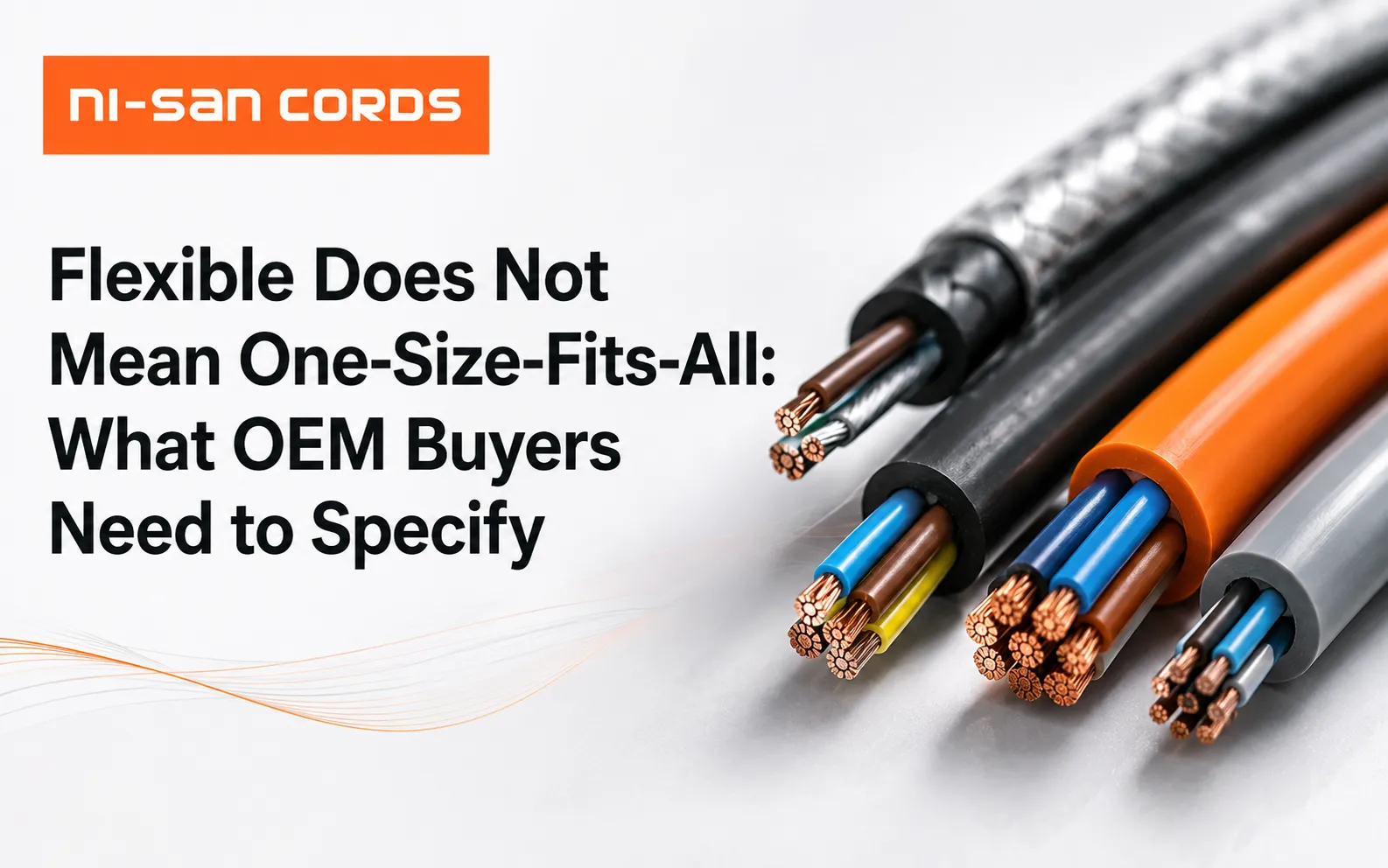
Flexible wire is easy to bend, route and terminate. That alone does not make it right for every job. Nisan Cords supplies OEM and bulk cable needs. The wire must suit the load, movement, space and heat inside the finished product. Fix the needs first. Discuss price after the build is clear.
Flexibility Begins Inside the Conductor
A solid conductor has one metal wire. A flexible conductor uses many fine strands. Those strands help the wire bend with less effort. This is useful in panels, appliances, lighting, equipment and tight spaces.
Yet the word “flexible” is not a full specification. Strand count, strand size, conductor area and lay affect how the wire handles. Fine strands may aid routing, but the terminal and crimp must suit them. Poor strand control can change resistance, joint quality and finished diameter.
The BIS product manual for IS 694 identifies rigid conductors as Class 1 or Class 2. It lists flexible conductors as Class 5. Buyers should confirm the required class on the drawing or order. A verbal request for “soft wire” leaves too much room for doubt.
Size the Wire for Real Working Conditions
Cable size cannot be chosen from equipment wattage alone. Current, voltage drop, run length, ambient heat, grouping, duty cycle and the method of installation all matter. A wire placed near a heater or motor may face more heat than one tested in open air.
Space also changes the choice. A crowded panel can trap heat. A sharp route can strain the wire near a terminal. Frequent movement needs a different review from a wire that bends once during assembly and then stays still.
Qualified design staff should approve the final size and build. Buying teams comparing flexible wires & cables manufacturers in India should send the approved load data, drawing and use conditions with each enquiry.
Match Insulation to the Risk
PVC grade, wall thickness and outer sheath affect heat response, abrasion, flame behaviour and service life. FR, FRLS and HRFR labels describe different properties. They are not simple levels where one is always better.
The selected grade must match the product design and set standard. Colour is important too. Clear colour coding speeds assembly and reduces wiring errors, but repeat batches must keep the agreed shade and marking clear.
Ask for Tests That Prove the Build
The March 2024 BIS product manual for IS 694 specifies a 25-metre sample quantity for approval work. It lists checks such as dimensions, conductor resistance, insulation resistance, high-voltage performance, heat shock, hot deformation, tensile strength and flame behaviour.
Not every test is required in the same way for every order. The buyer should agree which routine reports, batch records or type-test papers are needed. Test values should match the quoted product, not a different size from the supplier’s range.
Make Repeat Supply Easier
Approve a sealed sample or controlled drawing before bulk production. Fix conductor class, size, insulation, colour, print, coil length, packing and tolerance. Also state how changes will be reviewed.
Ni-San states that it makes single-core and multicore flexible cables for panels, appliances and equipment, with copper drawing, bunching, PVC compounding and extrusion handled in-house. The sound buying approach remains practical: match the wire to its task, verify the evidence and keep every repeat batch tied to the same approved requirement.