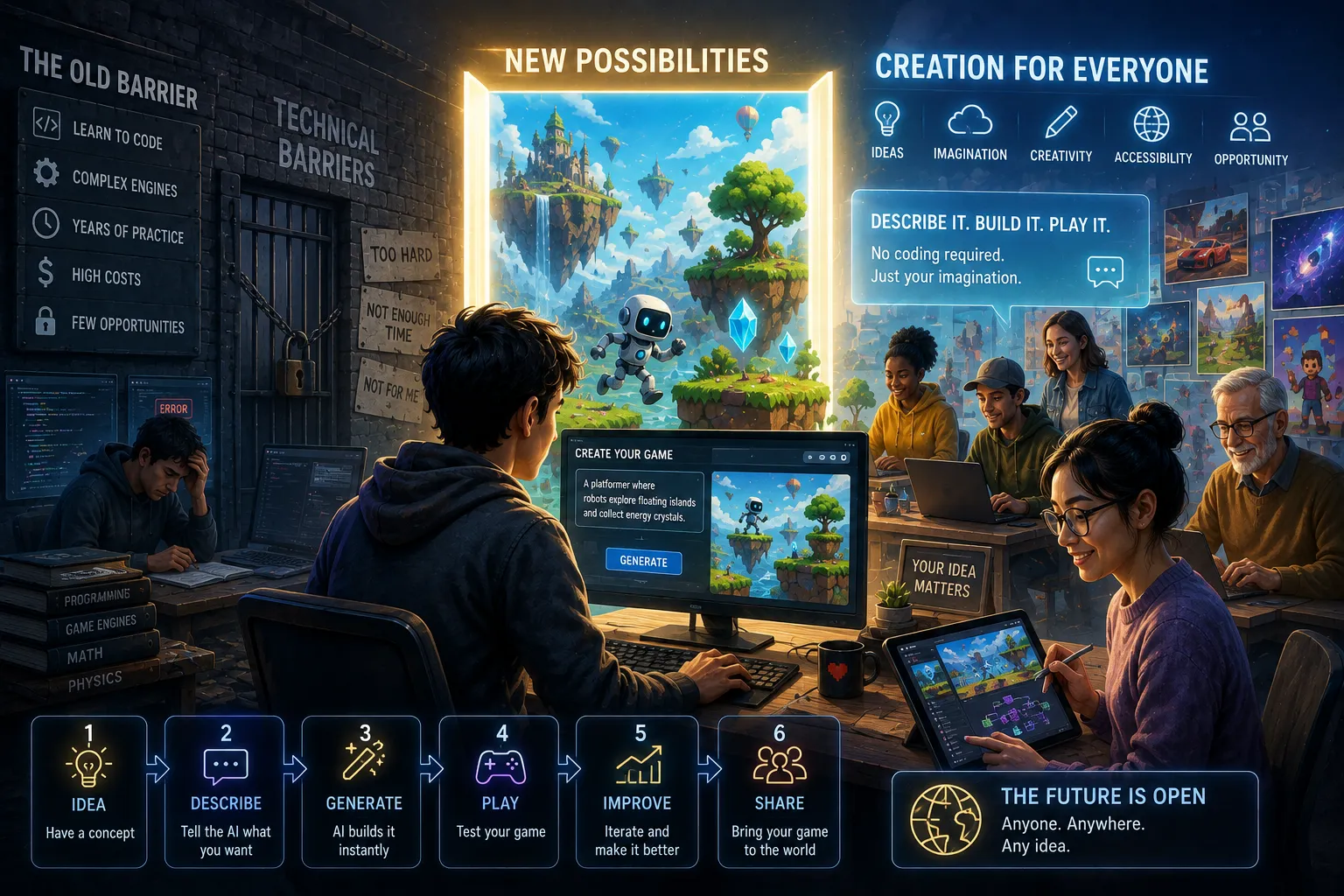
Making a game used to require crossing a threshold most people never got past: learning to code well enough to build something playable. That threshold quietly decided who got to participate in game creation and who didn’t, regardless of how good their ideas actually were. That barrier is disappearing fast, and understanding how it’s happening explains a lot about where game creation is headed for everyone, not just trained developers.
The Threshold That Used to Decide Everything
For most of gaming’s history, having a great idea meant very little without the technical skill to execute it. Learning a programming language well enough to build something functional took years most people didn’t have to spare, especially when development had nothing to do with their actual career. That gap wasn’t about talent. It was about access, and it filtered out an enormous number of good ideas simply because the people who had them lacked an unrelated technical skill.
Traditional development tools reinforced this without meaning to. A steep learning curve meant only people with significant free time, financial stability, or an existing technical inclination could realistically treat game creation as more than a passing interest. Everyone else’s ideas simply stayed ideas.
What’s Actually Making It More Accessible
Plain Language Replacing Technical Syntax
The biggest shift behind this new accessibility is that describing a game in ordinary language now produces working mechanics. There’s no need to learn correct syntax or understand how a specific engine structures logic underneath. A creator just describes what they want, and the platform handles the technical translation. That single change removes the steepest part of the traditional learning curve entirely.
Faster Feedback Loops for Beginners
When testing an idea used to take weeks of learning and implementation, trying game creation felt like a serious commitment before anyone even knew if they’d enjoy it. Modern tools let someone test a rough concept within a single sitting, which matters enormously for accessibility since it removes almost every obstacle standing between curiosity and a first real attempt.
Iteration Without a Technical Ceiling
Accessibility isn’t only about the first attempt, it’s about whether someone can keep refining what they’ve built. Traditional development made iteration expensive, which meant only people with real technical skill could meaningfully improve an idea through repeated testing. Modern tools make that process available to anyone, which means the quality ceiling for accessible creation keeps climbing instead of staying capped at “simple but functional.”
Who’s Actually Benefiting From This Shift
People Outside the Traditional Tech Pipeline
Game creation has historically skewed toward people who came up through computer science education or self-taught programming, often starting young with access to computers and free time that not everyone had. Accessible tools open the field to people who took entirely different paths, teachers, retail workers, retirees, anyone with a genuine idea and no technical background at all.
Creators Without Local Access to Formal Training
Programming education isn’t distributed evenly around the world. Plain-language development tools reduce dependency on that kind of formal training, letting creators anywhere with an internet connection participate regardless of what’s available to them locally.
People Who Assumed the Door Had Already Closed
Learning to code from scratch later in life discourages plenty of people who might otherwise have real creative ideas worth building. Describing a concept in plain language doesn’t carry that same steep learning curve, which makes game creation newly realistic for people who wrote it off years ago.
What Accessible Creation Actually Produces
It’s tempting to assume accessible tools automatically produce simpler or lesser results, but that assumption doesn’t hold up against what’s actually being built. Blocky Builder 3D is a good example of this in practice, a genuinely satisfying, well-executed game that shows accessible creation isn’t a diminished stand-in for traditional development, it’s simply a different starting point that can still reach real quality.
Anyone learning how to make your own game today has access to tools that make this kind of result increasingly common rather than exceptional, precisely because removing the technical barrier frees creators to focus on the decisions that actually determine quality, pacing, feel, fairness, rather than on debugging code that has nothing to do with whether a game is fun.
What Accessibility Doesn’t Remove
Making creation accessible doesn’t mean every resulting game is automatically good. The tool executes what’s described, it doesn’t supply the underlying creative instinct that makes an idea worth pursuing in the first place. That judgment still comes entirely from the person building the game.
Honest playtesting still matters just as much as it always has. A first-time creator using an accessible tool still needs to watch real players interact with their game and adjust based on what actually happens, not what they assumed would happen. And developing a genuine sense of what makes a game good still takes time, playing critically, noticing what works elsewhere, reflecting on why one version of a project felt better than another. Accessible tools remove one obstacle. They don’t remove the rest of the learning process.
Why This Shift Matters Beyond Individual Creators
When technical skill stops being the primary filter for who gets to build games, the range of perspectives entering the field naturally broadens. That diversity tends to produce a wider variety of ideas than a field filtered mainly by who happened to learn programming young.
It also means a single person with a genuinely good idea and no studio behind them can build something that reaches players directly, without needing to convince a larger organization to invest first. That directness is easy to underestimate, but it’s quietly reshaping who gets a real shot at making something people actually want to play.
Final Thoughts
Modern game creation becoming more accessible isn’t about lowering the bar for what counts as a good game. It’s about removing a barrier that never measured creative potential in the first place, technical skill. The people who always had good instincts for what makes a game fun now have a direct path to acting on those instincts, regardless of background, location, or how much free time they have to dedicate to a technical craft that was never really the point.