
Maghfirat ki dua is a supplication for seeking Allah’s forgiveness, mercy, and pardon. This guide provides commonly recited duas for forgiveness in Arabic, English, Urdu, Hindi, and Roman English, along with their meanings and transliterations. It also includes dua e maghfirat for deceased people and parents, helping readers find the appropriate supplication for personal repentance and prayers for those who have passed away.
Maghfirat Ki Dua: Key Points
- Maghfirat ki dua means seeking Allah’s forgiveness and pardon.
- Sayyid al-Istighfar is one of the well-known supplications for seeking forgiveness.
- Specific duas can be made for deceased people, parents, and personal forgiveness.
- Maghfirat duas are available here in Arabic with English, Urdu, Hindi, and Roman English meanings.
- Sincere repentance includes remorse, stopping the wrongdoing, and intending not to return to it.
Disclaimer: This article presents established Islamic teachings on seeking forgiveness based on Quranic verses and authentic hadith from Sahih Bukhari, Sahih Muslim, and other reliable sources. All Arabic supplications have been verified for accuracy. However, readers should consult qualified Islamic scholars for specific personal circumstances or religious rulings.
What Is Maghfirat Ki Dua? Meaning and Importance
Maghfirat ki dua refers to a supplication made to seek Allah’s forgiveness and mercy for sins, mistakes, and shortcomings. The word maghfirat means forgiveness or pardon, while dua refers to supplication.
Muslims may seek forgiveness through established duas, personal supplication, and sincere repentance. The Quran emphasizes that believers should not lose hope in Allah’s mercy, while authentic hadith describe the Prophet Muhammad (peace be upon him) frequently seeking forgiveness.
This guide covers both personal forgiveness duas and duas for deceased Muslims, including commonly searched forms such as dua e maghfirat, dua maghfirat for dead, and walid ki maghfirat ki dua.
Sayyid al-Istighfar: A Powerful Maghfirat Ki Dua
Sayyid al-Istighfar is a well-known supplication for seeking Allah’s forgiveness. It acknowledges Allah as the Lord, recognizes His blessings, admits one’s sins, and asks Him for forgiveness. The Arabic text, transliteration, and meaning are provided below.
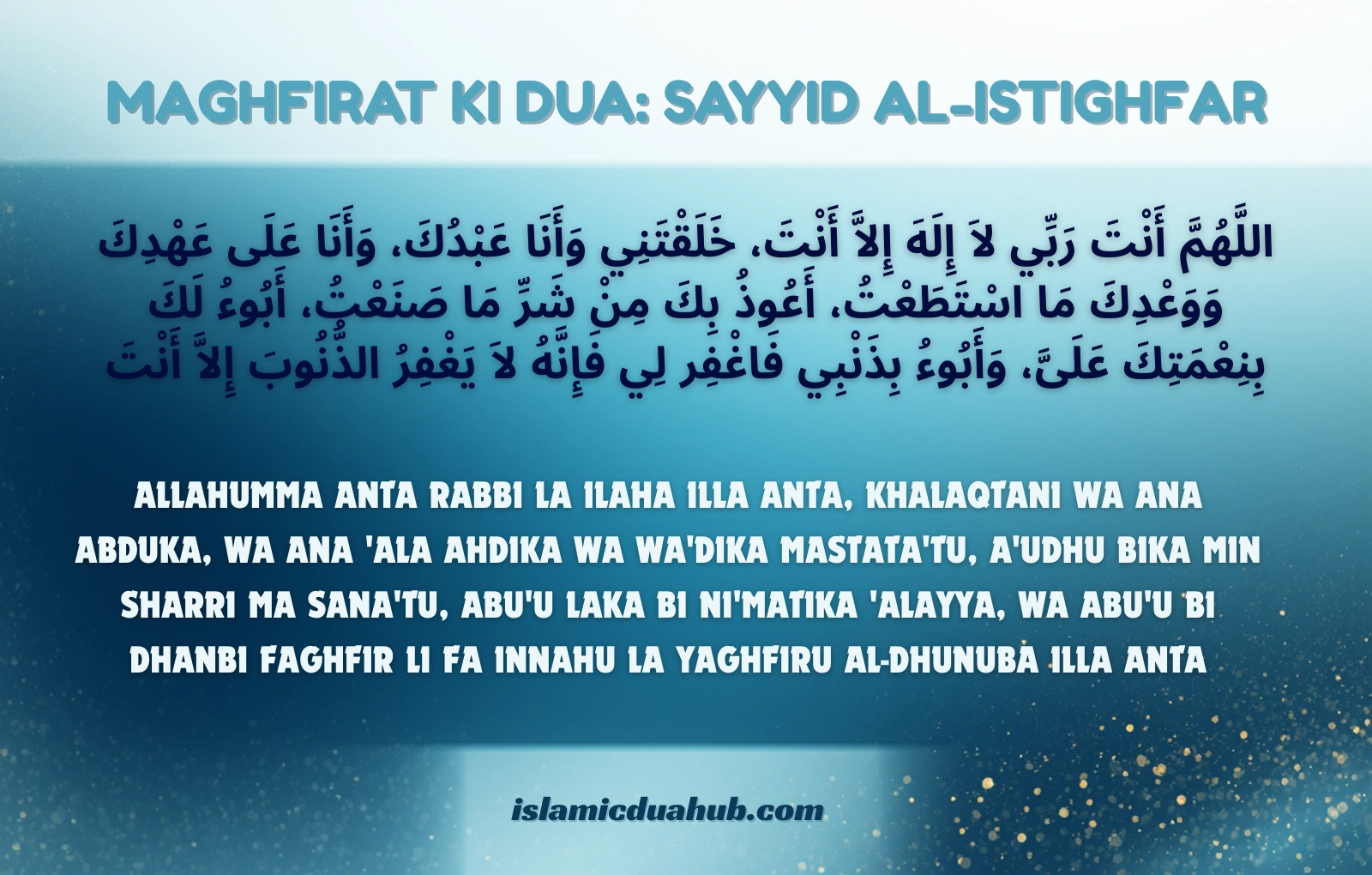
Arabic:
اللَّهُمَّ أَنْتَ رَبِّي لاَ إِلَهَ إِلاَّ أَنْتَ، خَلَقْتَنِي وَأَنَا عَبْدُكَ، وَأَنَا عَلَى عَهْدِكَ وَوَعْدِكَ مَا اسْتَطَعْتُ، أَعُوذُ بِكَ مِنْ شَرِّ مَا صَنَعْتُ، أَبُوءُ لَكَ بِنِعْمَتِكَ عَلَىَّ، وَأَبُوءُ بِذَنْبِي فَاغْفِر لِي فَإِنَّهُ لاَ يَغْفِرُ الذُّنُوبَ إِلاَّ أَنْتَ
Transliteration:
“Allahumma anta Rabbi la ilaha illa anta, khalaqtani wa ana abduka, wa ana ‘ala ahdika wa wa’dika mastata’tu, a’udhu bika min sharri ma sana’tu, abu’u laka bi ni’matika ‘alayya, wa abu’u bi dhanbi faghfir li fa innahu la yaghfiru al-dhunuba illa anta.”
Meaning:
“O Allah, You are my Lord, none has the right to be worshipped except You. You created me and I am Your servant, and I am faithful to my covenant and my promise as much as I can. I seek refuge with You from all the evil I have done. I acknowledge before You all the blessings You have bestowed upon me, and I confess to You all my sins. So I ask You to forgive me, for no one can forgive sins except You.”
The Prophet (peace be upon him) said: “Whoever says this with firm belief during the day and dies that day before evening, he will be among the people of Paradise, and whoever says it with firm belief at night and dies before morning, he will be among the people of Paradise.” (Sahih Bukhari 6306)
Simple Maghfirat Ki Duas for Daily Forgiveness
1. The Short and Powerful Istighfar
Arabic: أَسْتَغْفِرُ اللهَ الْعَظِيمَ الَّذِي لاَ إِلَهَ إِلاَّ هُوَ الْحَيُّ الْقَيُّومُ وَأَتُوبُ إِلَيْهِ
Transliteration: “Astaghfirullah al-‘Azeem al-ladhi la ilaha illa Huwa al-Hayy al-Qayyum wa atubu ilayh.”
Meaning: “I seek forgiveness from Allah the Almighty, Whom there is none worthy of worship except Him, the Living, the Sustainer, and I repent to Him.”
This can be recited at any time, ideally 100 times daily.
2. Three-Word Forgiveness
Arabic: أَسْتَغْفِرُ اللهَ وَأَتُوبُ إِلَيْهِ
Transliteration: “Astaghfirullah wa atubu ilayh.”
Meaning: “I seek Allah’s forgiveness and repent to Him.”
Prophet Muhammad (peace be upon him) used to say this more than 70-100 times daily.
Dua E Maghfirat for Dead and Deceased People
Praying for deceased parents is one of the most virtuous acts in Islam. The Quran instructs us: “My Lord, have mercy upon them as they brought me up when I was small.” (Quran 17:24)
Arabic: رَبِّ اغْفِرْ لِي وَلِوَالِدَيَّ وَارْحَمْهُمَا كَمَا رَبَّيَانِي صَغِيرًا
Transliteration: “Rabbi ghfir li wa li walidayya warhamhuma kama rabbayani saghira.”
Meaning: “My Lord, forgive me and my parents, and have mercy upon them as they brought me up when I was small.”
Waldain Ki Maghfirat Ki Dua for Parents
Waldain ki maghfirat ki dua is a supplication asking Allah to forgive and have mercy upon one’s parents. This section includes a Quranic dua for parents as well as a supplication that can be made for a deceased parent.
Arabic: اللَّهُمَّ اغْفِرْ لَهُ وَارْحَمْهُ وَعَافِهِ وَاعْفُ عَنْهُ
Transliteration: “Allahumma ghfir lahu warhamhu wa ‘afihi wa’fu ‘anhu.”
Meaning: “O Allah, forgive him, have mercy on him, grant him wellness, and pardon him.”
Replace “lahu” (for him) with “laha” (for her) when praying for a mother or female relative.
Maghfirat Ki Dua in Arabic, English, Urdu, Hindi & Roman English
Maghfirat Ki Dua in English
For English-speaking Muslims who want to understand the meaning while reciting:
English Translation of Sayyid al-Istighfar: “O Allah, You are my Lord, none has the right to be worshipped except You. You created me and I am Your servant, and I am faithful to my covenant and my promise as much as I can. I seek refuge with You from all the evil I have done. I acknowledge before You all the blessings You have bestowed upon me, and I confess to You all my sins. So I ask You to forgive me, for no one can forgive sins except You.”
Simple English Forgiveness Prayer: “O Allah, forgive me, have mercy on me, and accept my repentance. You are the Most Forgiving, the Most Merciful.”
While making dua in English is acceptable, learning the Arabic version brings you closer to the exact words taught by the Prophet (peace be upon him).
Maghfirat Ki Dua in Urdu
اردو میں مغفرت کی دعا مسلمانوں کے لیے بہت اہم ہے۔
سیّد الاستغفار (اردو ترجمہ): “اے اللہ! تو میرا رب ہے، تیرے سوا کوئی معبود نہیں۔ تو نے مجھے پیدا کیا اور میں تیرا بندہ ہوں، اور میں اپنی طاقت کے مطابق تیرے عہد اور وعدے پر قائم ہوں۔ میں اپنے کیے ہوئے برے کاموں کے شر سے تیری پناہ مانگتا ہوں۔ میں تیری نعمتوں کا اعتراف کرتا ہوں جو تو نے مجھ پر کی ہیں، اور میں اپنے گناہوں کا اقرار کرتا ہوں۔ پس مجھے بخش دے، بے شک تیرے سوا کوئی گناہ نہیں بخش سکتا۔”
آسان مغفرت کی دعا (اردو): “اے اللہ! مجھے بخش دے، مجھ پر رحم فرما، اور میری توبہ قبول فرما۔ بے شک تو بہت بخشنے والا اور رحم کرنے والا ہے۔”
Maghfirat Ki Dua in Hindi
हिंदी में मग़फ़िरत की दुआ:
सय्यिद अल-इस्तिग़फ़ार (हिंदी अनुवाद): “ऐ अल्लाह! तू मेरा रब है, तेरे सिवा कोई इबादत के लायक़ नहीं। तूने मुझे पैदा किया और मैं तेरा बन्दा हूँ, और मैं अपनी ताक़त के मुताबिक़ तेरे अहद और वादे पर क़ायम हूँ। मैं अपने किए हुए बुरे कामों के शर से तेरी पनाह माँगता हूँ। मैं तेरी नेमतों का एतराफ़ करता हूँ जो तूने मुझ पर की हैं, और मैं अपने गुनाहों का इक़रार करता हूँ। पस मुझे बख़्श दे, बेशक तेरे सिवा कोई गुनाह नहीं बख़्श सकता।”
आसान मग़फ़िरत की दुआ (हिंदी): “ऐ अल्लाह! मुझे माफ़ कर दे, मुझ पर रहम फ़रमा, और मेरी तौबा क़बूल फ़रमा। बेशक तू बहुत माफ़ करने वाला और रहम करने वाला है।”
When to Recite Maghfirat Ki Dua
Morning and Evening: After Fajr and before sleeping are spiritually powerful times.
After Every Prayer: The Prophet (peace be upon him) would say “Astaghfirullah” three times after each prayer.
During the Last Third of Night: This is when Allah descends to the lowest heaven asking, “Who is asking forgiveness of Me that I may forgive them?” (Sahih Bukhari 1145)
On Fridays: Especially during the last hour before Maghrib.
During Ramadan: Particularly in the last ten nights, especially Laylatul Qadr.
After Committing a Sin: Immediate repentance prevents sins from hardening the heart.
Read Also: Qarz Utarne Ki Dua
Benefits of Seeking Allah’s Forgiveness
Regular repentance brings multiple blessings:
Peace of Heart: Guilt and anxiety diminish when you sincerely turn to Allah.
Protection from Difficulties: The Quran states that seeking forgiveness brings rain, wealth, and children (Quran 71:10-12).
Increased Provisions: Prophet Nuh (peace be upon him) told his people that seeking forgiveness would increase their sustenance.
Spiritual Cleansing: Just as we shower daily for physical cleanliness, istighfar cleanses spiritual impurities.
Closeness to Allah: Acknowledging mistakes with humility strengthens your relationship with the Creator.
Conditions for Sincere Repentance
Your repentance must be sincere and complete. This includes:
- Genuine Remorse: Feel true regret for what you’ve done
- Immediate Cessation: Stop the sin completely
- Firm Intention: Commit to never returning to that sin
- Seeking Forgiveness: Make dua with humility and hope
- Restitution: If you’ve wronged someone, apologize and make amends
Allah says: “But whoever repents after his wrongdoing and reforms, indeed, Allah will turn to him in forgiveness.” (Quran 5:39)
Common Mistakes When Seeking Forgiveness
Repeating Sins with No Real Intention to Change: Repentance requires genuine commitment to improvement.
Delaying Repentance: Tomorrow is not guaranteed. Repent immediately when you recognize a mistake.
Losing Hope: No sin is too great for Allah’s mercy. Despair itself is a trap from Shaytan.
Mechanical Recitation: Speak from the heart, not just the tongue. Mean every word you say.
Not Forgiving Others: How can you expect Allah’s forgiveness if you refuse to forgive those who’ve wronged you?
Maghfirat Ki Dua: Final Reminder
Maghfirat ki dua is a way of turning to Allah with humility, regret, and hope. Whether you are seeking forgiveness for yourself or making dua for a deceased parent or another Muslim, the focus should remain on sincere supplication and repentance.
You can use the Arabic duas in this guide along with their English, Urdu, Hindi, and Roman English meanings to understand what you are reciting. Make seeking forgiveness part of your regular worship and continue turning to Allah with sincerity and hope in His mercy.
Remember: “Indeed, Allah loves those who are constantly repentant.” (Quran 2:222)
? Frequently Asked Questions About Maghfirat Ki Dua
Q: What is the best maghfirat ki dua?
A: Sayyid al-Istighfar is one of the well-known supplications for seeking Allah’s forgiveness. The guide above provides its Arabic text, transliteration, and meaning.
Q: What dua can I read for a deceased person?
A: You can make dua asking Allah to forgive and have mercy upon the deceased. The article includes a specific dua for a deceased person along with its Arabic text, transliteration, and meaning.
Q: What is the dua for a deceased father?
A: You can make dua asking Allah to forgive your father and have mercy upon him. The parents and deceased section above provides relevant supplications.
Q: Can I read maghfirat ki dua in English or Urdu?
A: You can understand the meaning of the dua through English, Urdu, Hindi, or Roman English translations provided in this guide. For established Arabic supplications, the Arabic wording is also included.
Q: What is the shortest maghfirat ki dua?
A: “Astaghfirullah” means “I seek Allah’s forgiveness” and is a short form of seeking forgiveness.
Q: How often should I seek Allah’s forgiveness?
A: The Prophet Muhammad (peace be upon him) is reported in authentic hadith to have frequently sought Allah’s forgiveness. The specific frequency should be understood according to the relevant hadith rather than treated as a mandatory daily number.
Written by: Ahmad Raza
Credentials: Islamic Studies Content Writer
 Read More duas for daily life at The Dua For You