
When a Muslim passes away and is being buried, a specific supplication is recited at the moment of placing earth into the grave. This supplication is known as mitti dene ki dua the dua recited while lowering the soil onto the deceased.
In Islam, every step of the funeral process carries deep spiritual significance. From the preparation of the body to the final burial, each act follows the guidance of the Quran and the Sunnah of the Prophet Muhammad ﷺ. The act of placing earth on the grave is no different it comes with its own prescribed words that carry a profound message about human existence.
This dua is taken directly from the Quran and reminds every person present at the burial of their own mortality. It speaks of three great truths: the creation of man from the earth, his return to it upon death, and his resurrection from it on the Day of Judgment.
Mitti Dene Ki Dua in Arabic
When placing earth into the grave, this dua is recited three times once with each handful of soil:
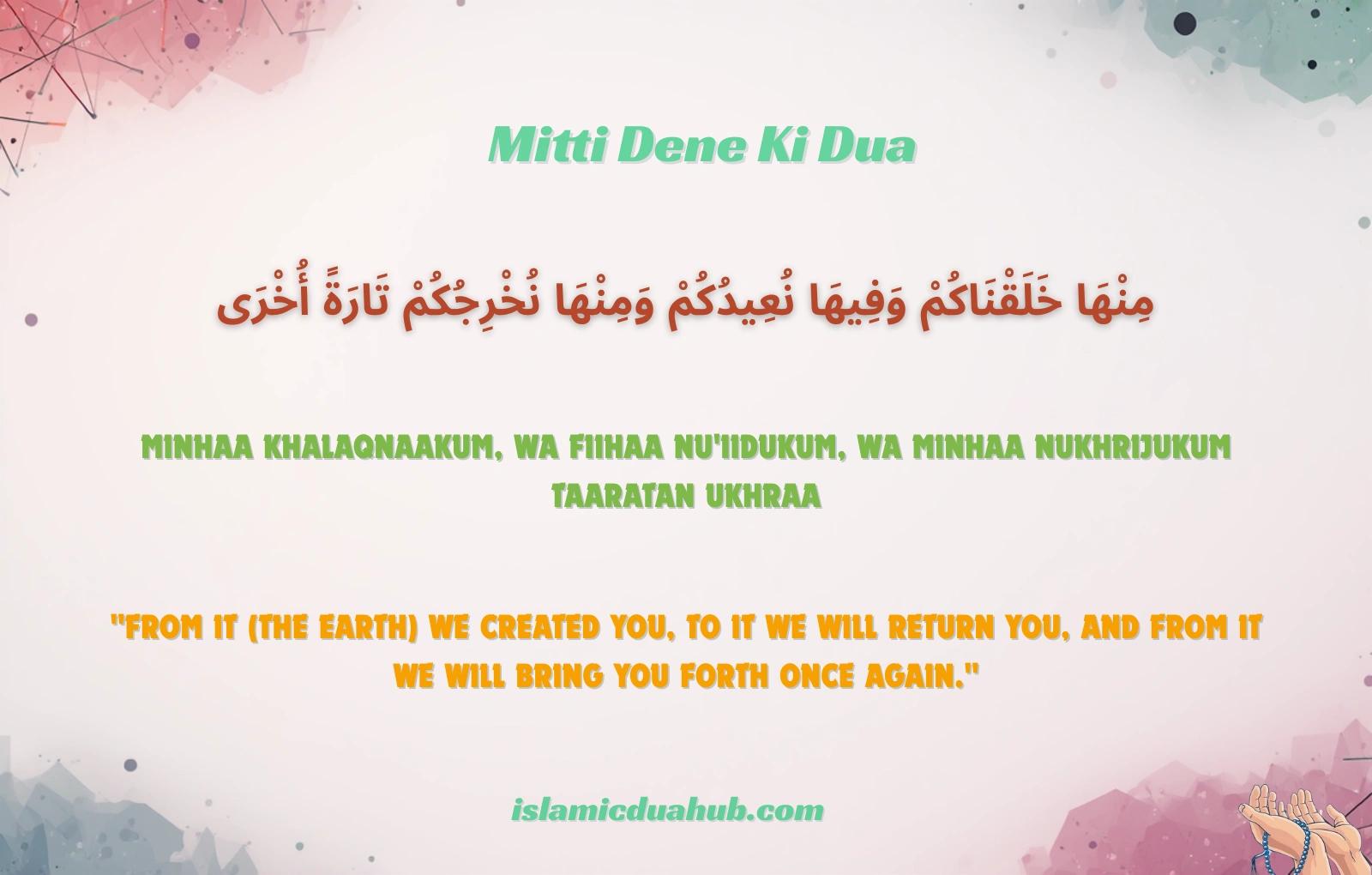
مِنْهَا خَلَقْنَاكُمْ وَفِيهَا نُعِيدُكُمْ وَمِنْهَا نُخْرِجُكُمْ تَارَةً أُخْرَى
Transliteration
Minhaa khalaqnaakum, wa fiihaa nu’iidukum, wa minhaa nukhrijukum taaratan ukhraa
Mitti Dene Ki Dua in English – Meaning
“From it (the earth) We created you, to it We will return you, and from it We will bring you forth once again.”
Mitti Dene Ki Dua in Urdu
“اسی (مٹی) سے ہم نے تمہیں پیدا کیا، اسی میں تمہیں واپس کریں گے، اور اسی سے تمہیں دوبارہ اٹھائیں گے۔”
Mitti Dene Ki Dua in Hindi
“इसी मिट्टी से हमने तुम्हें भुगतान किया, इसी में तुम्हें वापस करेंगे, और इसी से तुम्हें दोबारा उठाएंगे।”
Disclaimer: The content published on this website regarding Islamic duas, supplications, and religious practices is intended for general informational and educational purposes only.
The Source and Importance of This Dua
A Verse Directly from the Quran
Mitti dene ki dua is not just a recitation it is a direct verse from the Noble Quran. Allah Ta’ala revealed these words in Surah Ta-Ha, Ayat 55, and they carry within them the entire story of human life.
When this verse is recited at the time of burial, it is both a reminder and a declaration of faith. The mourners affirm their belief in the creation of man, the certainty of death, and the promise of resurrection all in a single, powerful sentence.
Connection to the Sunnah of the Prophet ﷺ
Islamic scholars have narrated that the Prophet Muhammad ﷺ recited this verse during funerals. Ibn Majah reports in Kitab al-Janaaiz that when placing earth on a grave, it was the practice to recite these words three times, once with each handful of soil. This makes mitti dene ki dua a firmly established Sunnah act that Muslims across generations have practiced.
Reciting this dua is a way of following the Prophet ﷺ in one of the most solemn and important moments of human life.
Mayyat Ko Mitti Dene Ki Dua – When and How It Is Recited
The Correct Time to Recite This Dua
Mayyat ko mitti dene ki dua is recited specifically at one point during the burial:
- After the deceased has been placed in the grave
- After the funeral prayer (Janaza Salah) has been performed
- At the moment when those present begin placing soil into the grave
- It is recited with each of the three handfuls of earth
This is not a dua recited before or after the burial process in general it belongs to the exact moment of placing earth on the deceased.
The Correct Method of Placing Earth
The proper Islamic way of placing soil into the grave follows these steps:
- Begin from the side of the head the first handful of earth is placed at the head end of the grave.
- Use three handfuls three separate amounts of soil are placed.
- Recite the dua each time“Minhaa khalaqnaakum, wa fiihaa nu’iidukum, wa minhaa nukhrijukum taaratan ukhraa” is said with every handful.
- Use the right hand soil is placed with respect, using the right hand or both hands together.
This method is based on hadith narrations and the practice taught by Islamic scholars across all major schools of thought.
Qabar Me Mitti Dene Ki Dua – Its Deeper Meaning
The words of qabar me mitti dene ki dua are deceptively short but carry immense depth. They cover the three stages of every human being’s journey:
Stage 1 – Creation: “From it We created you” Every human being was created from the earth. This is confirmed in multiple places in the Quran. The body returns to the same substance from which it was formed.
Stage 2 – Death: “To it We will return you” Death is not the end but a transition. Placing the deceased into the earth is not abandonment it is a fulfillment of Allah’s decree. The earth becomes a resting place until the Day of Judgment.
Stage 3 – Resurrection: “From it We will bring you forth once again” This is the promise of Qiyamah. Allah Ta’ala will resurrect all of mankind from the earth on the Day of Judgment. Reciting this at a burial strengthens the believer’s iman in the Akhirah.
Benefits of Reciting Mitti Dene Ki Dua
1. Fulfilling a Sunnah Act
Reciting mitti dene ki dua during the burial is following the footsteps of the Prophet ﷺ. Every Sunnah act carries its own reward, and this one is performed at one of the most spiritually significant moments in life.
2. Affirming Core Beliefs
The dua is a verbal affirmation of three pillars of Islamic belief the creation of man, death as Allah’s will, and the resurrection on the Day of Judgment. Reciting it renews iman in a powerful and meaningful way.
3. A Reminder of One’s Own Mortality
Standing at a graveside and reciting these words brings a powerful awareness of one’s own end. The Prophet ﷺ encouraged frequent remembrance of death, and this dua naturally invites that reflection.
4. Spiritual Comfort for Those Grieving
When mourners recite these words, they are reminded that the deceased has returned to Allah’s care. It helps shift the perspective from loss to trust in Allah’s plan, offering comfort during a deeply painful moment.
5. Reward for Participating in the Burial
The Prophet ﷺ encouraged Muslims to participate in funerals and burials, mentioning significant rewards for those who do so until the burial is complete. Reciting the prescribed dua during this participation adds to that reward.
Important Points to Know
Who Should Recite This Dua?
Anyone present at the graveside who is placing earth on the deceased should recite mitti dene ki dua. It is primarily men who perform the burial in Islam, as it is generally considered more appropriate for men to be at the graveside.
What If Someone Does Not Know the Dua?
Those who do not yet know the dua should make the intention to learn it. However, if someone forgets or does not know it at the time, they may still participate in the burial. Allah looks at the intention of the heart. That said, making the effort to memorize this short verse before attending a funeral is strongly encouraged.
Is This Dua Specific to the Burial Only?
Yes. Mitti dene ki dua in English or in any language is a dua specific to the act of placing earth on the grave. It is not recited at other times as a general supplication.
Additional Duas at the Graveside
While mitti dene ki dua is the main supplication recited during the burial itself, there are other supplications that can be made after the burial is complete:
Dua for the deceased after burial:
اللَّهُمَّ اغْفِرْ لَهُ وَثَبِّتْهُ
Allahummaghfir lahu wa thabbit-hu
“O Allah, forgive him and make him firm.”
The Prophet ﷺ would stand at the graveside after burial and say: “Seek forgiveness for your brother and ask for him to be made firm, for he is now being questioned.” (Abu Dawud)
This shows that the time after the burial is also a moment for sincere dua for the deceased.
Read Also: Gusal Karne Ki Dua
Conclusion
Mitti dene ki dua is one of the most profound supplications in Islamic practice. In just a few words, it encompasses the beginning of human life, the certainty of death, and the promise of resurrection. It is a verse from the Quran, a Sunnah of the Prophet ﷺ, and a moment of deep reflection for every Muslim who stands at a graveside.
Every Muslim should memorize this short dua. When the time comes to participate in the burial of a fellow Muslim, reciting mitti dene ki dua in Arabic or understanding its meaning in English, Hindi, or Urdu connects the believer to the deepest truths of their faith.
May Allah Ta’ala grant ease to the deceased in their graves, forgive their sins, and resurrect them among the righteous on the Day of Judgment. Ameen.
FAQs
Q1. What is mitti dene ki dua?
Mitti dene ki dua is the supplication recited while placing earth on a grave during an Islamic burial. It is taken from Surah Ta-Ha, Ayat 55 of the Quran.
Q2. What is mitti dene ki dua in English?
The meaning in English is: “From it (the earth) We created you, to it We will return you, and from it We will bring you forth once again.”
Q3. How many times is mitti dene ki dua recited?
It is recited three times once with each of the three handfuls of earth placed into the grave.
Q4. What is the Arabic text of mitti dene ki dua?
The Arabic text is: مِنْهَا خَلَقْنَاكُمْ وَفِيهَا نُعِيدُكُمْ وَمِنْهَا نُخْرِجُكُمْ تَارَةً أُخْرَى
Q5. Is mitti dene ki dua from the Quran?
Yes. It is a direct verse from the Quran Surah Ta-Ha, Chapter 20, Verse 55.
Q6. What is mayyat ko mitti dene ki dua?
Mayyat ko mitti dene ki dua refers to the same supplication recited specifically when placing earth on the body of the deceased in the grave. It is the same verse from Surah Ta-Ha.
Q7. Can women recite this dua?
Women are generally advised not to attend the gravesite in Islamic practice. The dua is recited by those present at the burial, which is typically men.
Q8. What is the Roman transliteration of mitti dene ki dua?
The transliteration is: Minhaa khalaqnaakum, wa fiihaa nu’iidukum, wa minhaa nukhrijukum taaratan ukhraa.
Written by: Ahmad Raza
Credentials: Islamic Studies Content Writer
 Read More duas for daily life at The Dua For You