Introduction
For many Muslim parents in the UK and USA, raising children with a meaningful connection to the Quran is an important part of family life. Yet this can sometimes feel challenging when English is a child’s dominant language, Arabic is not spoken regularly at home, and school, activities, and family responsibilities fill the week.
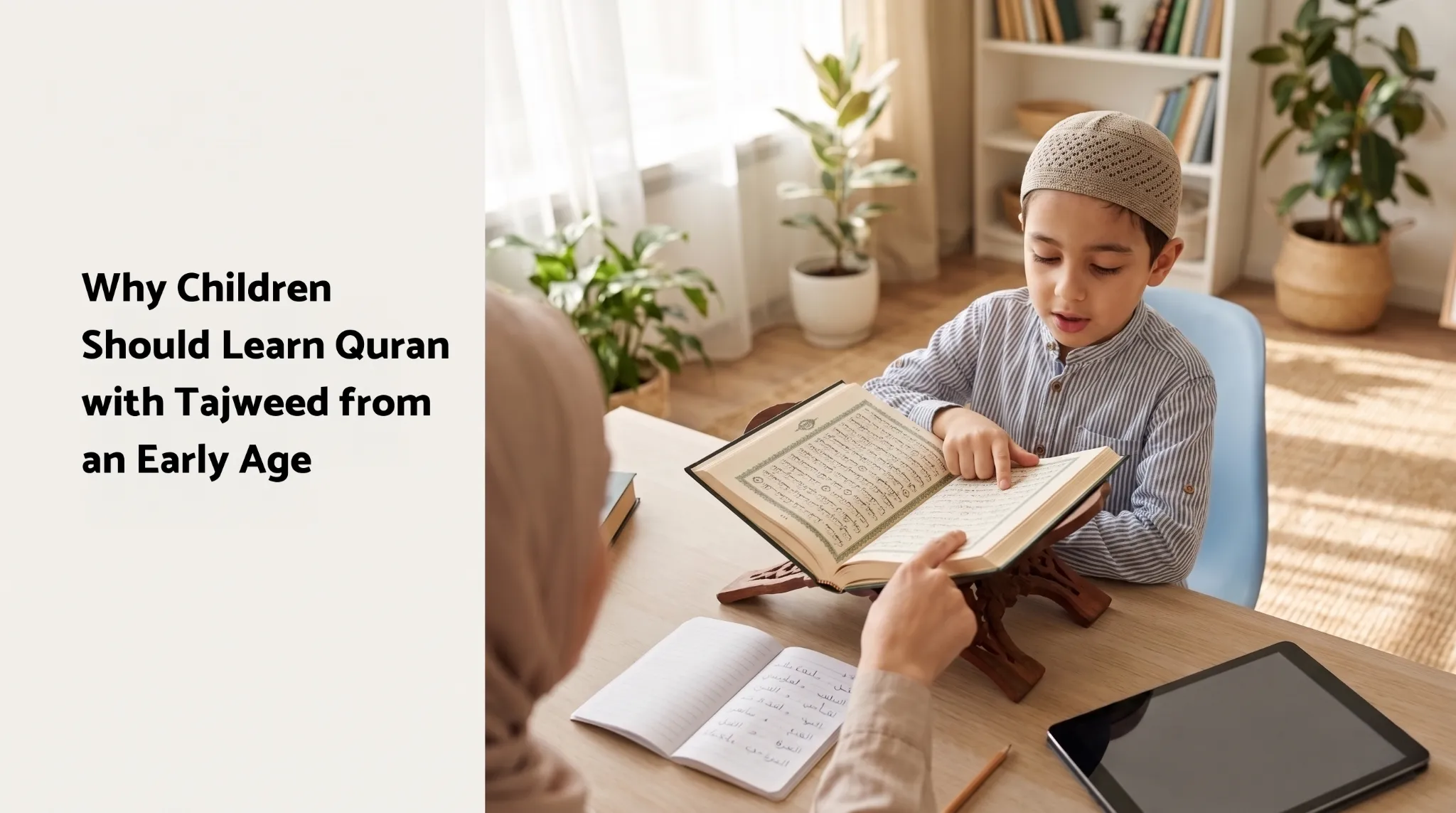
One valuable way to support a child’s Quran education is to begin learning Quran with Tajweed from an early age. Tajweed helps children pronounce the Quranic letters and words correctly, while regular lessons allow them to develop listening, memory, and reading skills gradually. When correct recitation is practised patiently during childhood, it can become a familiar and natural habit rather than something a learner must completely rebuild later.
Starting early does not mean rushing children or expecting perfection. It means using the years when children are naturally developing language and learning habits to give them a gentle, consistent foundation that can support them throughout life.
What Is Tajweed?
Tajweed is the set of principles that helps a person recite the Quran correctly. It includes the proper pronunciation of Arabic letters, the characteristics of those letters, the correct lengthening of certain sounds, and rules related to stopping and joining words during recitation.
The word “Tajweed” is often explained as meaning to improve or make something excellent. In Quran recitation, it means giving each letter and sound its proper pronunciation as carefully as possible.
This matters because some Arabic sounds are different from sounds found in English. For example, letters such as ع, ح, خ, ص, ض, ط, and ق may require movements of the throat, tongue, or mouth that children have not previously used. A child who hears and practises these sounds regularly can gradually become more comfortable producing them.
Tajweed is not about making children recite in a complicated or intimidating way. At its heart, it is about helping them read the words of the Quran accurately, respectfully, and with growing confidence.
Why Early Learning Matters
Children Are Developing Their Pronunciation
Childhood is an important period for language development. Children are constantly learning how sounds are formed, how words are remembered, and how listening connects with speaking. This makes early Quran learning a valuable opportunity to introduce Arabic sounds in a calm and structured way.
Children do not need to speak Arabic fluently before beginning Quran lessons. With appropriate teaching, they can learn to recognise and pronounce Quranic letters step by step. A patient teacher can demonstrate a sound, allow the child to listen, and then guide them as they try it themselves.
The aim is not to expect an accent or pronunciation that develops overnight. Rather, regular exposure gives children time to become familiar with sounds that may not be present in their everyday English speech.
Correct Pronunciation Can Become a Habit
A child who practises correct pronunciation repeatedly is more likely to develop comfortable and reliable recitation habits. Over time, the movement of the tongue, lips, and throat becomes more familiar, and the child may need less conscious effort to produce certain sounds.
This is similar to learning any other skill. Reading, handwriting, musical practice, and sports all become easier when children learn basic techniques carefully and repeat them regularly. Quran recitation also benefits from a strong beginning.
If a pronunciation pattern becomes deeply established, correcting it later may require additional patience and focused practice. This does not mean older learners cannot improve. Many people begin Tajweed as teenagers or adults and make excellent progress. However, learning Quran at an early age can help children build their foundation before inaccurate habits become difficult to change.
Early Practice Supports Listening Skills
Tajweed learning is not only about speaking. It also develops careful listening. Children learn to notice differences in sounds, lengths, pauses, and pronunciation. These listening skills can help them identify their own mistakes and follow a teacher’s correction more effectively.
Listening to good Quran recitation can also help children become familiar with rhythm and fluency. When this is combined with guided practice, they gradually learn to connect what they hear with what they see on the page.
For Muslim children growing up in English-speaking environments, this regular listening experience can be especially valuable. Arabic may not be part of their daily conversations, so Quran lessons may provide their most consistent opportunity to hear and practise formal Arabic sounds.
Learning Can Build Confidence
Children often feel encouraged when they can see their progress. Learning a new surah, reading a longer passage, or pronouncing a challenging letter more clearly can give them a sense of achievement.
Confidence grows when lessons are suitable for the child’s age and ability. A young beginner should not be compared with an older sibling, classmate, or fluent Arabic speaker. Instead, progress can be measured against the child’s own previous efforts.
When Quran recitation feels familiar, children may be more comfortable reading in front of family members, joining prayer, participating in mosque activities, or continuing their studies as they grow older.
“Learning in Childhood Is Like Engraving on Stone”
A famous Arabic saying describes learning in childhood as being “like engraving on stone.” The expression is a vivid way of saying that knowledge and skills practised during childhood can become deeply rooted.
The saying should not be understood to mean that children never forget anything. Children can forget lessons, lose confidence, or need revision just like adults. What it highlights is that early learning may leave a strong impression, especially when it is reinforced through regular practice.
For example, a child may not remember every Tajweed rule by name years later, but the correct sound, rhythm, or pronunciation they practised repeatedly may remain familiar. With ongoing revision, that foundation can be strengthened and used naturally.
This is why every year of a child’s early education can be an opportunity to develop useful habits. Parents do not need to create an intense schedule. Even a short, consistent routine can help children form a positive relationship with Quran learning.
Growing Up in the UK and USA
Muslim families in the UK and USA may face particular challenges when teaching Quran to children.
English May Be the Dominant Language
Children who attend English-speaking schools and spend most of their day communicating in English may have limited opportunities to hear Arabic. This can make some Quranic sounds unfamiliar.
It is entirely normal for children to need extra time with pronunciation. Regular lessons with clear examples can help them distinguish between similar letters and develop confidence gradually.
Arabic Exposure May Be Limited
Outside Quran lessons, children may not hear Arabic often. Family members may speak English at home, and Arabic-language community events may happen only occasionally. As a result, children may need structured opportunities to listen to Quran recitation and practise what they hear.
A consistent teacher can provide this structure while adapting lessons to the child’s level.
Busy Schedules Can Affect Consistency
Schoolwork, sports, clubs, travel, and family commitments can make it difficult to maintain Quran lessons. Some families begin with enthusiasm but struggle to establish a routine that fits their weekly life.
In these circumstances, shorter and regular lessons are often more sustainable than occasional long sessions. Online Quran lessons for kids can also make scheduling easier for families who live far from a suitable teacher or Islamic centre.
Children May Need Support With Certain Letters
Some children need focused help with particular letters or sounds. This is not a sign of failure. Pronunciation develops through hearing, imitation, correction, and repetition.
A qualified teacher who understands teaching Quran to children can break difficult sounds into manageable steps. They can also recognise when a child needs more practice, a different explanation, or simply more time.
How Structured Lessons Can Help
A structured approach to Quran learning for kids gives children a clear path from one stage to the next. Depending on their age and ability, lessons may include:
-
Learning and reviewing Arabic letters.
-
Connecting letters and reading simple words.
-
Practising short vowels and basic pronunciation.
-
Reading short surahs with guidance.
-
Developing familiarity with selected Tajweed rules.
-
Listening to and repeating correct recitation.
-
Reviewing previous material to strengthen memory.
-
Gradually improving fluency and confidence.
A structured programme does not have to be rigid. Good Tajweed for kids should remain flexible enough to respond to each child’s personality, attention span, and learning pace.
Some children learn quickly through repetition, while others benefit from visual examples, stories, movement, or frequent encouragement. The most effective Quran education is both purposeful and child-centred.
The Best Approach: Consistency Over Intensity
Parents sometimes assume that children must study for long periods to make meaningful progress. In reality, regularity is often more important than the length of a single lesson.
A child may benefit more from a short lesson several times a week than from a long session followed by several days without practice. Regular contact keeps the material familiar and allows pronunciation and reading skills to develop step by step.
A healthy routine might include:
-
A short lesson with a qualified teacher.
-
A few minutes of review on other days.
-
Listening to a selected passage during a calm part of the day.
-
Occasional revision with a parent or older sibling.
-
Praise for effort, not only for flawless performance.
The goal is to make Quran recitation a positive and manageable part of family life. Pressure may produce short-term compliance, but encouragement is more likely to support a lasting relationship with the Quran.
Practical Tips for Parents
1. Start Early, But Follow the Child’s Readiness
Early learning can be beneficial, but children develop at different rates. Begin with simple activities such as listening, recognising letters, or repeating short sounds. The lesson should match the child’s age, attention span, and ability.
2. Practise Regularly
Set a realistic routine that fits your family. A few minutes of review after school or before bedtime may be more effective than an ambitious schedule that is difficult to maintain.
3. Keep Lessons Age-Appropriate
Young children may need variety and shorter activities. Older children can gradually handle more reading, explanation, and independent practice. Lessons should challenge children without overwhelming them.
4. Review What They Have Learned
Revision helps children retain letters, sounds, surahs, and Tajweed rules. Ask the child to read a familiar passage, listen to a recording, or practise one sound that the teacher has highlighted.
5. Let Them Hear Good Recitation
Listening to skilled reciters can help children become familiar with correct pronunciation and rhythm. Choose recitation that is clear and suitable for the child’s level, and encourage active listening rather than leaving it as background sound only.
6. Praise Progress
Notice specific improvements: “Your ق sound was clearer today,” or “You remembered that stopping rule.” Specific praise shows children that their effort is recognised and helps them understand what progress looks like.
7. Choose a Qualified and Patient Teacher
A good teacher should understand Tajweed as well as child development. Look for someone who explains clearly, corrects gently, adapts lessons to the learner, and communicates constructively with parents.
Supporting a Lifelong Connection
Learning Quran with Tajweed from an early age is not only about completing a reading level or memorising a set number of surahs. It is about helping children develop a respectful and confident relationship with the Quran.
A strong foundation can support future learning in several ways. Children may become more comfortable revising independently, listening carefully, asking questions, and improving their recitation. They may also be more prepared to study advanced Tajweed, memorisation, translation, or Arabic when they are older.
Most importantly, children can come to see Quran learning as a normal and valued part of life rather than a task introduced only when they are expected to perform well. This attitude can remain meaningful as they move from primary school to secondary school, university, and adulthood.
Parents should not feel that they must create a perfect learning environment. Family routines change, children have difficult periods, and progress is not always steady. What matters is returning patiently to the habit, keeping expectations realistic, and making space for the Quran in a way that is warm and sustainable.
Conclusion
Learning Quran with Tajweed from an early age gives children time to develop accurate pronunciation, careful listening, strong memory, and positive learning habits. For Muslim children growing up in the UK and USA, regular Quran lessons can provide valuable exposure to Arabic sounds that may not be part of their everyday environment.
The purpose is not to rush children or pressure them into perfection. Short lessons, regular revision, patient correction, encouragement, and age-appropriate teaching can help correct recitation become increasingly natural. With a strong foundation, children are better placed to continue their Quran education with confidence throughout their lives.
Parents who would like professional guidance may wish to explore
, which provides online Quran and Tajweed education with qualified teachers for children and non-Arabic-speaking learners. It can be a helpful option for families seeking structured support that fits life in the UK or USA.