
Ya Hayyu Ya Qayyum Birahmatika Astaghees Dua is a well-known supplication for seeking Allah’s mercy and help during times of difficulty. The dua begins by calling upon Allah as Al-Hayyu, the Ever-Living, and Al-Qayyum, the One who sustains and maintains all things.
The short supplication is:
“Ya Hayyu Ya Qayyum Birahmatika Astaghees”
This page provides the Arabic text, transliteration, English meaning, full version, Urdu translation, Hindi translation, word-by-word explanation, hadith references, benefits, and guidance on when to recite the dua.
Hadith Introduction
A narration attributed to Anas ibn Malik (RA) reports that when a matter distressed the Prophet ﷺ, he would say:
“O Living, O Self-Sustaining Sustainer! In Your Mercy do I seek relief.”
Reference: Jami’ al-Tirmidhi, No. 3524.
Ya Hayyu Ya Qayyum Birahmatika Astaghees is presented in the page’s hadith material as a supplication associated with the Prophet ﷺ during times of distress. The page also discusses the longer version beginning with the same words and explains its meaning, wording, and reported context.
The Complete Dua: Ya Hayyu Ya Qayyum Birahmatika Astaghees in Arabic
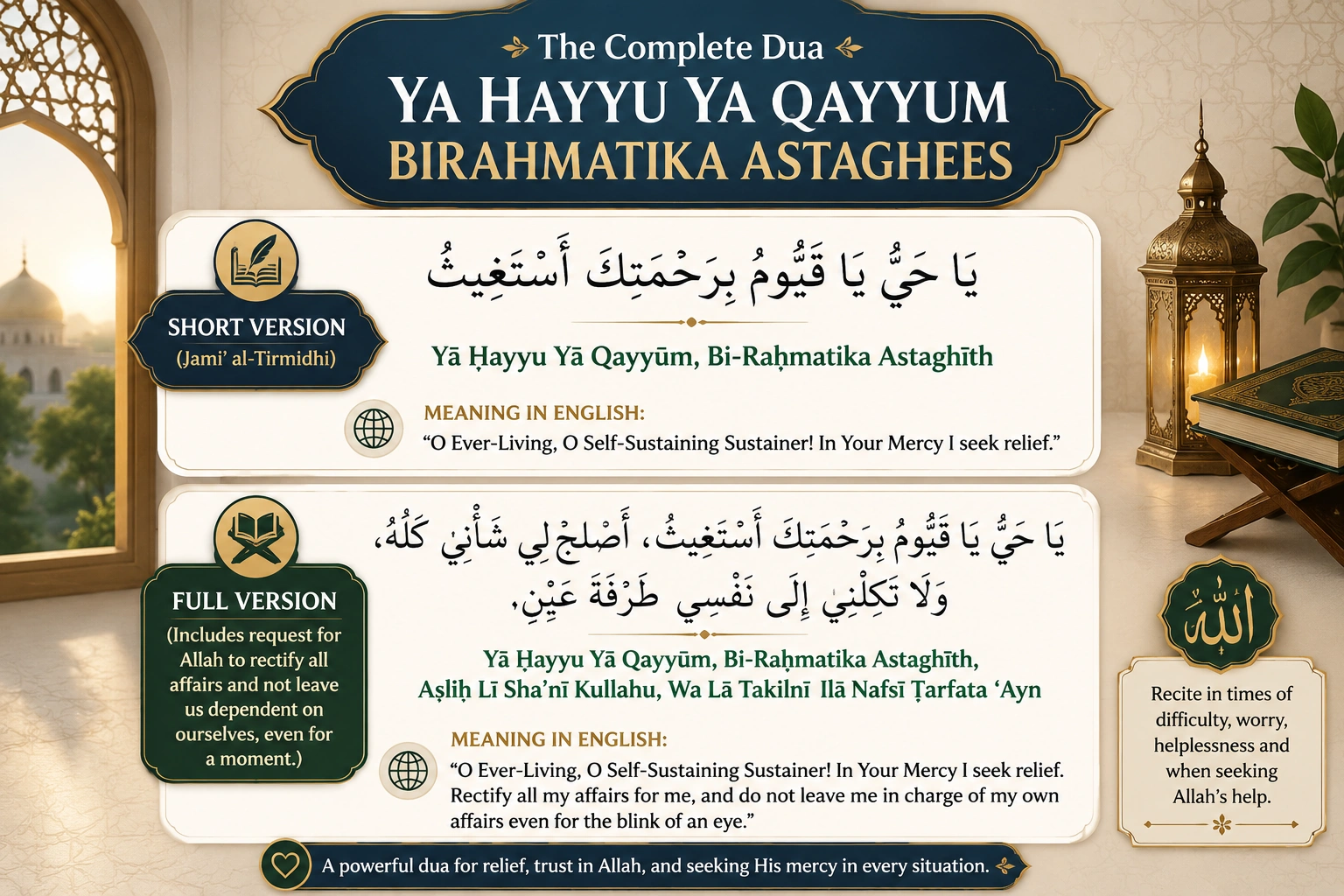
Short Version (Jami’ al-Tirmidhi)
يَا حَيُّ يَا قَيُّومُ بِرَحْمَتِكَ أَسْتَغِيثُ
Transliteration: Yā Ḥayyu Yā Qayyūm, Bi-Raḥmatika Astaghīth
Meaning in English: “O Ever-Living, O Self-Sustaining Sustainer! In Your Mercy I seek relief.”
Full Ya Hayyu Ya Qayyum Birahmatika Astaghees Dua
The longer version adds a request for Allah to rectify all of the believer’s affairs and not leave them dependent upon themselves, even for a moment.:
يَا حَيُّ يَا قَيُّومُ بِرَحْمَتِكَ أَسْتَغِيثُ، أَصْلِحْ لِي شَأْنِي كُلَّهُ، وَلَا تَكِلْنِي إِلَى نَفْسِي طَرْفَةَ عَيْنٍ
Transliteration: Yā Ḥayyu Yā Qayyūm, Bi-Raḥmatika Astaghīth, Aṣliḥ Lī Sha’nī Kullahu, Wa Lā Takilnī Ilā Nafsī Ṭarfata ‘Ayn
Meaning in English: “O Ever-Living, O Self-Sustaining Sustainer! In Your Mercy I seek relief. Rectify all my affairs for me, and do not leave me in charge of my own affairs even for the blink of an eye.”
Ya Hayyu Ya Qayyum Birahmatika Astaghees Meaning: Word by Word
Understanding every word transforms this from a memorized phrase into a living, conscious plea.
يَا حَيُّ — Yā Ḥayyu (O Ever-Living)
Al-Hayyu (الحَيُّ) is one of Allah’s most exalted names. It means He alone possesses life that has no beginning, no end, and no dependence on anything outside Himself. Every living creature — human beings, angels, animals — has life only because Allah granted it and sustains it at every moment. Only Al-Hayyu has life by His own essence.
Ibn al-Qayyim wrote in Madarij al-Salikin that Al-Hayyu is the foundation from which every other divine attribute flows. His knowledge, His power, His will, His mercy — all are expressions of His being Al-Hayyu.
This name appears in Ayat al-Kursi (Quran 2:255): “Allāhu lā ilāha illā huwa Al-Ḥayyu Al-Qayyūm” — affirming its centrality in Islamic theology.
يَا قَيُّومُ — Yā Qayyūm (O Self-Sustaining Sustainer)
Al-Qayyum (القَيُّومُ) means the One who stands entirely by Himself and through whom everything else exists and is sustained at every single moment. Everything in existence depends on Al-Qayyum — not partially, not occasionally — completely and continuously. Were Allah’s sustaining to be withdrawn for even an instant, the entire universe would cease to exist.
بِرَحْمَتِكَ — Bi-Raḥmatika (By Your Mercy)
This is the foundation of the entire plea. The believer is not presenting their good deeds, not bargaining with past worship, not claiming a right. They are appealing to nothing except Allah’s own mercy. This reflects the highest degree of humility in Islamic supplication — acknowledging that even the most devoted servant’s hope lies in Allah’s mercy, not in their own merit.
أَسْتَغِيثُ — Astaghīth (I Seek Relief / I Cry Out for Help)
The word astaghīth comes from istighātha — to cry out for rescue in a moment of overwhelming need. It is not a polite request. It is an urgent, sincere plea directed to the only One who can truly rescue.
أَصْلِحْ لِي شَأْنِي كُلَّهُ — Aṣliḥ Lī Sha’nī Kullahu (Rectify All My Affairs for Me)
A total, comprehensive request — covering religious life, worldly matters, relationships, health, finances, and everything in between. The word kullahu (all of it) ensures nothing is left outside the supplication.
وَلَا تَكِلْنِي إِلَى نَفْسِي طَرْفَةَ عَيْنٍ — Wa Lā Takilnī Ilā Nafsī Ṭarfata ‘Ayn
“And do not leave me in charge of my own affairs even for the blink of an eye.”
This is perhaps the most profound acknowledgment in the entire dua. The believer recognizes that their own judgment and ego — without Allah’s guidance — cannot be trusted even for the shortest imaginable moment. It is total reliance on Allah, expressed with extraordinary precision.
Ya Hayyu Ya Qayyum Birahmatika Astaghees Meaning in Urdu
مختصر ورژن: “اے ہمیشہ زندہ رہنے والے، اے ہر چیز کو قائم رکھنے والے، میں تیری رحمت کے وسیلے سے فریاد کرتا ہوں۔”
مکمل ورژن: “اے ہمیشہ زندہ رہنے والے، اے ہر چیز کو قائم رکھنے والے، میں تیری رحمت کے وسیلے سے فریاد کرتا ہوں۔ میرے تمام معاملات درست فرما دے، اور مجھے ایک پل کے لیے بھی اپنے نفس کے حوالے نہ فرما۔”
یہ دعا حضرت انس بن مالک رضی اللہ عنہ سے مروی ہے اور جامع ترمذی (حدیث نمبر 3524) میں موجود ہے۔ مکمل ورژن سنن الکبریٰ للنسائی اور مستدرک حاکم میں محفوظ ہے۔
Ya Hayyu Ya Qayyum Birahmatika Astaghees Meaning in Hindi
संक्षिप्त संस्करण: “हे सदा जीवित रहने वाले, हे सबको क़ायम रखने वाले, मैं तेरी रहमत के ज़रिए फ़र्याद करता हूँ।”
पूर्ण संस्करण: “हे सदा जीवित रहने वाले, हे सबको क़ायम रखने वाले, मैं तेरी रहमत के ज़रिए फ़र्याद करता हूँ। मेरे सभी मामलों को दुरुस्त फ़रमा दे, और मुझे एक पल के लिए भी अपने नफ़्स के हवाले न कर।”
यह दुआ हज़रत अनस बिन मालिक (रज़ि.) की रिवायत से जामि’ तिर्मिज़ी (No. 3524), सुनन अल-कुबरा (नसाई), और मुस्तदरक हाकिम में वर्णित है।
Who Narrated Ya Hayyu Ya Qayyum Birahmatika Astaghees?
Primary narrator: Sayyiduna Anas ibn Malik (RA) — the personal servant of the Prophet ﷺ for ten years and one of the most prolific narrators of hadith. The Prophet ﷺ mentioned this supplication to Sayyidah Fatimah (RA) and instructed her to recite it morning and evening. Sayyiduna Abdullah ibn Mas’ud (RA) also narrated a version, recorded in Mustadrak al-Hakim (1/509) and Shu’ab al-Iman of al-Bayhaqi (No. 10231), that the Prophet ﷺ would recite it whenever any worry or concern befell him.
Ya Hayyu Ya Qayyum and Ism al-A’zam
The names Al-Hayyu and Al-Qayyum hold an important place in Islamic theology and appear together in several Quranic passages, including Ayat al-Kursi (Quran 2:255). Classical scholars have also discussed the significance of these names in connection with Ism al-A’zam, the Greatest Name of Allah.
Benefits of Ya Hayyu Ya Qayyum Birahmatika Astaghees
The value of this dua is best explained through its meaning, reported prophetic context, and the themes of Allah’s mercy, reliance, and seeking help from Him. Avoid attributing specific worldly outcomes to the dua unless they are supported by a reliable source.
1. Seeking Allah’s Help During Distress
The dua expresses a direct plea for relief through Allah’s mercy.
2. Calling Upon Allah as Al-Hayyu and Al-Qayyum
The supplication begins by invoking two significant divine names.
3. Expressing Reliance on Allah
The wording emphasizes dependence upon Allah rather than relying solely upon one’s own ability.
4. Asking Allah to Rectify All Affairs
The extended version contains the comprehensive request: “Aṣliḥ lī sha’nī kullahu”, meaning “Rectify all my affairs for me.”
5. Encouraging Consistent Supplication
The article can discuss persistence in dua while clearly distinguishing authenticated prophetic instructions from later personal practices.
6. A Meaningful Part of Daily Dhikr
Where the relevant narration supports morning or evening recitation, present the evidence and source clearly.
When to Recite Ya Hayyu Ya Qayyum Birahmatika Astaghees Dua
| Time | Basis |
|---|---|
| After Fajr (morning) | Direct prophetic instruction — narration to Fatimah (RA) |
| Before sleeping (evening) | Direct prophetic instruction — same narration |
| During any distress | Primary context of Tirmidhi No. 3524 |
| During sujud (prostration) | The servant is closest to Allah in sujud (Muslim, No. 482) |
| Last third of night (Tahajjud) | Hadith of divine descent — Bukhari, No. 1145 |
| After obligatory salah | Scholars’ recommendation based on general du’a acceptance times |
How to Make Ya Hayyu Ya Qayyum Birahmatika Astaghees Part of Your Daily Routine
Consistency turns a supplication from an emergency response into a living, ongoing relationship with Allah. The following are practical, hadith-grounded ways to build this into daily practice.
Learn the short version first.
Memorize the Arabic, transliteration, and meaning so you understand what you are saying rather than simply repeating unfamiliar words.
Learn the full version.
Once the short dua is familiar, learn the extended wording and its meaning.
Recite it during genuine moments of need.
The meaning of the dua makes it particularly relevant when seeking Allah’s help and mercy during difficulty.
Reflect on the meaning.
Consider the meanings of Al-Hayyu, Al-Qayyum, Allah’s mercy, and the request that all affairs be rectified.
Teach the meaning as well as the words.
If teaching the dua to children or family members, explain its meaning alongside its Arabic wording.
Read Also: Dua e Qunoot
Common Mistakes When Reciting This Dua
Reciting Without Understanding the Meaning
Knowing what the words mean can make the supplication more conscious and meaningful.
Treating the Dua as a Guaranteed Formula
Avoid promising a particular worldly result from reciting the dua.
Adding Unsupported Benefits
Do not attribute specific rewards, cures, financial outcomes, or guaranteed results unless supported by an authentic source.
Confusing Personal Practice With Sunnah
If discussing a practice such as repeating the dua a particular number of times, clearly distinguish personal devotional practice from an established prophetic instruction.
Mixing Different Hadith Reports
Keep the source and grading of each version clearly identified.
Conclusion
Ya Hayyu Ya Qayyum Birahmatika Astaghees is a concise supplication centered on seeking Allah’s mercy and help. Its words call upon Allah as Al-Hayyu, the Ever-Living, and Al-Qayyum, the One who sustains all things.
The extended version adds a comprehensive request for Allah to rectify one’s affairs and not leave one dependent upon oneself even for a moment.
Learn the Arabic, understand the meaning, and keep the dua as part of a sincere practice of turning to Allah in times of difficulty and need.
? FAQs About Ya Hayyu Ya Qayyum Birahmatika Astaghees Dua
Q1: What is the meaning of Ya Hayyu Ya Qayyum Birahmatika Astaghees?
Ya Hayyu Ya Qayyum Birahmatika Astaghees means, “O Ever-Living, O Self-Sustaining Sustainer! In Your mercy I seek relief.” The longer version also asks Allah to rectify all affairs and not leave the person to themselves even for the blink of an eye.
Q2: What is the Arabic of Ya Hayyu Ya Qayyum Birahmatika Astaghees?
The short Arabic version is:
يَا حَيُّ يَا قَيُّومُ بِرَحْمَتِكَ أَسْتَغِيثُ
Q3: What is the full Ya Hayyu Ya Qayyum dua?
The longer version is:
يَا حَيُّ يَا قَيُّومُ بِرَحْمَتِكَ أَسْتَغِيثُ، أَصْلِحْ لِي شَأْنِي كُلَّهُ، وَلَا تَكِلْنِي إِلَى نَفْسِي طَرْفَةَ عَيْنٍ
Q4: What is Ya Hayyu Ya Qayyum Birahmatika Astaghees in Urdu?
“اے ہمیشہ زندہ رہنے والے، اے سب کو قائم رکھنے والے، میں تیری رحمت کے ذریعے فریاد کرتا ہوں۔”
Q5: Is Ya Hayyu Ya Qayyum Birahmatika Astaghees from the Quran or Hadith?
The supplication is discussed in hadith sources, including Jami’ al-Tirmidhi, No. 3524, as cited on this page. The names Al-Hayyu and Al-Qayyum also appear in the Quran, including Quran 2:255.
Q6: How many times should I recite Ya Hayyu Ya Qayyum Birahmatika Astaghees?
Do not state a fixed number unless a reliable source establishes one specifically for this dua. The page should distinguish authenticated instructions from personal devotional practices.
Q7: When can I recite Ya Hayyu Ya Qayyum Birahmatika Astaghees?
The dua may be discussed in connection with seeking Allah’s help during distress. If you include morning, evening, sujood, or other times, identify the evidence for each practice separately rather than presenting every time as a specific prescribed time for this dua.
Q8: Can I read Ya Hayyu Ya Qayyum Birahmatika Astaghees in English?
You can learn and understand its meaning in English, but when referring to reciting the Arabic supplication, use the Arabic wording and a reliable transliteration to help with pronunciation.
Written by: Ahmad Raza
Credentials: Islamic Studies Content Writer
 Read More duas for daily life at The Dua For You