
Abu Darda, may Allah be pleased with him, was a close companion of the Prophet Muhammad, peace be upon him. He was known among the Sahabah for his deep knowledge of the Quran, his calm nature, and his complete trust in Allah during difficult moments.
He was respected as a leading scholar of the Quran and was later given the title Hakim ul Ummah, meaning the wise one of the community, because of his deep knowledge of faith and daily life.
Among the supplications linked to him, Dua Abu Darda holds a special place in daily remembrance. This dua expresses full reliance on Allah and confidence that nothing happens without His will.
Below is the Arabic text of this dua, along with its transliteration, Urdu and Hindi meaning, and the situations when it can be recited.
Dua of Abu Darda in Arabic
Many readers look for Dua Of Abu Darda In Arabic before checking the translation, so it is shared here first in its original wording.
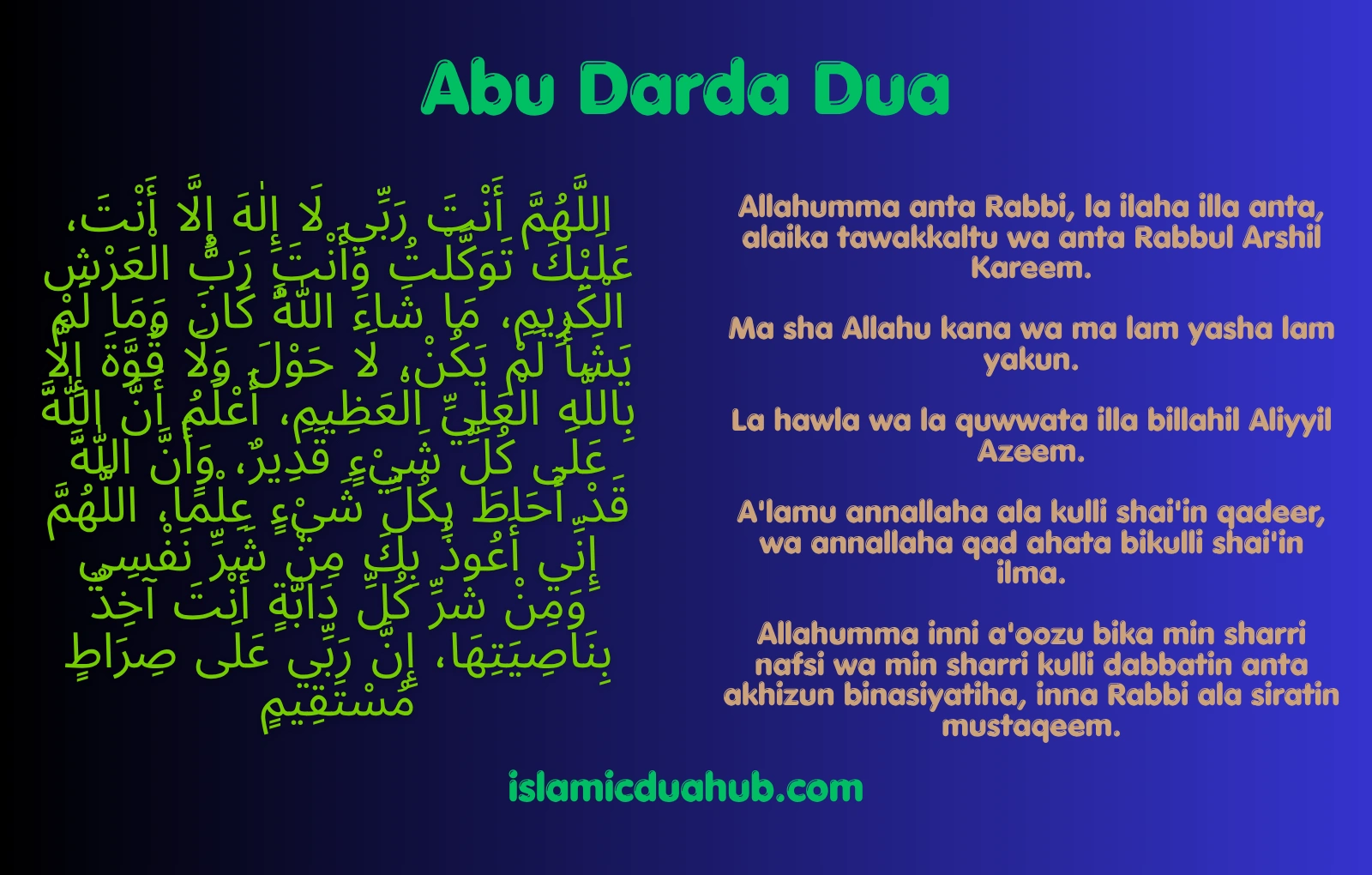
اللَّهُمَّ أَنْتَ رَبِّي لَا إِلٰهَ إِلَّا أَنْتَ، عَلَيْكَ تَوَكَّلْتُ وَأَنْتَ رَبُّ الْعَرْشِ الْكَرِيمِ، مَا شَاءَ اللَّهُ كَانَ وَمَا لَمْ يَشَأْ لَمْ يَكُنْ، لَا حَوْلَ وَلَا قُوَّةَ إِلَّا بِاللَّهِ الْعَلِيِّ الْعَظِيمِ، أَعْلَمُ أَنَّ اللَّهَ عَلَى كُلِّ شَيْءٍ قَدِيرٌ، وَأَنَّ اللَّهَ قَدْ أَحَاطَ بِكُلِّ شَيْءٍ عِلْمًا، اللَّهُمَّ إِنِّي أَعُوذُ بِكَ مِنْ شَرِّ نَفْسِي وَمِنْ شَرِّ كُلِّ دَابَّةٍ أَنْتَ آخِذٌ بِنَاصِيَتِهَا، إِنَّ رَبِّي عَلَى صِرَاطٍ مُسْتَقِيمٍ
Abu Darda Dua Transliteration (Roman)
Allahumma anta Rabbi, la ilaha illa anta, alaika tawakkaltu wa anta Rabbul Arshil Kareem.
Ma sha Allahu kana wa ma lam yasha lam yakun.
La hawla wa la quwwata illa billahil Aliyyil Azeem.
A’lamu annallaha ala kulli shai’in qadeer, wa annallaha qad ahata bikulli shai’in ilma.
Allahumma inni a’oozu bika min sharri nafsi wa min sharri kulli dabbatin anta akhizun binasiyatiha, inna Rabbi ala siratin mustaqeem.
Dua E Abu Darda Hindi Transliteration
अल्लाहुम्म अंत रब्बी, ला इलाहा इल्ला अंत, अलैक तवक्कलतु व अंत रब्बुल अर्शिल करीम।
मा शा अल्लाहु काना व मा लम यशा लम यकुन।
ला हौला वला कुव्वत इल्ला बिल्लाहिल अलिय्यिल अज़ीम।
अअ़लमु अन्नल्लाहा अला कुल्ली शैइन क़दीर, व अन्नल्लाहा क़द अहाता बिकुल्ली शैइन इल्मा।
अल्लाहुम्म इन्नी अऊज़ु बिक मिन शर्रि नफ़्सी व मिन शर्रि कुल्ली दाब्बतिन अंत आख़िज़ुन बिनासियतिहा, इन्न रब्बी अला सिरातिम मुस्तक़ीम।
Dua Abu Darda Meaning in English
O Allah, You are my Lord. There is no god but You. I have placed my trust in You, and You are the Lord of the Glorious Throne.
Whatever Allah wills happens, and whatever He does not will does not happen. There is no power and no strength except through Allah, the High, the Great.
I know that Allah has power over all things, and that Allah has full knowledge of everything.
O Allah, I seek refuge in You from the evil of my own self, and from the evil of every creature whose forelock You hold. My Lord is on a straight path.
Dua Abu Darda Urdu Translation
Readers who do not read Arabic often look for Dua Abu Darda Urdu Translation first, so the meaning is shared below in simple Urdu wording.
اے اللہ، تو میرا رب ہے، تیرے سوا کوئی معبود نہیں۔ میں نے تجھ پر بھروسہ کیا اور تو عرشِ کریم کا رب ہے۔
جو اللہ نے چاہا وہی ہوا اور جو اس نے نہ چاہا وہ نہیں ہوا۔ کوئی طاقت اور قوت نہیں سوائے اللہ بزرگ و برتر کی مدد کے۔
میں جانتا ہوں کہ اللہ ہر چیز پر قدرت رکھتا ہے اور اس نے ہر چیز کا علم اپنے گھیرے میں رکھا ہے۔
اے اللہ، میں اپنے نفس کے شر سے اور ہر اس مخلوق کے شر سے تیری پناہ مانگتا ہوں جس کی پیشانی تیرے ہاتھ میں ہے۔ بے شک میرا رب سیدھے راستے پر ہے۔
Hindi Meaning
ऐ अल्लाह, तू ही मेरा रब है, तेरे सिवा कोई इलाह नहीं। मैंने तुझ ही पर भरोसा किया, और तू ही महान अर्श का रब है।
जो अल्लाह ने चाहा वही हुआ, और जो उसने नहीं चाहा वह नहीं हुआ। कोई ताक़त और ज़ोर नहीं सिवाय अल्लाह बुज़ुर्ग और महान की मदद के।
मुझे यक़ीन है कि अल्लाह हर चीज़ पर क़ुदरत रखता है, और उसने हर चीज़ का इल्म घेर रखा है।
ऐ अल्लाह, मैं अपनी जान की बुराई से और हर उस मख़लूक़ की बुराई से तेरी पनाह माँगता हूँ जिसकी पेशानी तेरे हाथ में है। बेशक मेरा रब सीधे रास्ते पर है।
Hadith Source: This dua is recorded by Imam Tabarani and Imam Ibn al-Sunni in Amal al-Yawm wal Laylah.
Abu Darda Dua: The Story Behind It
A narration recorded in the books of Imam Tabarani and Ibn al-Sunni describes a morning when Abu Darda recited these words. Later that day, a man came running to tell him his house was on fire.
Abu Darda calmly replied that his house had not burned, since he had placed his trust in Allah through this supplication that morning. A second man came with the same news, and he gave the same calm answer. By the time a third man arrived, the fire had already been put out before reaching his home.
Scholars such as Al-Albani pointed out that the chain of narrators for this specific story is weak, because of one narrator within it. At the same time, the wording of the dua itself agrees with the Quran and other reliable hadith.
Part of its meaning reflects Surah Hud, where it is mentioned that every living being is held by its forelock under Allah’s control, and that the believer’s path leads straight to Him. Because of this, scholars say the words can still be recited for the virtue of remembrance, even though the specific story behind them carries a weak chain.
This approach is common in Islamic scholarship. A narration about an event may not reach the level needed for legal rulings, yet the wording of a supplication built on Quranic meaning remains fit for daily use. People searching for Dua Abu Darda Benefits or Dua E Abu Darda are usually looking for this balance between the story and the actual words of remembrance.
When to Read This Dua
This dua fits naturally into the morning and evening remembrance routine, since it is centered on protection and trust.
It can be recited:
- After Fajr prayer, at the start of the day
- In the evening, before sunset
- Before leaving home for work, travel or any task
- During moments of fear, worry or uncertainty
- When starting a new task that feels heavy or uncertain
- Before sleeping, as a way to end the day with reliance on Allah
Dua Abu Darda Benefits
The benefits of this dua come directly from the meaning carried in its words. Reciting it with sincerity offers the following spiritual benefits.
Protection from sudden harm
The dua places full trust in Allah against unexpected danger, loss or accidents.
Strengthens reliance on Allah
Repeating the phrase “I have placed my trust in You” builds a habit of depending on Allah in every situation, big or small.
Calms unnecessary fear
The line about Allah holding every creature by its forelock reminds the heart that nothing moves without His permission.
Renews commitment to the right path
Ending with “my Lord is on a straight path” refreshes the intention to remain firm on a righteous way of life.
Builds patience during hardship
Knowing that whatever Allah wills will happen, and what He does not will cannot happen, helps a person accept difficult outcomes with patience instead of panic.
These benefits depend on sincere belief and regular practice, not on the words being repeated alone.
Abu Darda Name Meaning In Urdu
Those who search for Abu Darda Name Meaning In Urdu are usually curious about the background of this title rather than the dua itself.
Abu Darda was the kunya, or family title, of a companion whose given name was Uwaymir ibn Zayd. Among the Arabs, a kunya was commonly used in place of a person’s actual name as a mark of respect.
In Urdu, ابو دردا (Abu Darda) is generally explained as the title of this respected companion of the Prophet, peace be upon him, a scholar of the Quran who later served as the first judge of Damascus.
He accepted Islam after the Battle of Badr and was known for spending his nights in prayer while serving the early Muslim community by day. His title remains attached to his name across Islamic history, books of hadith and biographies of the Sahabah.
Before Islam, Abu Darda worked as a trader selling perfume in Madinah. After accepting faith, he tried to combine business with worship, but balancing both proved difficult, so he gave up trade and devoted his time fully to the Quran and serving the religion.
The Prophet, peace be upon him, made a bond of brotherhood between Abu Darda and Salman al-Farisi. When Salman visited his home, his wife was wearing simple clothing, and she explained that Abu Darda had little interest in worldly comforts. This story is often shared to show his level of devotion and simple living.
Abu Darda is remembered for saying that knowledge is the true legacy left behind by the Prophets, more valuable than gold or silver. This statement reflects why he spent his life teaching the Quran and helping others stay firm in faith, and why his name is still mentioned with respect today.
Conclusion
Dua Abu Darda carries a message of complete trust in Allah during moments of fear and uncertainty. Even though the specific incident connected to it carries a weak chain of narration, the wording of the dua matches the teachings of the Quran and other reliable sources.
Reciting Abu Darda Dua in the morning and evening can bring a sense of calm, protection and renewed reliance on Allah. With sincere intention, this dua serves as a steady reminder that every matter rests in Allah’s hands alone, and that a believer’s heart settles only through trust in Him.
 See More Reliable Islamic Duas:
- So Kar Uthne Ki Dua
- Sir Dard Ki Dua In Quran
- Naya Chand Dekhne Ki Dua
- Hadsat Se Bachne Ki Dua
- Hazrat Yunus Dua
- Musibat Ki Dua in Hindi
- Dua Between Two Sujood
- Labbaik Allahumma Labbaik Dua
- Ya Muqallibal Qulub Dua
- Ghabrahat Ki Dua
- Khatmul Quran Dua
- Zalzala Ki Dua
- Imtihan Mein Kamyabi Ki Dua
- Sawari Ki Dua
? FAQs
Is Dua Abu Darda recorded in Sahih Bukhari or Sahih Muslim?
No, this dua is recorded by Imam Tabarani and Ibn al-Sunni, not in Sahih Bukhari or Sahih Muslim.
Is it permissible to recite this dua daily?
Yes, since its wording matches the Quran and other reliable hadith, it can be recited daily as a general dua of protection.
What does this dua protect from?
It is recited for protection from sudden trouble, fear, loss and harm, based on full trust in Allah.
Who was Abu Darda?
Abu Darda was a companion of the Prophet, peace be upon him, known as a scholar of the Quran and the first judge of Damascus.
Should Abu Darda Dua be read in Arabic or in Urdu and Hindi?
The supplication itself should be recited in Arabic, while the Urdu or Hindi meaning helps in following its message.
Can this dua be recited after any prayer?
Yes, it can be recited after Fajr or any other prayer, and it is not restricted to a fixed time of day.
Is there a specific number of times to repeat this dua?
No fixed count is mentioned in the narration, so it can be recited once or a few times based on personal preference.
Written by: Ahmad Raza
Credentials: Islamic Studies Content Writer
Read More duas for daily life at Instant Dua