Many Muslims say a short phrase whenever they face hardship, weakness or fear. This phrase is “La hawla wala quwwata illa billah”, often written online as Lahaula Walakuata Illabillah. People search for the Lahaula Walakuata Illabillah meaning because they hear it from elders, imams or in daily conversations and want to know its real sense.
This dua is one of the shortest yet most powerful sentences in Islam. The Prophet Muhammad ﷺ called it a treasure from Paradise. It carries deep meaning about trust in Allah and submission to His will, and it is repeated by Muslims of every background and language.
Below is the Lahaula Walakuata Illabillah meaning in Arabic, English, Urdu, Hindi, Tamil, Malayalam and Bangla along with its transliteration, explanation, benefits and the right time to recite it.
Lahaula Walakuata Illabillah In Arabic
Arabic text:
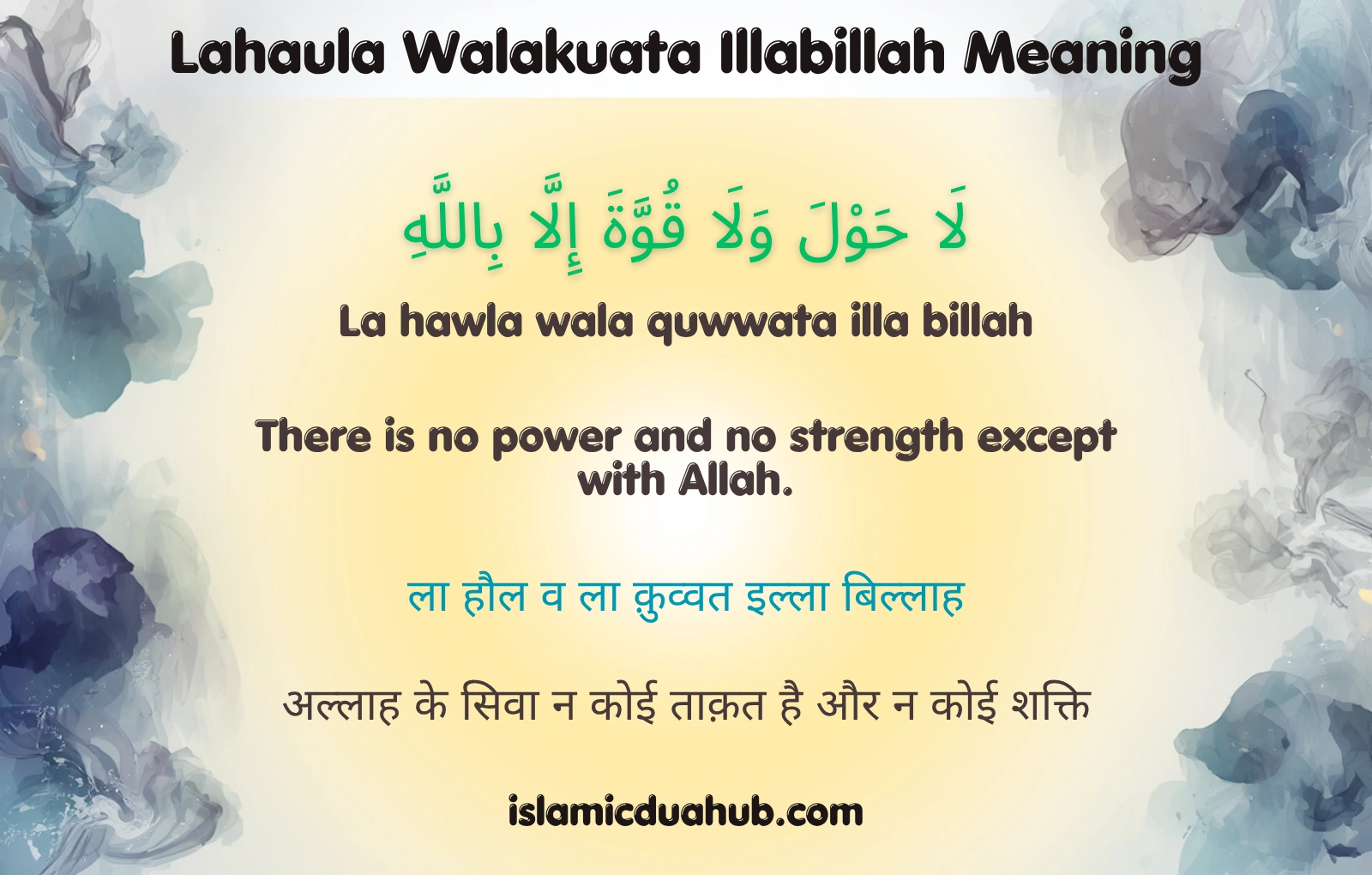
لَا حَوْلَ وَلَا قُوَّةَ إِلَّا بِاللَّهِ
This is the original Arabic form of the dua. It is short, easy to remember and used by Muslims around the world during moments of difficulty. Reciting it in Arabic keeps the wording exactly as the Prophet ﷺ taught it to his companions.
Lahaula Walakuata Illabillah Transliteration
Roman: La hawla wala quwwata illa billah
Hindi transliteration: ला हौल व ला क़ुव्वत इल्ला बिल्लाह
Many people spell this phrase differently online, such as Lahaula Walakuata Illabillah or Lahawla Wala Quwwata Illabillah, but the pronunciation stays close to the original Arabic words. The small spelling differences come from converting Arabic sounds into Roman letters, and they do not change the actual dua.
Other Common Spellings of This Dua
Because Arabic letters do not always match Roman letters one to one, this dua appears under several spellings across websites and social media. Some of the common forms include La hawla wala quwwata illa billah, Lahawla Walaquwwata Illabillah, and Lahaula Walakuata Illabillah. All of these point to the exact same Arabic sentence and carry the exact same meaning, so a reader should not feel confused when seeing a slightly different spelling in another source.
Lahaula Walakuata Illabillah Meaning In English
The Lahaula Walakuata Illabillah meaning in English is:
“There is no power and no strength except with Allah.”
This sentence reminds a believer that real power, control and ability belong only to Allah. A person cannot move, act or succeed without His help. Saying this phrase in English helps a new Muslim or a non Arabic speaker grasp the heart of the dua before reciting it in Arabic, and it also makes the dua easier to explain to children or to someone outside the faith who asks about it.
Lahaula Walakuata Illabillah Meaning In Urdu
نہ کوئی طاقت ہے اور نہ کوئی قوت مگر اللہ کی مدد سے
The Lahaula Walakuata Illabillah meaning in Urdu tells us, in simple words, that no person has any real strength or power on their own. Every ability a person has comes from Allah. Urdu speaking Muslims often use this phrase during personal struggles, family problems or financial worry, since it brings the heart back to reliance on Allah.
Lahaula Walakuata Illabillah Meaning In Hindi
अल्लाह के सिवा न कोई ताक़त है और न कोई शक्ति
The Lahaula Walakuata Illabillah meaning in Hindi carries the same message. A believer accepts that strength, decisions and outcomes rest in the hands of Allah alone. Many Hindi speaking Muslims are taught this phrase by their parents as children, often without knowing its full hadith background until later in life.
Lahaula Walakuata Illabillah Meaning In Arabic
In its own language, the Lahaula Walakuata Illabillah meaning in Arabic is built from four words. “La hawla” means there is no power or ability to move from one state to another. “Wala quwwata” means and no strength to act. “Illa billah” means except through Allah. Together, the sentence confirms that all movement, ability and strength exist only because Allah allows them.
Lahaula Walakuata Illabillah Meaning In Tamil
அல்லாஹ்வைத் தவிர வேறு வலிமையும் இல்லை, சக்தியும் இல்லை
The Lahaula Walakuata Illabillah meaning in Tamil shows there is no strength and no power except through Allah. Tamil speaking Muslims use this phrase the same way as other Muslims worldwide, during hardship, illness or sudden stress, and many recite it quietly under their breath as a form of dhikr.
Lahaula Walakuata Illabillah Meaning In Malayalam
അല്ലാഹുവല്ലാതെ ശക്തിയോ കഴിവോ ഇല്ല
The Lahaula Walakuata Illabillah meaning in Malayalam shows the same belief, that ability and power exist only because of Allah’s permission. It is commonly taught in madrasas across Kerala alongside other short dhikr phrases recited after daily prayers.
Lahaula Walakuata Illabillah Meaning Bangla
আল্লাহ ব্যতীত কোনো শক্তি নেই এবং কোনো ক্ষমতা নেই
The Lahaula Walakuata Illabillah meaning Bangla version matches the Arabic sense closely, that no strength or power exists separately from Allah’s will. Bangla speaking households often pass this phrase down through generations as one of the first dhikr a child memorizes, usually alongside short Quranic verses.
Explanation of Lahaula Walakuata Illabillah
This phrase is also called Hawqalah by scholars. The Prophet Muhammad ﷺ taught it to his companion Abu Musa al Ashari, whose actual name was Abdullah bin Qais. The Prophet ﷺ asked him, “Shall I not tell you of a phrase from the treasures of Paradise?” and then taught him to say Lahaula Walakuata Illabillah. This narration is recorded in Sahih al Bukhari, Hadith 6384, and Sahih Muslim, Hadith 2704.
The Quran also carries a similar idea in Surah Al Kahf, verse 39. A believing companion advised a proud man, who had a beautiful garden, to say “Maa shaa Allah, la quwwata illa billah” instead of boasting about his wealth. The exact wording of Lahaula Walakuata Illabillah does not appear word for word in the Quran, but the same belief in Allah’s sole power runs through that verse.
Saying this dua is a way of admitting human weakness. A person cannot avoid harm, gain benefit or change their situation without Allah’s permission. The phrase combines belief in Tawheed, which is the oneness of Allah, with humility before Him. Scholars also mention that this sentence is a remedy for sorrow and worry, since grief often comes from feeling powerless over a situation.
This dua is not only for hard times. It also reminds a believer to stay grateful and humble during ease, since every blessing and every bit of strength also comes from Allah’s mercy and not from personal effort alone.
This phrase also strengthens tawakkul, which means placing complete trust in Allah after doing one’s best effort. A believer is still expected to work, plan and try, but the heart should know that the final result depends on Allah and not on personal skill alone. Repeating this phrase keeps that balance between effort and trust clear in daily life.
When To Read This Dua
A believer can recite Lahaula Walakuata Illabillah at many moments, such as:
- When facing a difficult task or hard decision. Saying it before starting something hard calms the heart and shifts reliance toward Allah.
- When feeling weak, anxious or helpless. It works as a quiet reminder that the situation is in Allah’s control.
- After hearing bad news. It helps a person respond with patience instead of panic.
- When leaving the house. Many Muslims pair it with other dua for safety on the way out.
- After completing prayer. It is often said along with other short dhikr after Salah.
- Before sleeping. It closes the day with trust in Allah’s protection.
- When witnessing something impressive or seeing someone boasting about wealth. This matches the lesson from Surah Al Kahf, where pride is replaced with humility.
There is no fixed number of times to repeat it, but scholars suggest saying it often, especially during sadness, fear or sudden difficulty.
Benefits of Lahaula Walakuata Illabillah Dua
- A treasure of Paradise. The Prophet ﷺ described this phrase directly with this title in an authentic hadith, showing its high reward.
- Comfort during sadness and fear. Scholars note that repeating it eases worry, since it reminds the heart that outcomes are not in human hands alone.
- Stronger belief in Allah’s power. Regular recitation builds a habit of connecting every event, good or bad, back to Allah’s decree.
- A check against pride. It keeps a person humble instead of feeling proud over personal strength, wealth or achievement.
- A simple daily habit of dhikr. Because the phrase is short, it is easy to repeat throughout the day during work, travel or rest.
These benefits come from the hadith literature and the general teachings on dhikr in Islam, not from personal opinion or assumption.
Conclusion
The Lahaula Walakuata Illabillah meaning carries a short but powerful message for every Muslim. It teaches that true strength and power rest only with Allah. Reciting this phrase during hardship, fear or even daily routine builds humility and trust in Him.
Whether read “la hawla wala quwwata illa billah” in Arabic, English, Urdu, Hindi, Tamil, Malayalam or Bangla, the heart of this dua remains the same. It reminds a believer to depend fully on Allah, accept His decree and stay grateful in every situation, just as the Prophet ﷺ taught it to his companions over fourteen centuries ago.
 See More Reliable Islamic Duas:
- Hadsat Se Bachne Ki Dua
- Hazrat Yunus Dua
- Musibat Ki Dua in Hindi
- Dua Between Two Sujood
- Labbaik Allahumma Labbaik Dua
- Ya Muqallibal Qulub Dua
- Ghabrahat Ki Dua
- Khatmul Quran Dua
- Zalzala Ki Dua
- Imtihan Mein Kamyabi Ki Dua
- Sawari Ki Dua
- Dua Abu Darda
? FAQs
What does Lahaula Walakuata Illabillah mean?
It means there is no power and no strength except with Allah.
Is this dua mentioned in the Quran?
The exact wording is not in the Quran, though a close idea appears in Surah Al Kahf, verse 39.
Which hadith mentions this phrase?
It is mentioned in Sahih al Bukhari and Sahih Muslim, where the Prophet ﷺ called it a treasure of Paradise.
When should a Muslim say this dua?
It can be said during hardship, fear, sadness or any moment of weakness, and also in daily routines like leaving home or after prayer.
Can this dua be recited in any language?
The dua itself should be recited in Arabic, though its meaning can be understood in any language such as English, Urdu, Hindi, Tamil, Malayalam or Bangla.
Is Lahaula Walakuata Illabillah the same as Hawqalah?
Yes. Hawqalah is the scholarly name given to this exact phrase, taken from its first two Arabic words.
Does this dua need a special condition to be said?
No. It can be said at any time, in any place, without wudu, since it is a form of dhikr and not a formal prayer.
Written by: Ahmad Raza
Credentials: Islamic Studies Content Writer
Read More duas for daily life at Instant Dua