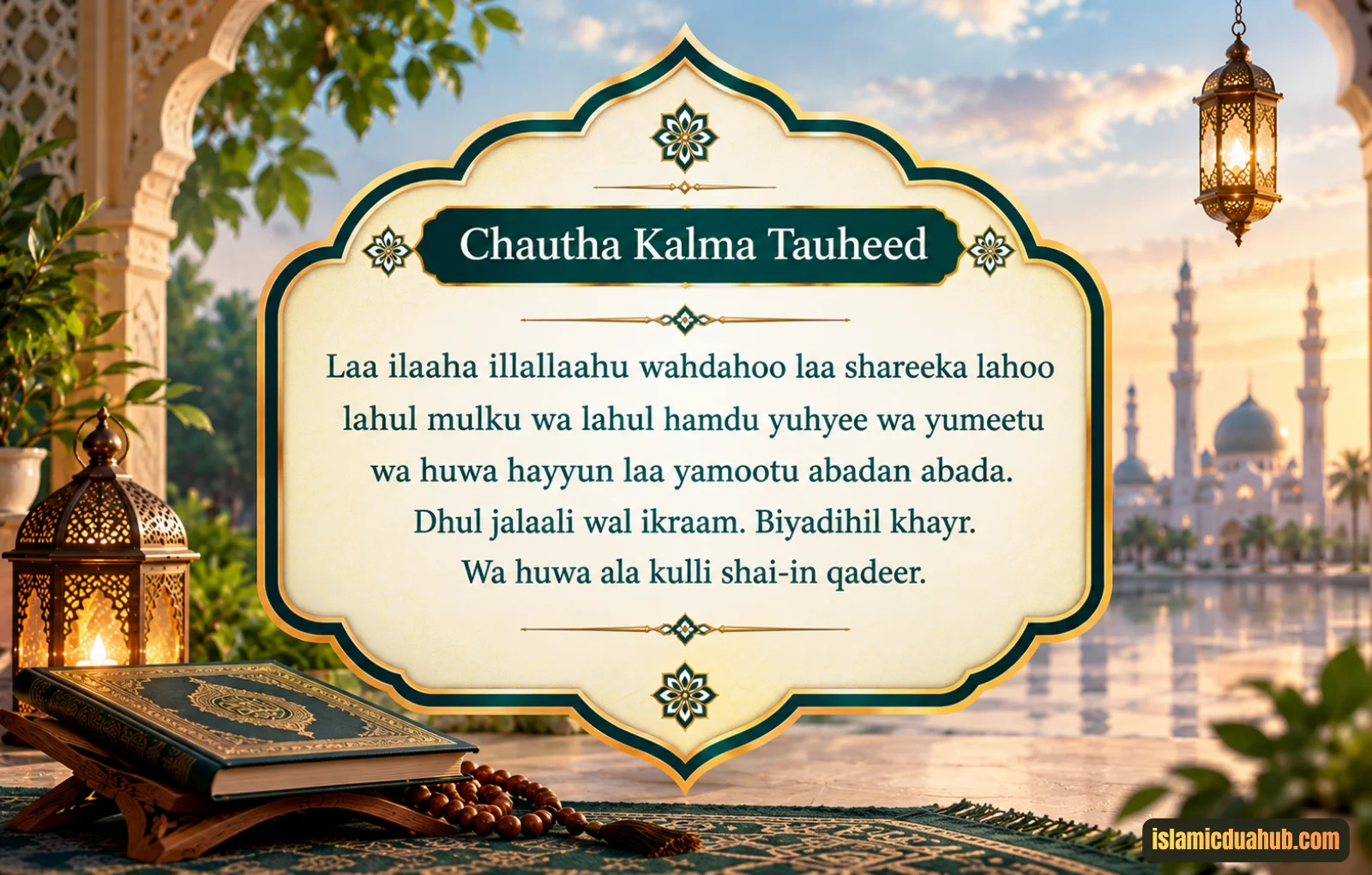
The Chautha Kalma Tauheed holds a very special place in Islamic belief. It is the Fourth Kalma among the six Islamic Kalimahs, and it carries one of the most powerful declarations of the Oneness of Allah.
The word “Tauheed” means the absolute Oneness of Allah. This Chautha Kalma Tauheed is a complete expression of that belief. It affirms that Allah is One, He has no partner, no equal, and no son. It also honors the station of Prophet Muhammad (peace be upon him) as His final messenger.
Muslims recite the 4 Kalma regularly in their daily lives, especially during morning and evening adhkar, after prayers, and as a form of remembrance (dhikr). It strengthens faith and keeps the heart connected to the core of Islamic belief.
Disclaimer: The content on this website is for informational purposes only. Always refer to qualified Islamic scholars for religious rulings and guidance.
Chautha Kalma in Arabic
Below is the complete Arabic text of the Fourth Kalma:
لَآ اِلٰهَ اِلَّا اللّٰهُ وَحْدَهٗ لَا شَرِيْكَ لَهٗ لَهُ الْمُلْكُ وَلَهُ الْحَمْدُ يُحْيِيْ وَيُمِيْتُ وَهُوَ حَيٌّ لَّا يَمُوْتُ اَبَدًا اَبَدًاؕ ذُو الْجَلَالِ وَالْاِكْرَامِؕ بِيَدِهِ الْخَيْرُؕ وَهُوَ عَلٰى كُلِّ شَيْءٍ قَدِيْرٌؕ
Chautha Kalma Tauheed Transliteration
Laa ilaaha illallaahu wahdahoo laa shareeka lahoo lahul mulku wa lahul hamdu yuhyee wa yumeetu wa huwa hayyun laa yamootu abadan abada. Dhul jalaali wal ikraam. Biyadihil khayr. Wa huwa ala kulli shai-in qadeer.
Chautha Kalma Meaning in English
There is no god but Allah. He is Alone and has no partner. His is the kingdom and for Him is all praise. He gives life and He causes death. He is living and will never die, ever, ever. He is the Lord of Majesty and Honour. In His hand is all goodness. And He has power over all things.
Chautha Kalma In Hindi
The Chautha Kalma in Hindi transliteration allows Hindi-speaking Muslims to recite it correctly:
ला इलाहा इल्लल्लाहु वहदहू ला शरीका लहू लहुल मुल्कु व लहुल हम्दु युह्यी व युमीतु व हुव हय्युन ला यमूतु अबदन अबदा। ज़ुल जलाली वल इक्राम। बियदिहिल खैर। व हुव अला कुल्लि शैइन कदीर।
Chautha Kalma Meaning in Hindi:
कोई माबूद नहीं सिवाय अल्लाह के। वह अकेला है, उसका कोई शरीक नहीं। उसी की बादशाहत है और उसी की तारीफ है। वह जिलाता है और वह मारता है। वह जिंदा है और कभी नहीं मरेगा। वह बड़ाई और इज्जत वाला है। भलाई उसी के हाथ में है। और वह हर चीज़ पर कादिर है।
Chautha Kalma With Tarjuma in Urdu
The Chautha Kalma with tarjuma in Urdu is widely taught across South Asian madrassas and Islamic schools:
کوئی معبود نہیں سوائے اللہ کے، وہ اکیلا ہے، اس کا کوئی شریک نہیں، اسی کی بادشاہت ہے اور اسی کی تعریف ہے، وہ زندگی دیتا ہے اور وہی موت دیتا ہے، وہ ہمیشہ زندہ ہے اور کبھی نہیں مرے گا۔ وہ بزرگی اور عزت والا ہے۔ بھلائی اسی کے ہاتھ میں ہے اور وہ ہر چیز پر قادر ہے۔
What Is the Chautha Kalma Tauheed?
The Chautha Kalma Tauheed is the Fourth Kalma in Islam. The word “Kalma” means “word” or “phrase,” and in Islamic tradition the six Kalimahs are core declarations of faith that every Muslim should know, recite, and hold in the heart.
The 4 Kalma is specifically called “Kalma Tauheed” because it focuses entirely on Tauheed, the belief in the absolute Oneness of Allah. It goes beyond simply stating that Allah exists. It describes His qualities in depth:
He has no partner. He holds all power. All praise returns to Him. He gives life and takes it away. He is eternal and never dies. He is the Lord of Majesty.
This Fourth Kalma brings together many of the most essential attributes of Allah in a single declaration.
The Meaning of Tauheed in Islam
Tauheed is the foundation of Islamic belief. It means that Allah is One, without any partner, rival, equal, or helper. It rules out every form of shirk (associating partners with Allah), which Islam considers the gravest sin.
Tauheed covers three main areas:
Tauheed Ar-Rububiyyah
Believing that Allah alone is the Lord and Creator of everything that exists.
Tauheed Al-Uluhiyyah
Believing that only Allah deserves worship. No person, object, or creation is worthy of being worshipped.
Tauheed Al-Asma Wa Sifat
Believing in the names and attributes of Allah exactly as they appear in the Quran and the verified Sunnah, without distortion or comparison.
The Chautha Kalma Tauheed addresses all three of these dimensions in one concise and powerful declaration.
When to Recite the 4 Kalma
The 4 Kalma can be recited at any time as a form of dhikr. However, certain times carry special spiritual value:
After Every Prayer (Salah)
Many Muslims include the Chautha Kalma Tauheed in their post-prayer adhkar. It reinforces the purpose of prayer, which is submission to Allah alone.
In the Morning and Evening
Morning and evening are highlighted in the Quran as prime times for the remembrance of Allah. The 4 Kalma fits naturally into these adhkar sessions.
During Illness or Hardship
When a person faces difficulty, reciting this Fourth Kalma strengthens the heart. It reminds the believer that all power belongs to Allah and He alone controls all affairs.
Before Sleeping
Many scholars recommend reciting the Chautha Kalma Tauheed before sleep to close the day with the remembrance of Allah’s Oneness.
How to Recite the Chautha Kalma Tauheed
Step 1: Maintain Cleanliness
While formal purity (wudu) is not required for dhikr, being in a state of cleanliness shows proper respect for the words of remembrance.
Step 2: Face the Qibla If Possible
Facing the direction of the Kaaba is preferable for dhikr when the situation allows, though it is not mandatory.
Step 3: Recite With the Heart and the Tongue Together
The Chautha Kalma Tauheed should not just be words on the tongue. Reflect on the meaning as you recite. Focus on the declaration that Allah is One, He has no partner, and all praise belongs to Him alone.
Step 4: Recite Slowly and Clearly
Do not rush. Reciting each phrase of the 4 Kalma slowly keeps the mind present and the heart engaged.
Step 5: Repeat as Many Times as You Wish
There is no fixed upper limit for general dhikr. The Chautha Kalma Tauheed may be repeated as many times as one wishes, earning reward with each recitation.
Benefits of Reciting Chautha Kalma Tauheed
Strengthens Iman
Every recitation of the Chautha Kalma Tauheed reconnects the heart to the most fundamental truth in Islam. This constant renewal keeps the believer firm in faith.
Earns Immense Reward
In a sound hadith recorded by Imam Muslim, the Prophet (peace be upon him) said that reciting “La ilaha illallahu wahdahu la sharika lahu lahul mulku wa lahul hamdu wa huwa ala kulli shai-in qadeer” one hundred times a day equals freeing ten slaves, earns one hundred good deeds, wipes away one hundred sins, and acts as a shield from Shaytan for that entire day. The Fourth Kalma is a fuller form of this very dhikr.
Cleanses Minor Sins
Regular and sincere remembrance of Allah is a means of erasing minor sins. The Chautha Kalma Tauheed, when recited with full focus and belief, carries this spiritual benefit.
Protection From Shaytan
The consistent remembrance of Allah’s Oneness acts as a spiritual shield. Shaytan struggles against a heart fully occupied with the declaration that Allah alone is worthy of all worship.
Brings Peace to the Heart
Allah says in Surah Ar-Ra’d (13:28) that hearts attain rest in the remembrance of Allah. The Chautha Kalma Tauheed is one of the most complete forms of that remembrance.
Defines a Muslim’s Identity
The Kalma Tauheed is a statement of complete belief. To say it with sincerity and conviction is to affirm full submission to the One God.
Chautha Kalma Tauheed and the Quran
Several Quranic verses reflect the phrases found within the Chautha Kalma Tauheed:
The phrase “Lahul mulku wa lahul hamd” (His is the kingdom and all praise is for Him) is reflected in Surah Al-Fatihah (1:2), where Allah says: “All praise is for Allah, the Lord of all worlds.”
The phrase “Yuhyee wa yumeetu” (He gives life and causes death) echoes Surah Al-Baqarah (2:258) and Surah Qaf (50:43), where Allah’s sole authority over life and death is established.
The phrase “Dhul jalaali wal ikraam” (Lord of Majesty and Honour) appears directly in Surah Ar-Rahman (55:27 and 55:78), one of the most revered chapters of the Quran.
These connections confirm that the Chautha Kalma Tauheed draws its content directly from Quranic teachings and forms a complete summary of core Islamic belief.
The Six Kalimahs in Islam
The Chautha Kalma is one of six important Kalimahs taught widely in South Asian Islamic education:
First Kalma (Tayyab): Declaration that there is no god but Allah and Muhammad is His messenger.
Second Kalma (Shahadat): A fuller form of the testimony of faith.
Third Kalma (Tamjeed): Glorifying the perfection of Allah.
Fourth Kalma (Tauheed): The Chautha Kalma Tauheed, declaring the Oneness and attributes of Allah in full.
Fifth Kalma (Astaghfar): Seeking forgiveness from Allah.
Sixth Kalma (Radde Kufr): Rejecting all forms of disbelief and polytheism.
Together they form a complete foundation for Islamic faith.
Teaching the Fourth Kalma to Children
The Chautha Kalma Tauheed is among the first things taught to Muslim children in homes and madrassas across South Asia. When children recite the 4 Kalma with proper meaning, they begin building a clear sense of Tauheed from a young age.
Parents and teachers are encouraged to go beyond simple memorization and explain the Chautha Kalma meaning in Hindi or Urdu so that children grasp what they are saying. A child who knows the Chautha Kalma in Arabic along with its tarjuma carries a lifelong treasure of correct Islamic belief.
When teaching children, cover the Arabic text with correct pronunciation, the Roman transliteration, the Chautha Kalma meaning in simple words, and the importance of believing in what the words declare.
🤲 Read These Other Islamic Supplications As Well:
Conclusion
The Chautha Kalma Tauheed is far more than a memorized phrase. It is a living declaration of the most important truth in Islam: that Allah is One, without any partner or equal.
Every phrase in the Fourth Kalma carries deep meaning. Together they present a complete picture of who Allah is: the Owner of all kingdoms, the Giver of life and death, the Eternal, the Majestic, the All-Powerful.
Reciting the Chautha Kalma Tauheed regularly, with full sincerity and attention to its meaning, is one of the most meaningful acts of worship a Muslim can perform outside of formal prayer. It strengthens faith, earns great reward, cleanses the heart, and keeps the believer in constant connection with Allah.
Make the 4 Kalma a part of your daily dhikr, share the Chautha Kalma with tarjuma with your children, and hold firm to the belief it declares.
La ilaha illallah. There is no god but Allah.
May Allah accept our remembrance and keep our hearts firm upon Tauheed. Ameen.
? Frequently Asked Questions
What is the Chautha Kalma Tauheed?
It is the Fourth Kalma in Islam, called Kalma Tauheed because it declares the absolute Oneness of Allah along with several of His key attributes.
What is the Chautha Kalma meaning in English?
It means there is no god but Allah, He is alone with no partner, His is the kingdom and all praise, He gives life and causes death, He is ever-living and never dies, He is the Lord of Majesty and Honour, all goodness is in His hand, and He has power over all things.
Is Chautha Kalma Tauheed from the Quran?
It is composed of phrases drawn directly from the Quran and verified hadith. Its core phrase closely matches a hadith recorded in Sahih Muslim.
When should the 4 Kalma be recited?
It can be recited at any time. It is especially recommended after prayers, during morning and evening adhkar, before sleeping, and in moments of difficulty.
What is the difference between the First Kalma and the Chautha Kalma?
The First Kalma (Tayyab) is the short Shahadah. The Chautha Kalma Tauheed is a more detailed declaration focused entirely on the Oneness and attributes of Allah.
Can the Chautha Kalma be recited for protection?
Yes. According to the hadith in Sahih Muslim, reciting the core phrase of Tauheed one hundred times a day provides protection from Shaytan for that day.
Is there a fixed number of times to recite it?
There is no set number required for general dhikr. You may recite the 4 Kalma as many times as you wish and earn reward for each repetition.
Written by: Ahmad Raza
Credentials: Islamic Studies Content Writer
Read More duas for daily life at Instant Dua