The Pehla Kalma holds the highest place among all the statements of faith in Islam. It is known as Kalma Tayyab, which means “the word of purity.” Every Muslim, young or old, begins their journey of faith with this single, powerful declaration.
Pehla Kalma in Arabic is just one sentence, but it carries the entire foundation of Islam within it. It speaks of two things that every Muslim must believe with full heart: the Oneness of Allah and the prophethood of Muhammad (peace be upon him). Without believing in both, the faith of a person is incomplete.
Kalma in Islam is not simply a phrase to memorize. It is a lifelong commitment. Reciting it with understanding brings a Muslim closer to Allah and reminds them of the true purpose of their creation.
Pehla Kalma In Arabic
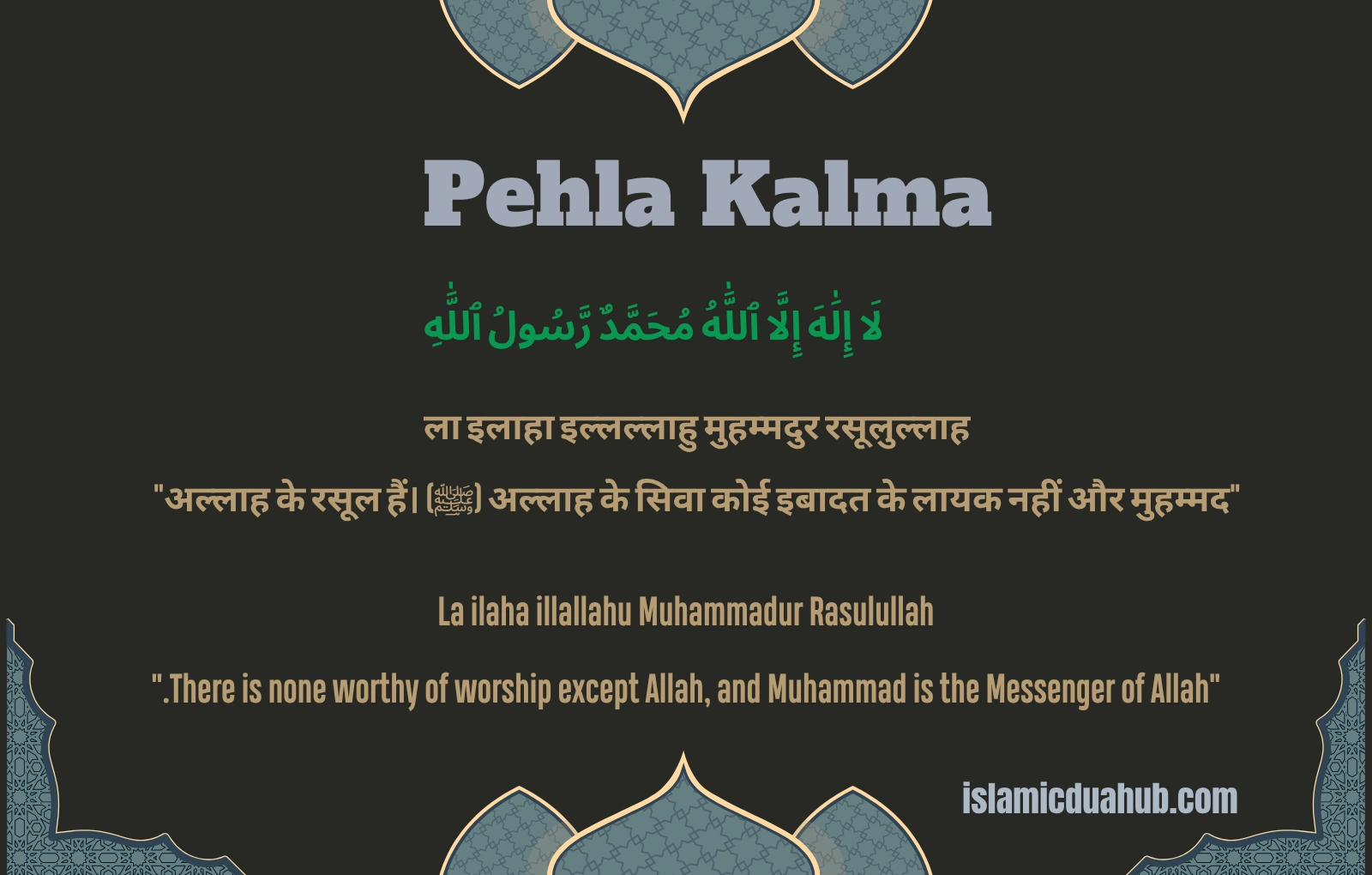
لَا إِلَٰهَ إِلَّا ٱللَّٰهُ مُحَمَّدٌ رَّسُولُ ٱللَّٰهِ
Pehla Kalma Transliteration
La ilaha illallahu Muhammadur Rasulullah
Pehla Kalma In English (Meaning)
“There is none worthy of worship except Allah, and Muhammad is the Messenger of Allah.”
Pehla Kalma In Hindi
ला इलाहा इल्लल्लाहु मुहम्मदुर रसूलुल्लाह
हिंदी अर्थ: “अल्लाह के सिवा कोई इबादत के लायक नहीं और मुहम्मद (ﷺ) अल्लाह के रसूल हैं।”
Pehla Kalma In Urdu (اردو ترجمہ)
اللہ کے سوا کوئی معبود نہیں، محمّدؐ اللہ کے رسول ہیں۔
What Is Kalma In Islam?
The word Kalma in Arabic (كَلِمَة) means “a word” or “a statement.” In Islamic usage, Kalma refers to a declaration of belief that forms the foundation of a Muslim’s faith.
In total, there are six Kalmas widely taught across Muslim communities, especially in South Asian countries like India, Pakistan, and Bangladesh. These six Kalmas were compiled by Islamic scholars to explain the basic beliefs of Islam in a clear and memorable way. However, it is important to know that all six Kalmas together do not appear in a single hadith or verse of the Quran. Rather, they are based on Quranic verses and prophetic teachings collected and organized for ease of learning.
Among all six, the Pehla Kalma Tayyab is the first and most fundamental. It is the gateway to Islam and the very first statement a person recites when accepting the faith.
Pehla Kalma Tayyab Meaning: Breaking It Down
Pehla Kalma Tayyab is made up of two distinct parts, each carrying its own powerful meaning.
Part One: La ilaha illallah
This is the declaration of Tawheed, the Oneness of Allah. It means: “There is no deity worthy of worship except Allah.” This part of the Kalma removes all forms of shirk (associating partners with Allah) from a person’s heart and affirms that only Allah deserves to be worshipped.
Part Two: Muhammadur Rasulullah
This is the declaration of Risalat, the prophethood. It means: “Muhammad is the Messenger of Allah.” This part confirms that Prophet Muhammad (peace be upon him) is the final prophet and messenger sent by Allah to guide all of humanity.
Together, these two parts form the complete Pehla Kalma Tayyab. A Muslim must believe in both with full conviction from the heart. One cannot accept the Oneness of Allah without also accepting the prophethood of Muhammad (peace be upon him).
Explanation: Why Is Pehla Kalma So Important?
The Pehla Kalma Tayyab is the very first pillar of Islam. It is the starting point of a Muslim’s entire faith. When a person wishes to accept Islam, the first thing they do is recite this Kalma with sincerity.
The word “Tayyab” in Arabic means “pure” or “purity.” Reciting this Kalma with true belief purifies the heart from the darkness of shirk and brings it into the light of Tawheed. It reshapes how a person thinks, lives, and worships.
This Kalma is also one of the most powerful forms of dhikr (remembrance of Allah). Muslims are encouraged to recite it throughout their lives, not just once at the time of accepting Islam. Every time it is recited with a sincere heart, it strengthens the bond between the servant and Allah.
In Islam, the concept of Tawheed, which is the belief in the absolute Oneness of Allah, is the most important belief. The Pehla Kalma is the clearest and most direct expression of that belief. It is taught to children from a young age so that the foundation of their faith is strong from the very beginning.
How To Recite Pehla Kalma Step By Step
Reciting the Pehla Kalma is simple, but doing it with the right intention and awareness makes it far more meaningful. Follow these steps to recite it properly.
Make A Fresh Intention In Your Heart
Before reciting, make a clear intention (niyyah) in your heart. Know that you are about to declare the most important statement in Islam. This is not just a set of words; it is a commitment to Allah alone. A sincere heart is the most important condition for the Kalma to carry weight.
Face The Qiblah If Possible
While the Pehla Kalma can be recited at any time and in any direction, facing the Qiblah (the direction of the Kaabah) when possible is a mark of respect and adds to the spiritual quality of the recitation.
Recite In A Clear And Calm Voice
Pronounce the words clearly, one by one, without rushing. The correct recitation is:
لَا إِلَٰهَ إِلَّا ٱللَّٰهُ مُحَمَّدٌ رَّسُولُ ٱللَّٰهِ
La ilaha illallahu Muhammadur Rasulullah
ला इलाहा इल्लल्लाहु मुहम्मदुर रसूलुल्लाह
Take care with the pronunciation of “La ilaha illallah.” The “La” (لَا) is a negation, meaning “there is no.” Pause slightly after “La ilaha” before completing with “illallah” so the full meaning is felt: no god except Allah.
Understand The Meaning While Reciting
As each word leaves the tongue, hold its meaning in the mind. “La ilaha” means there is no deity. “Illallah” means except Allah. “Muhammadur Rasulullah” means Muhammad is the Messenger of Allah. Reciting with understanding transforms the Kalma from a routine utterance into a deeply felt declaration of faith.
Recite With Full Conviction From The Heart
The tongue speaks the words, but the heart must confirm them. Islamic scholars are unanimous that the Kalma must be believed sincerely from within for it to be valid as a declaration of faith. Reciting only with the tongue, without the heart being present, does not fulfil the true spirit of the Kalma.
Repeat It As Often As Possible
There is no fixed limit to how many times the Pehla Kalma can be recited. Muslims are encouraged to make it a regular part of their dhikr throughout the day, after salah, before sleep, and in moments of difficulty. Every sincere repetition is an act of worship and a renewal of faith.
When To Read Pehla Kalma
At The Time Of Accepting Islam
When a non-Muslim wishes to enter the fold of Islam, they recite the Kalma Tayyab with sincere conviction. This is the most significant moment of its use.
At The Time Of Death
The Prophet Muhammad (peace be upon him) instructed Muslims to encourage their loved ones to recite La ilaha illallah at the time of death. This is confirmed in Sunan Ibn Majah (1444), where the Prophet (peace be upon him) said:
“Urge your dying ones to say La ilaha illallah.”
Reciting the Kalma at the last moments of life holds tremendous spiritual importance. It is the final testimony a Muslim gives before departing from this world.
As Daily Dhikr And Remembrance
Pehla Kalma is not restricted to any fixed time or occasion. Muslims are encouraged to recite it throughout the day as dhikr. Remembering Allah through this Kalma brings peace to the heart and keeps a Muslim aware of their purpose in life.
After Every Salah
Many Muslims make it a practice to recite La ilaha illallah after their daily prayers as part of their regular dhikr routine.
Benefits Of Pehla Kalma Tayyab
Foundation Of All Good Deeds
Every righteous deed of a Muslim rests upon the sincerity of Tawheed. When a person truly believes in La ilaha illallah from the heart, every act of worship becomes pure and meaningful. The Kalma is the root from which all good grows.
Path To Forgiveness
It was narrated from Mu’adh ibn Jabal (may Allah be pleased with him) that the Messenger of Allah (peace be upon him) said:
“There is no soul that died bearing witness to La ilaha illallah, and that I am the Messenger of Allah, from the heart with certainty, but Allah will forgive it.” (Sunan Ibn Majah, 3796)
This hadith shows that sincere belief in the Kalma is a reason for Allah’s forgiveness.
A Pillar Of Islam Itself
Prophet Muhammad (peace be upon him) made clear the central role of this declaration in the following hadith narrated by Ibn Umar, reported in Jami At-Tirmidhi (2609):
“Islam is based upon five: the testimony of La ilaha illallah and that Muhammad is the Messenger of Allah, the establishment of Salah, giving Zakah, fasting the month of Ramadan, and performing Hajj to the House.”
The very first pillar is the testimony of Pehla Kalma Tayyab.
Peace And Tranquility Of The Heart
Reciting the Kalma with awareness brings a deep sense of calm to the believer. Knowing that only Allah is worthy of worship, and that everything in this world belongs to Him, gives a Muslim a sense of peace that cannot come from worldly things.
Protection From Shirk
The most dangerous sin in Islam is shirk, associating partners with Allah. The Kalma Tayyab is a constant reminder and a shield against shirk. Each time it is recited, it renews a Muslim’s commitment to worship Allah alone.
Unity Among Muslims
Across different countries, cultures, languages, and backgrounds, all Muslims are bound by this single declaration. The Pehla Kalma Tayyab is the common thread that connects over 1.8 billion Muslims worldwide. It removes barriers of language and race and unites the entire Ummah under one belief.
Ease At The Time Of Death
Islamic scholars have noted that a person who spent their life reciting and living by the Kalma will find ease at the time of death. The final moments of life are made lighter for those who held firm to this declaration.
Conclusion
The Pehla Kalma Tayyab is not just the first Kalma in Islam. It is the very foundation upon which the entire faith of a Muslim is built. From the day a person accepts Islam to the final moments of their life, this declaration remains the most powerful statement they can make.
La ilaha illallahu Muhammadur Rasulullah: there is no deity worthy of worship except Allah, and Muhammad is His Messenger. These words carry the weight of Tawheed, the beauty of Risalat, and the complete meaning of what it is to be Muslim.
Every Muslim should not only memorize the Pehla Kalma but truly understand what it means. Reciting it with a sincere heart, with full conviction, is one of the most beloved acts in the sight of Allah. May Allah grant every Muslim the ability to live by these words and to depart from this world with them on their lips. Ameen.
🤲 Read Also These Trusted Islamic Duas:
- Imtihan Mein Kamyabi Ki Dua
- Sawari Ki Dua
- Dua Abu Darda
- Dua Lahaula Walakuata Illabillah Meaning
- Dua For Good Health
- Pani Peene Ki Dua
- Barkat Ki Dua
- Suhoor Dua
- Tahajjud Ki Dua
- Surma Lagane Ki Dua
- Hasbi Allah Dua
- Sana Dua In Namaz Hindi
- Dua E Mujeer
- Lailatul Qadr Ki Dua
? Frequently Asked Questions (FAQs)
What is Pehla Kalma Tayyab?
Pehla Kalma Tayyab is the first declaration of faith in Islam. It means: “There is none worthy of worship except Allah, and Muhammad is the Messenger of Allah.” The word Tayyab means purity, as this Kalma purifies the heart from shirk.
What does Kalma mean in Islam?
Kalma comes from the Arabic word “Kalimah,” meaning “word” or “statement.” In Islam, it refers to a declaration of belief. The Pehla Kalma is the most important of all such declarations.
How many Kalmas are there in Islam?
There are six Kalmas: Tayyab, Shahadat, Tamjeed, Tauheed, Astaghfar, and Radde Kufr. The Pehla Kalma Tayyab is the first and most fundamental among them.
Is it mandatory to memorize all six Kalmas?
No, memorizing all six is not a strict ruling. The six Kalmas are not found together in a single hadith or Quranic verse. They were compiled by scholars for ease of learning. Knowing the Pehla Kalma with full understanding is what matters most.
When should the Pehla Kalma be recited?
It can be recited at any time as dhikr. It is especially important when accepting Islam, at the time of death, and as part of daily remembrance of Allah.
What is the difference between Pehla Kalma and Shahada?
The Shahada is a longer, formal version used when accepting Islam: “Ash-hadu an la ilaha illallah, wa ash-hadu anna Muhammadan abduhu wa rasuluh.” The Pehla Kalma is the shorter form. Both share the same core belief in Tawheed and Risalat.
Can children memorize the Pehla Kalma?
Yes. Teaching the Pehla Kalma to children is an important part of Islamic upbringing. It is among the first things Muslim children are taught so that Tawheed is rooted in their hearts from an early age.
Written by: Ahmad Raza
Credentials: Islamic Studies Content Writer
🤲 Read More duas for daily life at Instant Dua