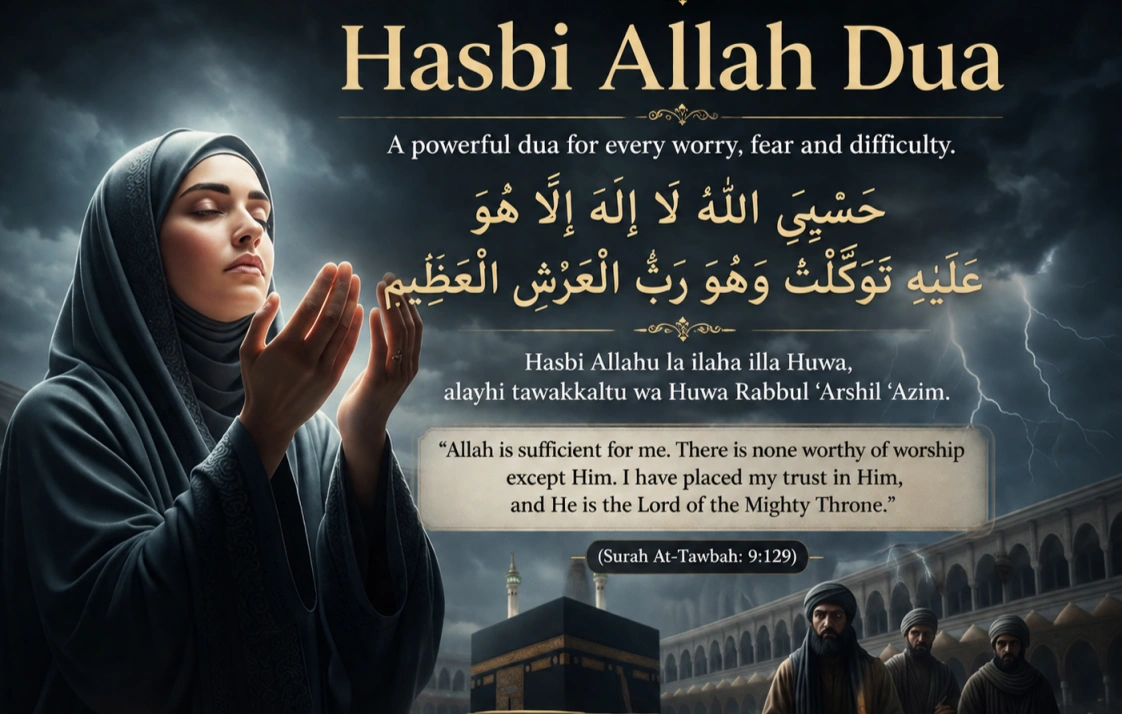
Hasbi Allah Dua is one of the most repeated phrases of trust in Allah present in the Quran and hadith. Muslims turn to it during moments of worry, fear, and uncertainty, because it carries a direct declaration that Allah alone is enough for a believer.
The phrase Hasbi Allah means “Allah is sufficient for me.” It comes from Surah At-Tawbah, ayah 129, the closing verse of the surah, and it is also recorded in a well known hadith with an added portion. Many people search for this dua without knowing its full wording, its correct source, or when it should be recited. The correct Arabic text, transliteration, and meaning of this dua are set out below in one place, together with the situations in which it fits best.
Because Hasbi Allah and the related phrase Hasbunallahu Wa Ni’mal Wakeel are often mixed up, a short clarification on both forms is included below, along with the difference between the two. The opening line, Hasbi Allah Hu La Ilaha Illa Huwa, is where the correct wording of this dua begins.
Hasbi Allah Dua In Arabic
The full dua, as recorded in Sunan Abu Dawood 5081, and connected to the closing verse of Surah At Tawbah, reads as follows.
حَسْبِيَ اللَّهُ لَا إِلَٰهَ إِلَّا هُوَ عَلَيْهِ تَوَكَّلْتُ وَهُوَ رَبُّ الْعَرْشِ الْعَظِيمِ
Reading Hasbi Allah Dua In Arabic first, before moving to the transliteration, helps preserve the correct pronunciation and the sound of each word as it was revealed.
Hasbi Allah Dua In English
Hasbiya Allahu la ilaha illa huwa, alayhi tawakkaltu, wa huwa Rabbul Arshil Azeem.
For readers who cannot yet read Arabic script, Hasbi Allah Dua In English transliteration above offers an easy way to memorize the sound before attaching the full meaning to each phrase.
Hasbi Allah Dua In Hindi
हस्बियल्लाहु ला इलाहा इल्ला हुवा, अलैहि तवक्कल्तु, व हुवा रब्बुल अर्शिल अज़ीम।
Reciters comfortable with Devanagari script can follow Hasbi Allah Dua In Hindi above alongside the Arabic text until the pronunciation feels natural.
Hasbi Allah Dua In Urdu
حسبی اللہ لا الہ الا ھو علیہ توکلت و ھو رب العرش العظیم
Hasbi Allah Dua In Urdu is written above in Nastaliq script for readers who follow Urdu as their primary reading language.
Hasbi Allah Meaning
Hasbi Allah Hu La Ilaha Illa Huwa carries this simple meaning:
“Allah is sufficient for me. There is no god worthy of worship except Him. I have placed my trust in Him, and He is the Lord of the Mighty Throne.”
Each part of the sentence builds on the one before it. The first part is a statement of reliance. The second part, Hasbi Allah Hu La Ilaha, is a renewal of faith in the Oneness of Allah. The third part is an act of surrender, placing every matter in the hands of Allah. The final part reminds the reciter that Allah is the Lord of the greatest of all thrones, so nothing in creation is beyond His control.
Grasping the full Hasbi Allah Meaning takes more than a quick translation. It settles in the heart slowly, through repetition during both ease and hardship, until trust in Allah becomes a habit rather than a reaction reserved for crisis moments alone.
Hasbi Allah Dua Meaning In Hindi
हस्बी अल्लाह दुआ का सीधा अर्थ है,
“अल्लाह मेरे लिए काफी है। उसके सिवा कोई सच्चा माबूद नहीं। मैंने उसी पर भरोसा किया, और वही अर्श ए अज़ीम का रब है।”
इस दुआ का हर हिस्सा भरोसे की एक सीढ़ी की तरह है। पहला हिस्सा अल्लाह पर भरोसे का ऐलान करता है, दूसरा हिस्सा तौहीद यानी अल्लाह की एकता की गवाही देता है, तीसरा हिस्सा हर मामला अल्लाह के हवाले करने का इरादा दिखाता है, और आखिरी हिस्सा याद दिलाता है कि अल्लाह की ताकत सबसे बड़े अर्श तक फैली हुई है।
Hasbi Allah Wa Ni’mal Wakeel: A Related Dua
A second phrase, close in meaning but different in wording, is often searched alongside Hasbi Allah Dua under the term Hasbi Allah Wa Ni’mal Wakeel. The correct wording is Hasbunallahu Wa Ni’mal Wakeel, meaning “Allah is sufficient for us, and He is the best Disposer of affairs.”
This line comes from the Quran, Surah Aal e Imran, ayah 173. It was said by Prophet Ibrahim (AS) when he was placed in the fire, and again by Prophet Muhammad (peace be upon him) and his companions when they faced a large gathering of enemy forces before the Battle of Uhud.
The difference is small but worth noting. Hasbiya Allahu speaks in the singular, “Allah is sufficient for me,” while Hasbunallahu speaks in the plural, “Allah is sufficient for us.” Both phrases express complete reliance on Allah, and a believer may recite either depending on whether the situation concerns them personally or concerns their family and community together.
Explanation Of The Dua
This dua is built around the concept of Tawakkul, which means placing full trust in Allah after doing everything within one’s own ability. Tawakkul does not mean sitting back and waiting for outcomes without effort. A student still studies before an exam, a patient still visits a doctor, and a traveler still checks the route before a journey.
Once the effort is made, the outcome is handed over to Allah, and this dua becomes the words that carry that surrender. It reminds the heart that Allah’s plan, whether it feels easy or difficult in the moment, comes from perfect wisdom.
Ibn Abbas, a companion of the Prophet, narrated that Prophet Ibrahim (AS) said this phrase as he was thrown into the fire by his people. The fire, by the command of Allah, became cool and safe for him. The Prophet Muhammad (peace be upon him) and the believers said the same words when told that a large army had gathered against them, and their trust in Allah only grew stronger.
When To Read This Dua
During Times Of Fear Or Threat
The dua is suited to moments when a person feels threatened, whether by another person, a difficult circumstance, or an uncertain outcome. It was recited by Ibrahim (AS) in the most extreme test of his life.
During Financial Hardship Or Debt
Many Muslims recite this phrase when facing money worries, unpaid debts, or loss of income, as a reminder that provision comes from Allah alone.
Before Facing A Difficult Task Or Decision
Reciting it before an exam, an interview, a medical procedure, or any event that causes anxiety helps settle the heart before stepping into the unknown.
During Grief Or Personal Loss
The words offer comfort during illness, loss of a loved one, or any period of sadness, since they redirect the heart back to Allah’s wisdom and mercy.
As Part Of Daily Dhikr
Some scholars mention it can be said in the morning and evening as a general habit of remembrance, though the specific hadith about reciting it seven times for guaranteed relief from grief is weak according to several hadith scholars, so it should not be treated as a guaranteed formula for a fixed number of repetitions.
Hasbi Allah Dua Benefits
Hasbi Allah Dua Benefits reach beyond a single hard day. Reciting it regularly reshapes how a believer responds to hardship over months and years, not only in the moment of a crisis.
Strengthens Trust In Allah
Repeating this phrase during hardship trains the heart to lean on Allah rather than panic or despair, strengthening the bond of Tawakkul over time.
Brings Calm During Anxiety
The words carry a psychological and spiritual steadying effect, since they remind the reciter that the outcome of every matter rests with a Lord who is fully aware and fully capable.
Connects The Reciter To Prophetic Example
Saying the same words used by Ibrahim (AS) and Prophet Muhammad (peace be upon him) links the believer to a long chain of trust that has carried the faithful through history’s hardest moments.
Renews Faith In Allah’s Oneness
Because the phrase includes “la ilaha illa huwa,” every recitation is also a renewal of Tawheed, the belief that none is worthy of worship except Allah.
Reciting This Dua In Daily Life
The phrase fits easily into everyday routines. It can be whispered while stuck in traffic, before opening an important email, while waiting for medical test results, or during a heated disagreement at home or work. It does not require a special setting or ritual, only a sincere heart and a moment of reflection on Allah’s power.
Parents also teach it to children as one of the earliest short duas, since it is short, easy to memorize, and carries a complete message of faith in a single line. Passing on these benefits to the next generation starts with this kind of simple daily repetition at home.
Etiquette Of Reciting This Dua
A few simple manners raise the value of any dua, including this one. Facing the Qibla is not a requirement but is preferred when possible. Reciting with a calm heart, in a state of ablution where practical, and with sincere attention to the meaning rather than rushed pronunciation, brings the words closer to their intended purpose.
Raising the hands is not necessary for this specific line since it is closer to a statement of remembrance than a formal supplication, though some scholars permit it either way. What matters most is the intention behind the words and the trust they represent, not the exact posture of the body while saying them.
Teaching children the correct pronunciation early, through repetition rather than pressure, helps the phrase settle naturally into memory alongside other short duas from early childhood.
Conclusion
The Hasbi Allah Dua carries centuries of trust behind its short line of Arabic words. From Prophet Ibrahim (AS) facing fire to Prophet Muhammad (peace be upon him) facing an army, the same phrase has carried believers through fear into calm certainty.
Reciting it during hardship, before a difficult task, or simply as part of daily remembrance keeps the heart anchored to Allah’s power and wisdom. Whether spoken as Hasbiya Allahu for a personal matter or Hasbunallahu Wa Ni’mal Wakeel for a shared one, the message stays the same: Allah is enough.
 See More Reliable Islamic Duas:
- Imtihan Mein Kamyabi Ki Dua
- Sawari Ki Dua
- Dua Abu Darda
- Dua Lahaula Walakuata Illabillah Meaning
- Dua For Good Health
- Pani Peene Ki Dua
- Barkat Ki Dua
- Suhoor Dua
- Tahajjud Ki Dua
- Surma Lagane Ki Dua
? FAQs
What does Hasbi Allah mean in English?
Hasbi Allah means “Allah is sufficient for me,” expressing complete reliance on Allah in every situation.
Is this dua from the Quran or hadith?
The core phrase “la ilaha illa huwa alayhi tawakkaltu” reflects the closing verse of Surah At Tawbah, and the full combined wording is recorded in Sunan Abu Dawood 5081.
What is the difference between Hasbi Allah and Hasbi Allah Wa Ni’mal Wakeel?
Hasbiya Allahu is said in the singular for personal matters, while the correctly worded Hasbunallahu Wa Ni’mal Wakeel is said in the plural for matters involving a group.
Can this dua be recited in any language?
It is best recited in Arabic as it was revealed, though reciting the transliteration or reflecting on its meaning in Hindi, Urdu, or English is also valuable for those still memorizing the Arabic.
Is it true that reciting this dua seven times removes all grief?
The hadith mentioning seven repetitions for guaranteed relief is considered weak by several scholars, so the dua should be recited with sincerity rather than as a fixed formula for a guaranteed result.
When did Prophet Ibrahim say this dua?
He said it when his people threw him into a blazing fire, and Allah made the fire cool and safe for him.
Written by: Ahmad Raza
Credentials: Islamic Studies Content Writer
Read More duas for daily life at Instant Dua