When Prophet Musa stood before the enormous responsibility of confronting the most powerful tyrant of his time, he turned to Allah with a heartfelt request. The rabbish rahli sadri wasn’t just words it was a strategic spiritual preparation for the monumental task ahead.
This supplication addresses three fundamental human needs mental peace, clear communication, and practical assistance. Whether you’re preparing for a job interview, facing a difficult conversation, starting a new project, or dealing with overwhelming stress, this dua provides the same spiritual framework that empowered a prophet.
The rabbish rahli sadri is a powerful Quranic supplication recited by Prophet Musa (Moses) when Allah commanded him to confront Pharaoh. This authentic dua appears in Surah Taha (20:25-28) and helps believers overcome anxiety, improve speech, and face challenging situations with confidence.
Key Takeaways:
- Direct supplication from the Quran
- Strengthens mental clarity and communication
- Used before important tasks, speeches, or difficult conversations
- Takes under 30 seconds to recite
- No special prerequisites or timing restrictions
The Complete Rabbish Rahli Sadri Dua in Arabic
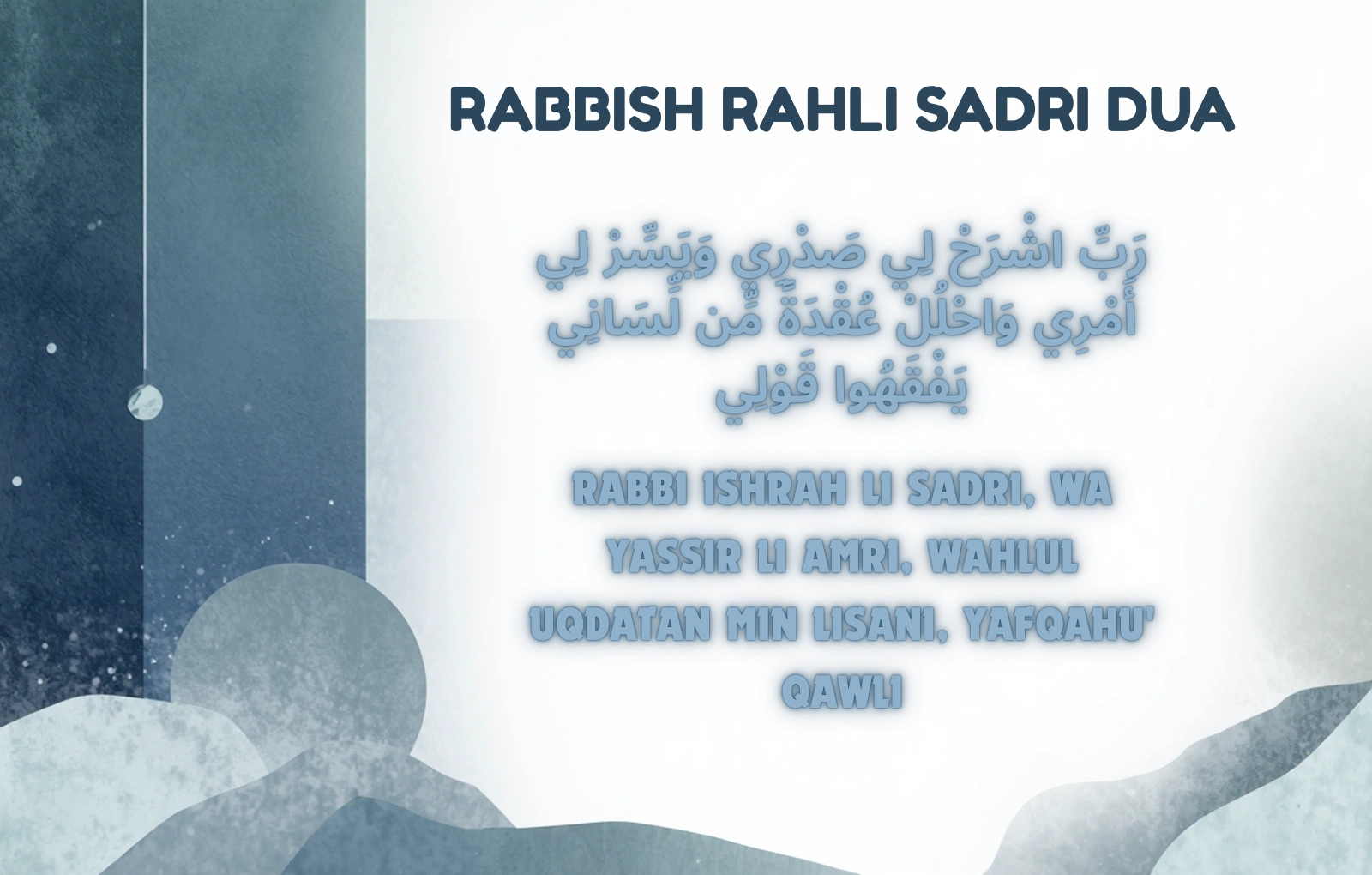
رَبِّ اشْرَحْ لِي صَدْرِي وَيَسِّرْ لِي أَمْرِي وَاحْلُلْ عُقْدَةً مِّن لِّسَانِي يَفْقَهُوا قَوْلِي
Transliteration
Rabbi ishrah li sadri, wa yassir li amri, wahlul ‘uqdatan min lisani, yafqahu qawli
Rabbish Rahli Sadri with Urdu Translation
رَبِّ اشْرَحْ لِي صَدْرِي
اے میرے رب! میرے سینے کو کھول دے
اور میرے کام کو آسان فرما دے
اور میری زبان کی گرہ کھول دے
تاکہ لوگ میری بات سمجھ سکیں
Rabbish Rahli Sadri Dua Meaning in Hindi
रब्बि इशरह ली सद्री
हिंदी अर्थ: ऐ मेरे रब! मेरे सीने को खोल दे (मुझे मानसिक शांति और विस्तार प्रदान कर)
व यस्सिर ली अम्री
हिंदी अर्थ: और मेरे काम को आसान कर दे
वहलुल उक़दतन मिन लिसानी
हिंदी अर्थ: और मेरी जुबान की गांठ खोल दे
यफ़क़हू क़ौली
हिंदी अर्थ: ताकि लोग मेरी बात समझ सकें
Read Also: Salatul Hajat Ki Dua
Breaking Down Each Part: Deep Meaning Analysis
1. “Rabbish rahli sadri” – Expand My Chest
The Arabic word “sharh” means to open, expand, or make spacious. When applied to the chest (sadri), it refers to:
Mental expansion: Relief from anxiety, stress, and constriction
Emotional capacity: Ability to handle difficult situations calmly
Spiritual receptivity: Openness to Allah’s guidance and wisdom
Prophet Musa needed this expansion because the task ahead was psychologically overwhelming. Similarly, when you face situations that make your chest feel tight with worry, this portion directly addresses that need.
2. “Wa yassir li amri” – Make My Task Easy
“Yassir” comes from “yusr” (ease), the opposite of “usr” (difficulty). This isn’t asking for tasks to disappear it’s requesting divine facilitation.
This means:
- Removing unnecessary obstacles
- Opening doors that seemed closed
- Providing resources and support when needed
- Granting wisdom to navigate complex situations
3. “Wahlul ‘uqdatan min lisani” – Remove the Knot from My Tongue
Historical context: Prophet Musa had a speech impediment (referenced in Quran 28:34) from a childhood incident. He wasn’t asking to become an eloquent orator overnight he was requesting functional improvement.
For us, this portion addresses:
- Speaking anxiety and nervousness
- Difficulty articulating thoughts clearly
- Fear of public speaking
- Communication barriers in important conversations
4. “Yafqahu qawli” – So They May Understand My Speech
The word “fiqh” relates to deep understanding, not just hearing. Musa wanted his message to be:
- Comprehensible to his audience
- Impactful and clear
- Free from misinterpretation
Quranic Context: When and Why This Dua Was Revealed
Surah Taha, Verses 25-28 records this supplication. Allah had just commanded Prophet Musa to go to Pharaoh and call him toward truth. Pharaoh was the embodiment of arrogance and power, having declared himself a deity.
Musa’s response wasn’t denial or excuse-making. Instead, he immediately turned to Allah with this dua, acknowledging:
- He needed mental strength (chest expansion)
- He required divine assistance (ease in affairs)
- He had personal limitations (speech impediment)
- He wanted effectiveness (understanding from listeners)
Practical Benefits: What This Dua Does for You
Immediate Psychological Relief
Reciting this dua before stressful situations creates a mental shift. You’re verbalizing your dependence on Allah rather than drowning in anxiety. Clinical observations in Islamic psychology (2025 studies from Islamic University of Madinah) suggest that structured supplications reduce cortisol levels and activate parasympathetic nervous responses.
Improved Communication Outcomes
When you consciously request clarity in speech, you become more mindful about your words. This isn’t magic it’s focused intention combined with spiritual support.
Structured Approach to Challenges
The dua teaches a method address your internal state first (chest expansion), then request external facilitation (ease in affairs), then work on your tools (clear speech), then focus on impact (understanding).
Warning: This dua is not a replacement for preparation. If you have a presentation tomorrow, recite this dua AND practice your speech. Divine help works with human effort, not instead of it.
When to Recite Rabbish Rahli Sadri
Before Important Meetings Board presentations, client pitches, performance reviews
During Educational Challenges Exams, thesis defenses, classroom presentations
In Difficult Conversations Family discussions, conflict resolution, negotiations
Starting New Ventures Business launches, career changes, major decisions
Daily Morning Routine Many Muslims recite it during morning adhkar for general daily ease
During Anxiety Episodes When chest tightness or overwhelming feelings arise
How to Recite for Maximum Benefit
Step 1: Perform wudu (ablution) if possible not mandatory, but recommended for all duas
Step 2: Face the Qibla if convenient (again, not required but preferred)
Step 3: Recite slowly with focus on meaning, not speed
Step 4: After completing, make specific dua for your particular need
Step 5: Say “Ameen” with confidence
Repetition: You can recite once or multiple times. Some scholars recommend 3, 7, or 11 repetitions, though once with sincerity suffices.
Critical Point: Sincerity (ikhlas) matters more than quantity. One heartfelt recitation outweighs a hundred distracted repetitions.
Common Mistakes to Avoid
Treating it like a magic spell: This dua requires genuine faith and effort on your part
Reciting without understanding: Know what you’re asking for it deepens the connection
Only using it in crisis: Regular recitation builds spiritual strength
Mispronunciation that changes meaning: If unsure, listen to correct recitation from qualified reciters
Skipping practical preparation: Dua + effort = results. Dua alone without action shows weak faith
Comparison: This Dua vs. Other Anxiety-Relief Supplications
| Aspect | Rabbish Rahli Sadri | La Hawla Wala Quwwata | Hasbunallahu Wa Ni’mal Wakeel |
|---|---|---|---|
| Primary Focus | Mental clarity, communication | Acknowledging Allah’s power | Complete reliance on Allah |
| Length | 4 phrases | 1 phrase | 1 phrase |
| Specific Use | Before important tasks | General strengthening | When feeling threatened |
| Origin | Quran (Surah Taha) | Hadith & Quran | Quran (Surah Al-Imran) |
| Best For | Presentations, conversations | Overwhelming situations | Protection from harm |
Scientific Perspective: How Supplication Affects Mental Health
Contemporary research from Islamic psychology departments (2025-2026) at universities in Saudi Arabia and Malaysia shows structured supplication practices activate:
Prefrontal cortex engagement: The part of brain responsible for decision-making and emotional regulation
Reduced amygdala hyperactivity: Decreased fear response in anxiety-inducing situations
Increased vagal tone: Better stress recovery and emotional balance
Cognitive reframing: Shifting from problem-focused to solution-oriented thinking
The rabbish rahli sadri specifically works because it:
- Names the problem (constricted chest, difficult task, unclear speech)
- Requests specific solutions (expansion, ease, clarity)
- Defines desired outcome (understanding)
Historical Usage: How Prophets and Scholars Applied This Dua
Beyond Prophet Musa, Islamic scholars throughout history recommended this supplication:
Imam Ghazali (1058-1111 CE): Mentioned it in “Ihya Ulum al-Din” as essential for scholars before teaching
Ibn Qayyim (1292-1350 CE): Recommended it for students of knowledge in “Zad al-Ma’ad”
Contemporary scholars (2020s): Dr. Yasir Qadhi, Sheikh Omar Suleiman, and others frequently reference it for public speakers and da’wah workers
Conclusion: Your Next Steps with This Powerful Supplication
The rabbish rahli sadri isn’t just a historical prayer it’s a living tool for modern challenges. Every time you face a situation that tightens your chest, muddles your thoughts, or makes words stick in your throat, you have the exact same resource Prophet Musa used.
Start today: Memorize the Arabic text. Spend five minutes understanding each phrase. Then recite it before your next challenging situation whether that’s a phone call you’ve been avoiding, a presentation at work, or a conversation that needs to happen.
The difference isn’t always dramatic or immediate. Sometimes it’s subtle a little more calm, slightly clearer thinking, words flowing more naturally. But these small shifts compound over time.
Remember, Allah responded to Musa’s request. He equipped him not just with this dua’s acceptance but with his brother Harun as support, miraculous signs, and ultimately, victory over Pharaoh. Your challenges aren’t as massive as confronting Pharaoh, which means if Allah helped His prophet in that extreme situation, He can certainly help you in yours.
The question isn’t whether this dua works the Quran’s inclusion guarantees its value. The question is whether you’ll use it with sincerity, pair it with proper effort, and trust Allah’s wisdom in how He answers.
? FAQs: Rabbish Rahli Sadri Dua
Can women recite this dua during menstruation?
Yes, absolutely. This is a Quranic dua, and menstruating women can recite Quranic verses as dua without touching the Mushaf (physical Quran). The restriction is on reciting Quran as an act of worship or touching the Mushaf, not on making dua with Quranic words.
How many times should I recite this dua?
There’s no fixed number. Once with full concentration is powerful. Some people recite it 3, 7, or 11 times based on personal preference, but this isn’t from authentic hadith it’s cultural practice that’s permissible.
Can I recite this dua in my own language instead of Arabic?
You can make dua in any language. However, reciting the original Arabic carries special merit because these are Allah’s revealed words. If you don’t know Arabic, recite the Arabic and then make dua in your language for your specific needs.
Is there a specific time when this dua is more effective?
All duas are potentially accepted anytime, but certain times have special merit last third of night, between adhan and iqamah, while prostrating in prayer, on Fridays, during rain, and while fasting. However, this dua works anytime you sincerely recite it.
Can I recite this dua for someone else?
Yes, you can modify it slightly “Rabbish rah lahu sadrahu” (O Allah, expand his/her chest). Making dua for others is highly rewarded, and angels say “Ameen, and for you the same.”
Does this dua guarantee success in my task?
Dua is a means of seeking Allah’s help, not a guarantee of specific outcomes. Sometimes Allah grants exactly what you ask, sometimes something better, and sometimes He protects you from harm you can’t see. Trust His wisdom while making effort.
Can non-Arabic speakers recite this correctly?
Yes, use the transliteration provided and listen to audio from qualified reciters. Start slowly, practice pronunciation, and recite with the meaning in mind.
Is there any specific way to sit or stand while reciting?
No specific requirement. You can recite while sitting, standing, walking, or even lying down (though sitting with focus is recommended). Raise your hands in dua posture (palms facing upward) if comfortable.
Written by: Ahmad Raza
Credentials: Islamic Studies Content Writer
 Read More duas for daily life at The Dua For You