Tabbat Yada Surah is the 111th chapter of the Holy Quran. It is also widely known as Surah Al Masad and Surah Lahab. This short but powerful Surah consists of only 5 ayat (verses). It begins with the words “Tabbat yada abi lahabi watab,” which means “May the hands of Abu Lahab be ruined, and ruined is he.”
This Surah was revealed in Makkah and holds a significant place in Islamic history. It speaks directly about Abu Lahab, the paternal uncle of Prophet Muhammad (ﷺ), who was one of the most fierce enemies of Islam. The Surah condemns his actions and warns of his fate in the Hereafter.
Every Muslim who recites the Quran regularly comes across this Surah. It is short enough to memorize easily and carries deep meaning about the consequences of rejecting Allah and opposing His messenger.
Tabbat Yada Surah in Arabic
Below is the complete Tabbat Yada Surah in Arabic text:
بِسْمِ اللَّهِ الرَّحْمَٰنِ الرَّحِيمِ
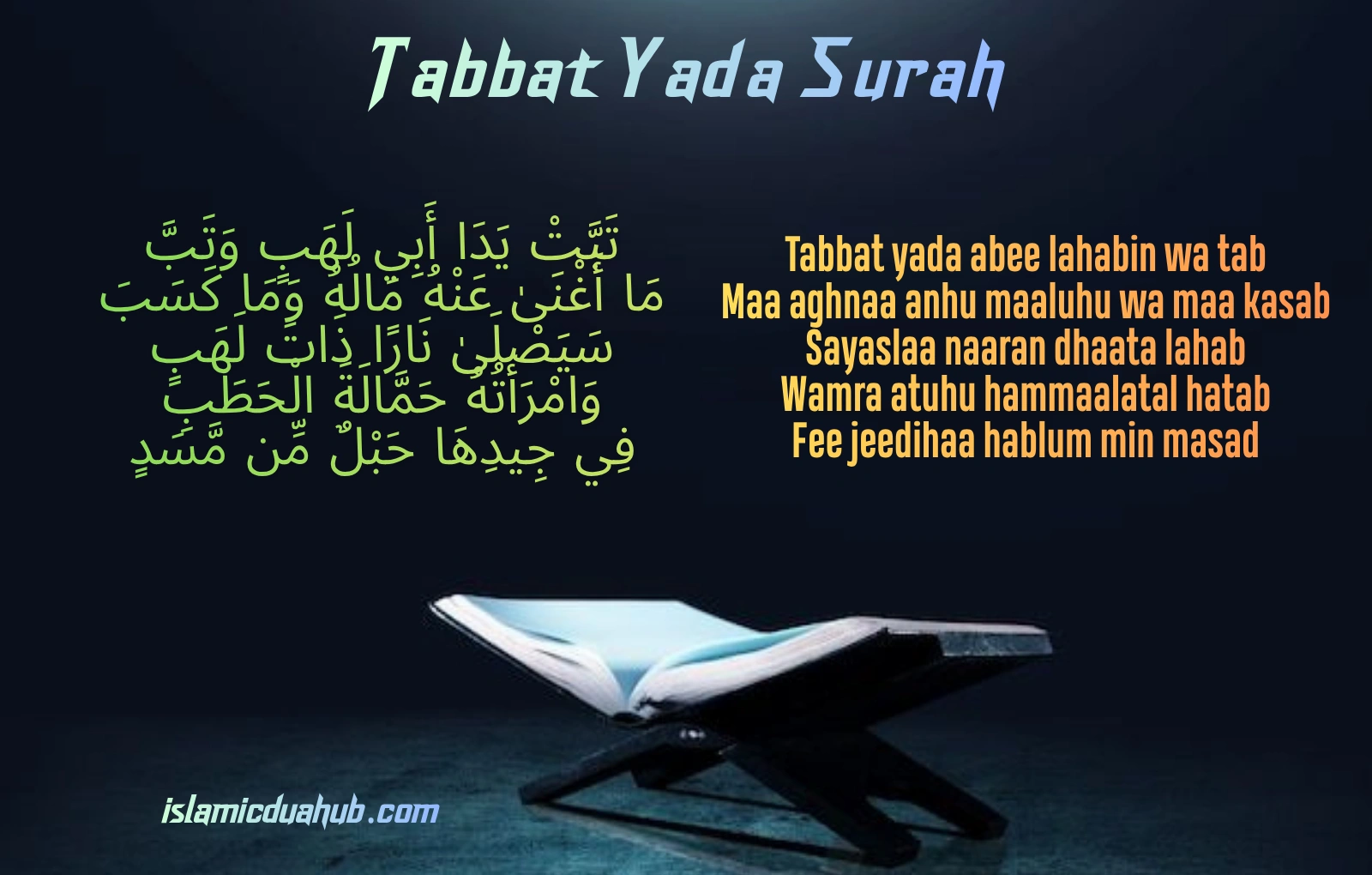
تَبَّتْ يَدَا أَبِي لَهَبٍ وَتَبَّ ﴿١
مَا أَغْنَىٰ عَنْهُ مَالُهُ وَمَا كَسَبَ ﴿٢
سَيَصْلَىٰ نَارًا ذَاتَ لَهَبٍ ﴿٣
وَامْرَأَتُهُ حَمَّالَةَ الْحَطَبِ ﴿٤
فِي جِيدِهَا حَبْلٌ مِّن مَّسَدٍ ﴿٥
Tabbat Yada Surah Transliteration (Roman English)
Here is the easy Roman transliteration of the full Tabbat Yada Surah in English:
| Ayat | Transliteration |
|---|---|
| 1 | Tabbat yada abi lahabi watab |
| 2 | Ma agna ‘anhu maluhu wama kasab |
| 3 | Sayasla naran thata lahab |
| 4 | Wam ra-atuhu hammalatal hatab |
| 5 | Fee jeediha hablun min masad |
Tabbat Yada Surah Meaning in English
Here is the Tabbat Yada Surah meaning in clear English, verse by verse:
| Ayat | English Meaning |
|---|---|
| 1 | May the hands of Abu Lahab be ruined, and ruined is he. |
| 2 | His wealth will not avail him or that which he gained. |
| 3 | He will enter to burn in a Fire of blazing flame. |
| 4 | And his wife as well, the carrier of firewood. |
| 5 | Around her neck is a rope of twisted fiber. |
Tabbat Yada Surah Meaning in Hindi
Tabbat Yada Surah in Hindi meaning, verse by verse:
| आयत | हिंदी अर्थ |
|---|---|
| 1 | अबू लहब के दोनों हाथ टूट जाएं और वह खुद भी बर्बाद हो जाए। |
| 2 | उसका माल और जो उसने कमाया, वह उसके किसी काम नहीं आया। |
| 3 | वह जल्द ही भड़कती आग में जलेगा। |
| 4 | और उसकी पत्नी भी जो लकड़ियों का गट्ठर उठाने वाली है। |
| 5 | उसकी गर्दन में मुड़ी हुई रस्सी होगी। |
Hindi Transliteration (हिंदी उच्चारण)
Tabbat Yada Surah का हिंदी उच्चारण इस प्रकार है:
| आयत | हिंदी उच्चारण |
|---|---|
| 1 | तब्बत यदा अबी लहबिन वतब |
| 2 | मा अग्ना अन्हु मालुहू वमा कसब |
| 3 | सयस्ला नारन ज़ातल लहब |
| 4 | वम्र अतुहू हम्मालतल हतब |
| 5 | फी जीदिहा हब्लुन मिन मसद |
Who Is Abu Lahab? Background and Historical Context
To fully understand this Surah, it is important to know who Abu Lahab was.
Abu Lahab was the real name Abd al-Uzza ibn Abd al-Muttalib. He was the paternal uncle of Prophet Muhammad (ﷺ). Despite being so close by blood, he became one of the most hateful enemies of Islam.
When the Prophet (ﷺ) called the people of Makkah to accept Islam, Abu Lahab publicly insulted him. He is reported to have said, “May your hands perish! Did you gather us for this?” This moment was witnessed by many Quraysh leaders.
His wife, Umm Jamil, also actively opposed Islam. She used to scatter thorns and sharp objects on the path of the Prophet (ﷺ) to harm him. The Surah refers to her as the “carrier of firewood,” which in Arabic also means someone who spreads mischief and slander.
This Surah was revealed as a direct response to Abu Lahab’s actions. It stands as a reminder that no amount of worldly wealth or status can protect a person who openly opposes the truth.
The Hadith That Explains the Revelation of This Surah
The great Sahabi Sayyiduna Ibn Abbas (رضي الله عنه) narrated:
The Prophet (ﷺ) climbed Mount Safa and called out to various tribes of Quraysh by name. When they gathered, he asked, “If I told you that an enemy cavalry is in the valley ready to attack you, would you believe me?” They replied, “Yes, we have never heard you speak anything but the truth.” He then said, “I am a warner to you of a severe punishment.” At this moment, Abu Lahab said, “May your hands perish! Is this why you gathered us?” This incident prompted the revelation of Surah Tabbat Yada (Surah Al Masad).
Reference: Sahih Al-Bukhari, Book 65, Hadith 4770
Surah Lahab: Names and Their Meaning
This Surah is known by three names in Islamic scholarship:
1. Surah Al Masad
The word “Masad” means twisted fiber or palm rope. It refers to the rope around the neck of Abu Lahab’s wife. This is the official name of the Surah in the Quran.
2. Surah Lahab
“Lahab” means flame or blazing fire. This name comes from the third verse, which describes the fire Abu Lahab will enter. Also, “Abu Lahab” itself means “Father of Flame.”
3. Tabbat Yada Surah
This is the most commonly used name among people. It comes from the opening words of the Surah. Many Muslims refer to it simply as Tabbat Yada.
When Is Tabbat Yada Surah Recited?
Surah Al Masad is recited in the following situations:
In Daily Salah: It is commonly recited in the Fard and Nafl prayers as it is a short Surah. Many Muslims recite it in the last two rakats of Fard Salah alongside other short Surahs.
For Quran Completion (Khatam): Since it is part of the Quran, it is recited during complete Quran recitations (Khatam ul Quran) individually or in groups.
For Memorization: It is one of the shortest Surahs and is often among the first Surahs children memorize when beginning Quran education.
General Tilawat: Muslims recite it as part of their daily Quran reading routine, especially when reciting the last Juz (Para 30, Juz Amma).
Benefits and Importance of Surah Al Masad
The recitation of every Surah of the Quran carries immense spiritual reward. Surah Al Masad holds specific importance for several reasons:
1. Strengthens Belief in Divine Justice
This Surah shows that Allah sees everything. No one who opposes truth can escape accountability. Reciting it reinforces a Muslim’s belief in the justice of Allah.
2. A Lesson in the Futility of Worldly Arrogance
Abu Lahab had great wealth and social status among the Quraysh. Yet all of it meant nothing before the command of Allah. This Surah reminds Muslims that arrogance and wealth without iman (faith) have no value.
3. Part of Juz Amma Surah Tabbat Yada
is in the 30th Juz (Para) of the Quran, known as Juz Amma. Completing this Juz regularly carries great reward. Scholars encourage regular recitation of all Surahs in this Juz for spiritual growth.
4. Teaches Muslims to Stand Firm Against Opposition
The Prophet (ﷺ) faced extreme opposition from his own family. This Surah teaches Muslims that truth will always prevail, even when the closest people oppose it. It builds conviction and patience.
5. Every Letter Carries Reward
The Prophet (ﷺ) said that every letter of the Quran carries ten rewards. Since Surah Lahab is part of the Quran, its recitation carries tremendous reward with every word.
Key Lessons from Tabbat Yada
Reading and reflecting on this Surah teaches Muslims several timeless lessons:
- Wealth, power, and family ties cannot protect a person who rejects the truth of Islam.
- Actions against the Prophet of Allah have consequences in this world and the next.
- Allah directly addressed individuals by name in the Quran, which shows the seriousness of Abu Lahab’s actions.
- The role of Abu Lahab’s wife shows that those who assist in opposing Islam share in the accountability.
- No amount of societal status gives permission to mock or harm the Messenger of Allah (ﷺ).
Conclusion
Tabbat Yada Surah is a short yet deeply meaningful chapter of the Holy Quran. Known also as Surah Lahab and Surah Al Masad, it carries a timeless message about the consequences of arrogance, opposition to truth, and reliance on worldly status over faith.
The story of Abu Lahab is a historical lesson for all generations. Despite being the Prophet’s own uncle and one of the most powerful men in Makkah, his wealth and position could not shield him from the judgment of Allah. His wife, who shared in his opposition, is also mentioned in this Surah Tabbat Yada as a warning.
For Muslims, reciting this Surah is an act of worship. Reflecting on its meaning strengthens iman, builds patience, and deepens the understanding of divine justice. Whether recited in Salah, during Quran revision, or in daily tilawat, every word of Surah Al Masad carries reward and wisdom.
May Allah grant us the ability to recite the Quran with understanding, learn from its lessons, and remain steadfast on the path of truth. Ameen.
 See More Reliable Islamic Surah:
? FAQs About Tabbat Yada Surah
Q1. What is Tabbat Yada Surah?
It is the 111th chapter of the Holy Quran with 5 verses, also known as Surah Al Masad and Surah Lahab.
Q2. What is the meaning of Tabbat Yada?
It means “May the hands of Abu Lahab be ruined, and ruined is he.”
Q3. What is Tabbat Yada Surah in Hindi meaning?
“अबू लहब के दोनों हाथ टूट जाएं और वह खुद भी बर्बाद हो जाए।”
Q4. Why is this Surah called Surah Lahab?
Because “Lahab” means flame, and the Surah describes Abu Lahab burning in a blazing fire.
Q5. Why is it called Surah Al Masad?
“Masad” means twisted rope, referring to the rope around Abu Lahab’s wife’s neck mentioned in the last verse.
Q6. Who was Abu Lahab’s wife mentioned in this Surah?
Her name was Umm Jamil bint Harb. She spread thorns on the Prophet’s (ﷺ) path and carried harmful rumors against him.
Q7. In which Para is Surah Al Masad?
It is in the 30th Para, known as Juz Amma.
Q8. What is the main lesson of Surah Tabbat Yada?
No wealth or worldly status can protect someone who opposes the truth of Allah.
Written by: Ahmad Raza
Credentials: Islamic Studies Content Writer
Read More duas for daily life at Instant Dua