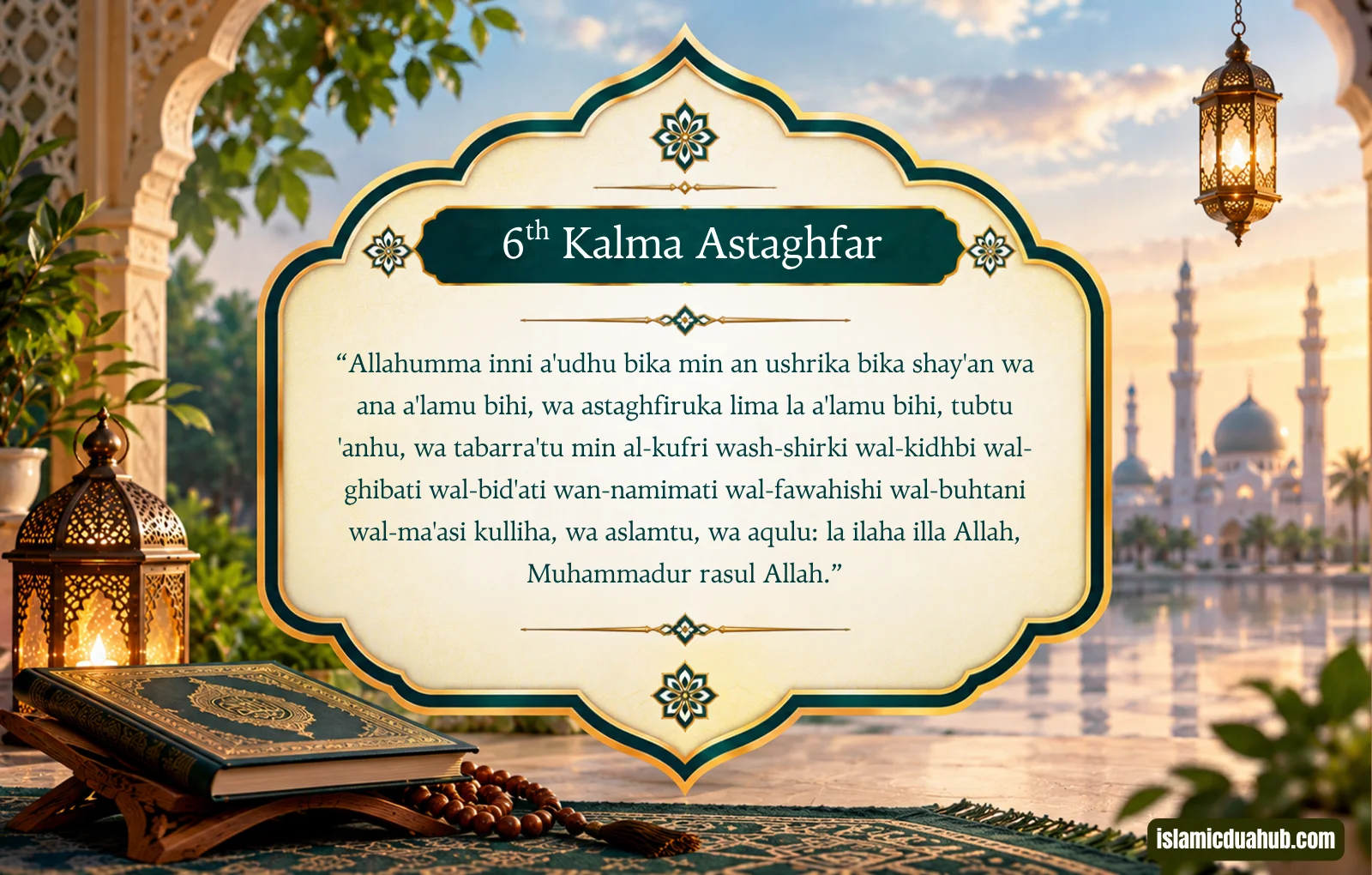
he 6th Kalma Radde Kufr is the sixth and final Kalima of Islam. Its name means “rejection of disbelief,” and it is one of the most powerful declarations a Muslim can make. This Kalma brings together three acts of faith in a single breath: seeking refuge from shirk, repenting from major sins, and renewing the Shahada.
In South Asian Islamic education, all six Kalimas are taught together from an early age. The 6th Kalma Radde Kufr holds a special place among them because it goes beyond belief and forgiveness. It publicly disavows disbelief, polytheism, and the most serious sins of the tongue and heart, then closes with a fresh declaration of faith.
The opening clause of the 6th Kalma Radde Kufr is not a new composition, which makes this kalma stand apart. It comes directly from a sahih hadith recorded by Imam al-Bukhari in Al-Adab al-Mufrad (Hadith 716) and later graded sahih by Shaykh al-Albani. This makes the 6th Kalma far more than a school recitation. It is a Sunnah supplication with deep roots in prophetic tradition.
Disclaimer: The content is for general Islamic knowledge and informational purposes only. While every effort has been made to ensure accuracy, readers are encouraged to consult qualified Islamic scholars for personal religious guidance. All Quranic references and hadith citations should be verified with trusted Islamic sources.
6th Kalma In Arabic
6th Kalma In Arabic Text:
اَللّٰهُمَّ اِنِّیْٓ اَعُوْذُ بِكَ مِنْ اَنْ اُشْرِكَ بِكَ شَيْئًا وَّاَنَآ اَعْلَمُ بِهٖ وَاَسْتَغْفِرُكَ لِمَا لَآ اَعْلَمُ بِهٖ تُبْتُ عَنْهُ وَتَبَرَّأْتُ مِنَ الْكُفْرِ وَالشِّرْكِ وَالْكِذْبِ وَالْغِيْبَةِ وَالْبِدْعَةِ وَالنَّمِيْمَةِ وَالْفَوَاحِشِ وَالْبُهْتَانِ وَالْمَعَاصِىْ كُلِّهَا وَاَسْلَمْتُ وَاَقُوْلُ لَآ اِلٰهَ اِلَّا اللهُ مُحَمَّدٌ رَّسُوْلُ اللّٰهِ
6th Kalma Transliteration
Allahumma inni a’udhu bika min an ushrika bika shay’an wa ana a’lamu bihi, wa astaghfiruka lima la a’lamu bihi, tubtu ‘anhu, wa tabarra’tu min al-kufri wash-shirki wal-kidhbi wal-ghibati wal-bid’ati wan-namimati wal-fawahishi wal-buhtani wal-ma’asi kulliha, wa aslamtu, wa aqulu: la ilaha illa Allah, Muhammadur rasul Allah.
6th Kalma In English: 6th Kalma Meaning
“O Allah, I seek refuge in You from knowingly associating any partner with You, and I seek Your forgiveness for what I do not know. I repent from it, and I disavow disbelief, polytheism, lying, backbiting, religious innovation, tale-bearing, lewdness, slander, and all acts of disobedience. I submit, and I declare: there is no deity worthy of worship except Allah, and Muhammad is the Messenger of Allah.”
6th Kalma In Urdu (6th Kalma In Urdu Meaning)
اے اللہ! میں تیری پناہ مانگتا ہوں اس بات سے کہ جان بوجھ کر تیرے ساتھ کسی کو شریک کروں، اور اس چیز کی معافی مانگتا ہوں جو مجھے معلوم نہیں۔ میں اس سے توبہ کرتا ہوں اور کفر، شرک، جھوٹ، غیبت، بدعت، چغلی، بے حیائی، بہتان اور تمام گناہوں سے بیزاری ظاہر کرتا ہوں۔ میں اسلام قبول کرتا ہوں اور کہتا ہوں: اللہ کے سوا کوئی عبادت کے لائق نہیں، محمد (ﷺ) اللہ کے رسول ہیں۔
6th Kalma Name And Its Meaning
The 6th Kalma name is Radde Kufr, which in Arabic is written as Radd al-Kufr (رَدّ الكُفْر).
The word “Radd” comes from the Arabic root r-d-d, meaning “to push back” or “to reject.” The word “Kufr” means “disbelief” or “concealment of the truth.” Together, Radde Kufr means “rejection of disbelief.”
In Urdu and South Asian madrasa traditions, the 6th Kalma is also called Chatha Kalma or Panjum Kalma Radd-e-Kufr, though the terms refer to the same text.
What Is The 6th Kalma Of Islam?
The 6th Kalma of Islam is the closing declaration of the Six Kalimas framework taught across South Asian madrasas. Each of the six Kalimas builds upon the one before it:
1st Kalma (Tayyab): Declaration of Tawheed and Prophethood
2nd Kalma (Shahadat): Formal testimony of faith
3rd Kalma (Tamjeed): Glorification of Allah
4th Kalima (Tawheed): Declaration of Allah’s oneness and attributes
5th Kalima (Astaghfar): Seeking forgiveness from Allah
6th Kalma (Radde Kufr): Rejection of disbelief and renewal of Islam
The 6th Kalma Radde Kufr presupposes all five before it. A Muslim has already declared Allah’s oneness, sought His forgiveness, and praised His majesty. Now, in the sixth and final statement, they publicly disavow every form of shirk and sin, then re-enter Islam by repeating the Shahada.
The Hadith Behind The 6th Kalma Radde Kufr
The opening clause of the 6th Kalma comes from a direct prophetic narration. It is recorded by Imam al-Bukhari in Al-Adab al-Mufrad, Book 31, Chapter 296, Hadith 716, and graded sahih by Shaykh Muhammad Nasir al-Din al-Albani. The same hadith also appears in Musnad Ahmad.
The narration runs as follows:
The Messenger of Allah (ﷺ) said to Abu Bakr al-Siddiq (RA): “O Abu Bakr, shirk among you is more concealed than the crawling of an ant.” Abu Bakr (RA) asked, “Is there shirk other than associating partners with Allah?” The Prophet (ﷺ) replied: “By Him in whose hand is my soul, shirk is more hidden than the crawling of an ant. Shall I not teach you something that, if you say it, will protect you from minor and major shirk?” He then said: “Say: O Allah, I seek refuge in You from knowingly associating partners with You, and I seek Your forgiveness for what I do not know.”
This hadith does two things at once and directly anchors the 6th Kalma Radde Kufr in prophetic tradition. It establishes that shirk has hidden forms a sincere believer might fall into without realising. And it provides a Sunnah-based supplication to seek protection from it every day.
Quranic Foundation Of The 6th Kalma
The 6th Kalma Radde Kufr is built on firm Quranic ground, with multiple verses forming its foundation. Surah An-Nisa (4:48) states that Allah does not forgive shirk without sincere repentance, but forgives everything else for whoever He wills. The same message is repeated in verse 4:116 for added emphasis.
Surah Luqman (31:13) describes shirk as the gravest injustice a human can commit. The Prophet Luqman counselled his son never to associate partners with Allah, calling it “zulm azeem” (the greatest wrong).
Despite this, the Quran does not close the door on those who have sinned. Surah Az-Zumar (39:53) says: “Do not lose hope in Allah’s mercy. For Allah certainly forgives all sins. He is indeed the All-Forgiving, Most Merciful.” Surah Al-Furqan (25:70) adds that for those who repent, believe, and do good deeds, Allah will replace their evil deeds with good ones.
The structure of the 6th Kalma perfectly reflects this Quranic balance: fear of shirk, repentance for sins known and unknown, disavowal of what is wrong, and confident re-entry into Islam through the Shahada.
Three Types Of Shirk This Kalma Protects Against
One of the most valuable aspects of the 6th Kalma Radde Kufr is that its two opening phrases address all three classical categories of shirk, making the 6th Kalma Radde Kufr a complete protection.
Shirk Akbar (Major Shirk)
This is the most severe form. It involves worshipping, calling on, or attributing to any person or object what belongs exclusively to Allah, such as the power of creation, sustenance, or divine authority. A Muslim who dies upon major shirk without repentance faces the gravest consequence in the next life. The phrase “min an ushrika bika shay’an wa ana a’lamu bihi” (from knowingly associating any partner with You) directly addresses this.
Shirk Asghar (Minor Shirk)
This includes acts that the Quran or Sunnah describe as shirk but that do not take a person out of the fold of Islam. The Prophet (ﷺ) specifically named riya (showing off in worship) as minor shirk. Other examples include swearing by other than Allah, wearing amulets as independent causes, and belief in superstitious omens.
Shirk Khafi (Hidden Shirk)
This is the innermost form, the one the Prophet (ﷺ) described to Abu Bakr (RA) as “more concealed than the crawling of an ant.” It involves inner ostentation in worship, secret reliance on created things while outwardly depending on Allah, or subtle hypocrisy in the heart. The phrase “lima la a’lamu bihi” (for what I do not know) seeks forgiveness for exactly this type.
Benefits Of Reciting The 6th Kalma Radde Kufr
Protection From Hidden Shirk
The opening clause is the same du’a the Prophet (ﷺ) taught Abu Bakr al-Siddiq (RA) as a daily shield against shirk in all its forms. Reciting it is acting upon a direct prophetic instruction from a sahih source.
Renewal Of Iman
The closing line of the 6th Kalma repeats the Shahada. Classical scholars note that re-affirming the declaration of faith refreshes a believer’s Iman, particularly during moments of spiritual weakness or distraction.
A Structured Act Of Repentance
The 6th Kalma names the gravest sins of the tongue and heart one by one: kufr, shirk, lying, backbiting, innovation, tale-bearing, lewdness, and slander. Naming them deliberately satisfies key conditions of valid tawba: sincere regret, resolve to stop, and clear disavowal.
Protection For The Tongue
Of all six Kalimas, this is the only one that specifically targets sins of the tongue. Daily recitation builds a Muslim’s awareness of ghibah (backbiting), namimah (tale-bearing), kidhb (lying), and buhtan (false accusation), making them easier to avoid.
A Comprehensive Declaration Of Faith
The 6th Kalma Radde Kufr wraps refuge from shirk, repentance for all sins, disavowal of disbelief, and reaffirmation of the Shahada into a single supplication. It is the most complete creedal statement among the six Kalimas.
When To Read The 6th Kalma Radde Kufr
There is no fixed daily count prescribed specifically for the 6th Kalma Radde Kufr as a compiled text. However, there are several meaningful occasions for reciting it:
As Part Of Morning And Evening Adhkar: Add it to your daily remembrance routine after Fajr and before sleeping. The opening clause is a sahih prophetic du’a that fits naturally among the adhkar al-sabah wal-masa (morning and evening supplications).
After Every Prayer: At a minimum, recite the opening clause after each salah as part of your post-prayer dhikr. This keeps the practice of seeking refuge from shirk consistent throughout the day.
Whenever Riya Or Hidden Shirk Is Suspected: If you catch yourself showing off in an act of worship, swearing by other than Allah, or relying inwardly on something other than Allah, recite the full 6th Kalma immediately. It serves as both refuge and repentance in that moment.
When Teaching Children: In the classical South Asian madrasa system, all six Kalimas are introduced to children early. The 6th Kalma specifically builds early awareness of major sins and the concept of disbelief.
How To Recite The 6th Kalma Radde Kufr
Recite the 6th Kalma Radde Kufr slowly and with full awareness of its meaning. The 6th Kalma Radde Kufr has a deliberate three-part structure.
Part 1 (Refuge): “Allahumma inni a’udhu bika min an ushrika bika shay’an wa ana a’lamu bihi, wa astaghfiruka lima la a’lamu bihi” , Pause here and feel the weight of what is being sought. You are asking Allah to protect you from both conscious and hidden shirk.
Part 2 (Disavowal): “Tubtu ‘anhu, wa tabarra’tu min al-kufri wash-shirki wal-kidhbi wal-ghibati wal-bid’ati wan-namimati wal-fawahishi wal-buhtani wal-ma’asi kulliha” , As each sin is named, let the mind register what it means. Backbiting, lying, slander, and innovation are not small matters. Naming them out loud is part of the sincerity of the disavowal.
Part 3 (Affirmation): “Wa aslamtu, wa aqulu: la ilaha illa Allah, Muhammadur rasul Allah” , End with the Shahada as a confident declaration. You have rejected falsehood and re-entered Islam with full awareness.
Wudu is not required for reciting the 6th Kalma Radde Kufr, though it is always praiseworthy to be in a state of purity during any dhikr.
1st To 6th Kalma: A Quick Overview
The six Kalimas are taught together because they form a complete journey of faith. Kalma 6 is the final and most comprehensive among them. Here is a brief summary of all six (Kalma 6 is detailed above):
1st Kalma (Tayyab): “La ilaha illa Allah, Muhammadur rasul Allah” , There is no deity but Allah, Muhammad is the Messenger of Allah.
2nd Kalma (Shahadat): The formal testimony adding “Ashhadu an la ilaha illa Allah wa ashhadu anna Muhammadan abduhu wa rasuluh.”
3rd Kalma (Tamjeed): A glorification of Allah combining SubhanAllah, Alhamdulillah, La ilaha illa Allah, Allahu Akbar.
4th Kalma (Tawheed): A longer declaration of Allah’s oneness, attributing all sovereignty and creation to Him alone.
5th Kalma (Astaghfar): A structured seeking of forgiveness, modelled on the Sayyid al-Istighfar supplication in Sahih al-Bukhari.
6th Kalma (Radde Kufr): The final declaration, combining refuge from shirk, disavowal of major sins, and re-affirmation of the Shahada.
Together, the 1st to 6th Kalma cover Tawheed, testimony, glorification, oneness, forgiveness, and rejection of disbelief. The sixth completes the set because it is only after establishing all of the above that one can meaningfully and sincerely reject disbelief.
🤲 Read Complete Kalimas In Detail:
- Pehla Kalma Tayyab
- Dusra Kalma Shahadat
- Teesra Kalma (Tamjeed)
- Chautha Kalma Tauheed
- Panchwa Kalma Astaghfar
Conclusion
The 6th Kalma Radde Kufr is far more than the final entry in a school curriculum. It is a complete act of worship in a single supplication. The 6th Kalma Radde Kufr combines a Sunnah du’a for protection from shirk, a structured repentance from the tongue’s worst sins, and a deliberate renewal of the Shahada.
Its opening clause comes directly from Al-Adab al-Mufrad 716, making it a prophetic supplication with a graded sahih chain. Its Quranic foundation rests on Surah An-Nisa 4:48, which establishes shirk as the gravest sin, and Surah Az-Zumar 39:53, which opens the door of mercy for all who sincerely repent.
Among all the six Kalimas, the 6th Kalma of Islam is uniquely powerful. The 6th Kalma Radde Kufr brings a Muslim full circle: from the first declaration of faith in the 1st Kalma to a complete disavowal of everything that contradicts it. Reciting the 6th Kalma Radde Kufr with awareness and sincerity is one of the most meaningful acts of daily dhikr. Make the 6th Kalma Radde Kufr a part of your everyday routine.
May Allah (SWT) grant us the tawfiq to recite it with a sincere heart and protect us from all forms of shirk, known and unknown. Ameen.
? FAQs About 6th Kalma Radde Kufr
Q1: What is the 6th Kalma name in Islam?
The 6th Kalma Radde Kufr name in Arabic is Radd al-Kufr, also written as Radd al-Kufr in Arabic, meaning “rejection of disbelief.”
Q2: What is the 6th Kalma Meaning in English?
The 6th Kalma In English (6th Kalma meaning in English) is: “O Allah, I seek refuge in You from knowingly associating any partner with You. I repent and disavow disbelief, shirk, lying, backbiting, innovation, tale-bearing, lewdness, slander, and all sins. I submit: there is no deity but Allah, Muhammad is His Messenger.”
Q3: Is the 6th Kalma from a hadith or Quran?
The opening clause of the 6th Kalma comes directly from a sahih hadith in Al-Adab al-Mufrad (Hadith 716), also recorded in Musnad Ahmad and graded sahih by Shaykh al-Albani. The Quranic foundation is found in Surah An-Nisa (4:48, 4:116) and Surah Az-Zumar (39:53).
Q4: What is the difference between the 5th and 6th Kalma?
The 5th Kalma (Astaghfar) seeks forgiveness from Allah for sins committed knowingly or unknowingly. The 6th Kalma Radde Kufr goes further by seeking refuge from shirk, naming and disavowing specific major sins, and renewing the Shahada. The 5th is repentance; the 6th is refuge, repentance, and public renewal of faith.
Q5: Is memorising the Six Kalimas considered bid’ah?
According to IslamQA Hanafi fatwa 238364, memorising the Six Kalimas is permissible and praiseworthy as a teaching framework. It is not bid’ah as long as one does not attribute a uniquely transmitted prophetic chain to the full compiled set. The individual texts are rooted in reliable sources.
Q6: How many times should the 6th Kalma be recited daily?
There is no fixed obligatory count. It can be recited once daily as part of morning and evening adhkar, after each prayer, or whenever one wishes to seek refuge from shirk and renew their faith.
Q7: Can children recite the 6th Kalma?
Yes. All six Kalimas are specifically taught to children in South Asian Islamic schools. The 6th Kalma helps young Muslims recognise the seriousness of shirk and the major sins of the tongue from an early age.
Written by: Ahmad Raza
Credentials: Islamic Studies Content Writer
Read More duas for daily life at Instant Dua