Islam teaches Muslims to seek forgiveness from Allah throughout their lives. No matter how many mistakes a person makes, the door of Allah’s mercy is always open. The Panchwa Kalma Astaghfar is one of the most powerful statements in Islam for seeking that forgiveness.
The word “Astaghfar” comes from the Arabic root “Ghafara,” which means to cover, to forgive, or to pardon. When a Muslim recites the 5 Kalma, he or she stands before Allah in complete humility and asks for pardon from all sins, whether those sins were done knowingly or unknowingly, openly or in secret.
Among the six Kalimas of Islam, the Panchwa Kalma Astaghfar holds a special place. It is the fifth of the six essential declarations that every Muslim should know, memorize, and recite with sincere intention and understanding.
Disclaimer: The content published on Islamic Dua Hub is for general informational and educational purposes only. We make every effort to ensure the accuracy of all Arabic texts, transliterations, and translations. However, for matters of religious rulings or personal Islamic guidance, please consult a qualified Islamic scholar.
What Is Panchwa Kalma Astaghfar?
The Panchwa Kalma Astaghfar is the fifth Kalima in Islam. The word “Panchwa” is an Urdu and Hindi word meaning “fifth.” So the complete name means “the fifth declaration of seeking forgiveness.”
Unlike the first Kalima, which is a declaration of faith, the fifth Kalima is a declaration of repentance. It is a heartfelt confession where a Muslim directly addresses Allah and seeks forgiveness for every type of sin committed throughout life.
The Panchwa Kalma covers a wide scope of sins in its wording. It asks for forgiveness from sins done on purpose, sins done by mistake, sins done in private, and sins done openly. It even asks forgiveness for sins that the person may not even be aware of.
This makes the 5 Kalma unique and deeply moving. It reflects the Islamic belief that humans are fallible and only Allah is free of all faults.
Panchwa Kalma Astaghfar In Arabic
Reading the Panchwa Kalma in Arabic with correct pronunciation is a priority for every Muslim. Below is the complete Arabic text of the Panchwa Kalma Astaghfar:
اَسْتَغْفِرُ اللّٰهَ رَبِّيْ مِنْ كُلِّ ذَنْبٍ اَذْنَبْتُهٗ عَمَدًا اَوْ خَطَاً سِرًّا اَوْ عَلَانِيَةً وَّاَتُوْبُ اِلَيْهِ مِنَ الذَّنْبِ الَّذِيْٓ اَعْلَمُ وَمِنَ الذَّنْبِ الَّذِيْ لَآ اَعْلَمُ اِنَّكَ اَنْتَ عَلَّامُ الْغُيُوْبِ وَسَتَّارُ الْعُيُوْبِ وَغَفَّارُ الذُّنُوْبِ وَلَا حَوْلَ وَلَا قُوَّةَ اِلَّا بِاللّٰهِ الْعَلِيِّ الْعَظِيْمِ
Panchwa Kalma Astaghfar Transliteration
For those who want to recite the Panchwa Kalma Astaghfar but are still learning Arabic pronunciation, here is the full Roman transliteration:
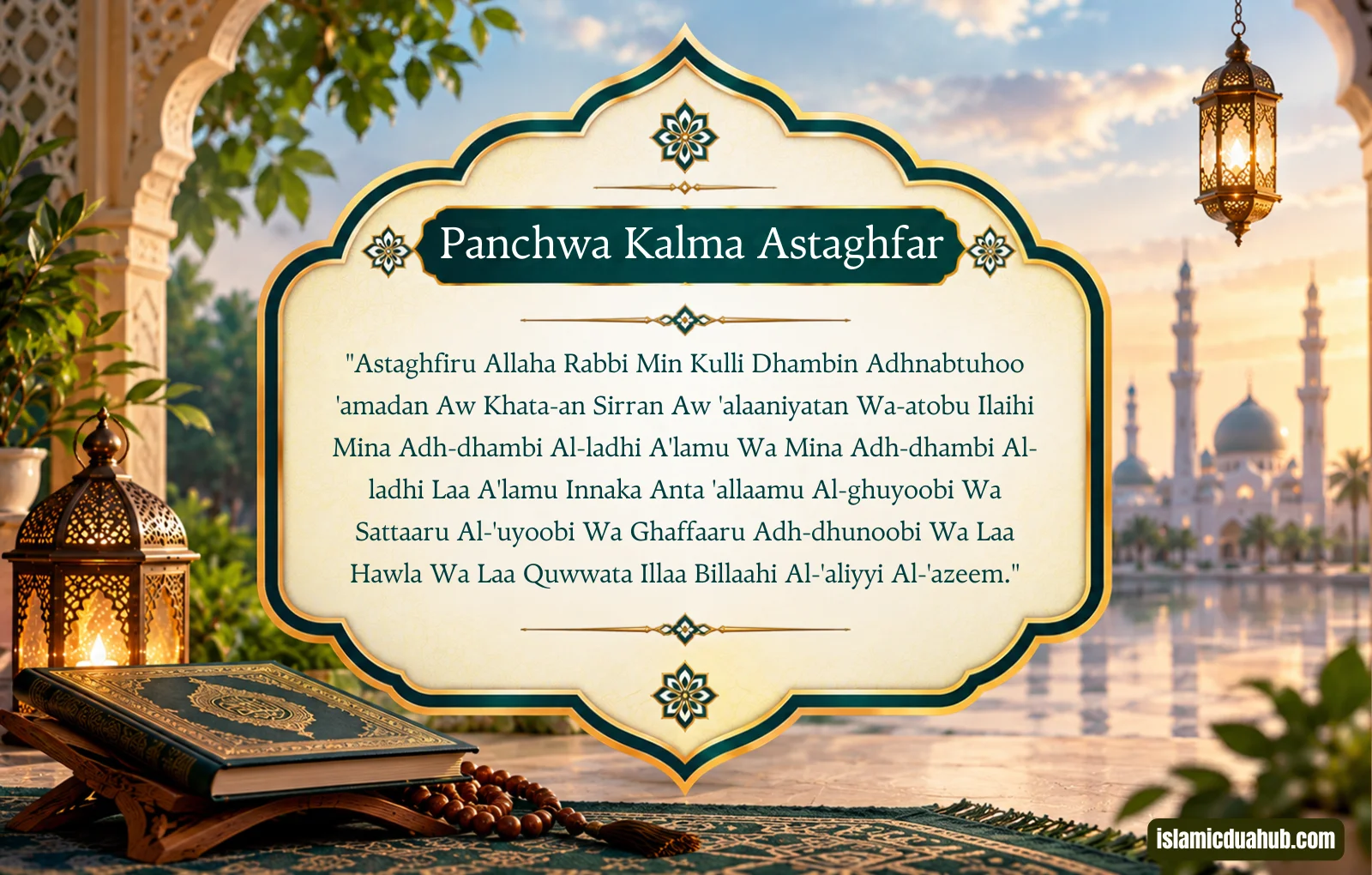
“Astaghfiru Allaha Rabbi Min Kulli Dhambin Adhnabtuhoo ‘Amadan Aw Khata-an Sirran Aw ‘Alaaniyatan Wa-atobu Ilaihi Mina Adh-Dhambi Al-Ladhi A’lamu Wa Mina Adh-Dhambi Al-Ladhi Laa A’lamu Innaka Anta ‘Allaamu Al-Ghuyoobi Wa Sattaaru Al-‘Uyoobi Wa Ghaffaaru Adh-Dhunoobi Wa Laa Hawla Wa Laa Quwwata Illaa Billaahi Al-‘Aliyyi Al-‘Azeem.”
Panchwa Kalma Astaghfar Meaning In English
Reading the Panchwa Kalma in English helps Muslims who are not fluent in Arabic fully grasp what they are saying to Allah. The complete English translation of the 5 Kalma is:
“I seek forgiveness from Allah, my Lord, for every sin that I have committed, intentionally or by mistake, secretly or openly. And I turn towards Him in repentance from the sin that I know and from the sin that I do not know. Indeed, You are the All-Knower of the hidden matters, the Concealer of faults, and the Forgiver of sins. And there is no power and no strength except with Allah, the Most High, the Most Great.”
Panchwa Kalma In Hindi
For readers who prefer Hindi, here is the Hindi transliteration of the Panchwa Kalma:
Hindi Transliteration:
“अस्तग़फिरु अल्लाहा रब्बी मिन कुल्लि ज़नबिन अज़नबतुहू अमदन अव ख़तअन सिर्रन अव अलानियतन व-अतूबु इलैहि मिनज़्ज़नबिल्लज़ी अअलमु व मिनज़्ज़नबिल्लज़ी ला अअलमु इन्नका अन्त अल्लामुल ग़ुयूबि व सत्तारुल उयूबि व ग़फ्फारुज़्ज़ुनूबि वला हव्ल वला कुव्वत इल्ला बिल्लाहिल अलियिल अज़ीम।”
Hindi Meaning (अर्थ):
“मैं अल्लाह से, जो मेरा रब है, हर उस गुनाह की माफी माँगता हूँ जो मैंने जानबूझकर या गलती से, छुपकर या खुलेआम किया। और मैं उन गुनाहों से भी तौबा करता हूँ जिन्हें मैं जानता हूँ और उन गुनाहों से भी जिन्हें मैं नहीं जानता। बेशक तू ही सभी छुपी हुई बातों का जाननेवाला है, ऐबों को छुपानेवाला है और गुनाहों को माफ करनेवाला है। और कोई ताकत और कोई कुव्वत नहीं है सिवाए अल्लाह के, जो बुलंद और महान है।”
Panchwa Kalma In Urdu
Urdu Meaning:
“میں اللہ سے، جو میرا رب ہے، ہر اس گناہ کی معافی مانگتا ہوں جو میں نے جان بوجھ کر یا غلطی سے، چھپ کر یا کھلم کھلا کیا۔ اور میں اُن گناہوں سے بھی توبہ کرتا ہوں جنہیں میں جانتا ہوں اور اُن گناہوں سے بھی جنہیں میں نہیں جانتا۔ بے شک تو ہی تمام پوشیدہ باتوں کا جاننے والا، عیبوں کو چھپانے والا اور گناہوں کو معاف کرنے والا ہے۔ اور کوئی طاقت اور قوت نہیں مگر اللہ کی، جو بلند مرتبہ اور عظیم ہے۔”
Understanding The Words Of The 5 Kalma
The Panchwa Kalma Astaghfar is not just a prayer. Each part of it carries a deep meaning. Breaking it down helps a person recite it with full awareness and sincerity.
“Astaghfiru Allaha Rabbi”
The Kalima begins with “I seek forgiveness from Allah, my Lord.” The word “Rabbi” means my Lord and Sustainer. Starting with this word establishes the direct relationship between a believer and their Creator.
“Min Kulli Dhambin Adhnabtuhoo Amadan Aw Khata-an”
This part means “from every sin that I committed, intentionally or by mistake.” Islam recognizes that humans sin in two ways. Some sins are committed on purpose and some happen out of carelessness or forgetfulness. Both types are included in this supplication.
“Sirran Aw Alaaniyatan”
This translates to “secretly or openly.” Sins committed in private, hidden from people, and sins done openly in public are both addressed here. This shows that the Panchwa Kalma covers all dimensions of human wrongdoing.
“Wa Mina Adh-Dhambi Al-Ladhi Laa A’lamu”
This is one of the most profound parts. It says “and from the sins that I do not know.” A person may have hurt others without realizing it, or done something wrong without awareness. The fifth Kalima covers even those hidden errors.
“Innaka Anta Allaamu Al-Ghuyoobi”
This means “You are the All-Knower of the unseen.” Here the believer acknowledges that Allah knows everything that is hidden, including every sin, every thought, and every secret act. This recognition brings deep humility.
“Wa Sattaaru Al-Uyoobi Wa Ghaffaaru Adh-Dhunoobi”
“The Concealer of faults and the Forgiver of sins.” This powerful phrase recognizes two of Allah’s great attributes. Allah not only forgives sins but also hides the faults of His servants from others. This is one of His greatest mercies.
“Wa Laa Hawla Wa Laa Quwwata Illaa Billaahi Al-Aliyyi Al-Azeem”
The Kalima closes with “And there is no power and no strength except with Allah, the Most High, the Most Great.” This is the declaration that humans are weak and that all ability belongs to Allah alone.
When To Recite Panchwa Kalma Astaghfar
The Panchwa Kalma Astaghfar can be recited at any time. There is no specific time restriction on seeking forgiveness from Allah. However, there are certain moments when reciting it carries particular weight.
After Every Salah (Prayer)
Many Muslims recite the fifth Kalima after completing their five daily prayers. It is a common practice to follow the obligatory prayers with Astaghfar and other forms of dhikr. Reciting the 5 Kalma after Salah is a way of washing away any shortcomings in the prayer itself.
After Committing A Sin
The best time to recite the Panchwa Kalma Astaghfar is immediately after realizing a mistake has been made. Islam does not encourage Muslims to delay repentance. Allah says in the Quran that He loves those who repent and purify themselves (Surah Al-Baqarah 2:222).
In The Final Third Of The Night
The Prophet Muhammad (peace be upon him) mentioned that Allah descends to the lowest heaven in the last third of every night and calls out: “Who is asking Me, so I can give him? Who is seeking My forgiveness, so I can forgive him?” Reciting the Panchwa Kalma during this sacred time is especially rewarding.
During Days Of Sorrow Or Hardship
When a person is going through difficulty, distress, or sorrow, reciting the fifth Kalima helps bring peace to the heart. The acknowledgment that all power belongs to Allah alone gives a believer strength and calmness.
Before Going To Sleep
Many scholars recommend reciting Astaghfar before sleeping so that a person enters their night in a state of repentance. The Panchwa Kalma is a complete and thorough way to do this.
How To Recite Panchwa Kalma Astaghfar
Reciting the fifth Kalima correctly involves more than just words. Here is how to recite it with proper intention and understanding.
Step 1: Make A Sincere Intention
Before reciting, make a clear intention in your heart that you are turning to Allah in genuine repentance. The intention (Niyyah) is the foundation of every act of worship in Islam.
Step 2: Be In A State Of Purity When Possible
While it is not required to be in wudu to make Astaghfar, being in a state of ritual purity shows additional respect and readiness for supplication.
Step 3: Face The Qibla
If the situation allows, turn towards the direction of the Kaaba while reciting. This shows reverence and focus.
Step 4: Recite Slowly And With Understanding
Do not rush through the words. Recite each word carefully and think about what you are saying. True Astaghfar requires awareness and feeling, not just mechanical repetition.
Step 5: Feel Genuine Regret
The core of Astaghfar is remorse. While reciting the Panchwa Kalma Astaghfar, feel genuine regret for past sins and make a firm resolve not to return to them.
Benefits Of Panchwa Kalma Astaghfar
Reciting the Panchwa Kalma Astaghfar regularly brings many spiritual and worldly benefits. These benefits are rooted in the Quran and the teachings of the Prophet Muhammad (peace be upon him).
Purification Of The Soul
Regular recitation of the 5 Kalma cleanses the heart and soul from the darkness that sins bring. Just as physical dirt is washed off with water, spiritual sins are purified through sincere Astaghfar. Allah says in Surah Al-Zumar (39:53): “Do not despair of Allah’s mercy. Surely Allah forgives all sins.”
Relief From Anxiety And Worry
One of the most immediate benefits that Muslims experience is a sense of peace after reciting the Panchwa Kalma Astaghfar. When a person confesses their faults to Allah and asks for forgiveness, a heavy burden is lifted from the heart.
Increase In Sustenance And Blessings
The Quran mentions in Surah Nuh (71:10-12) that the Prophet Nuh told his people to seek forgiveness and that Allah would send them abundant rain, increase their wealth and children, and bless them with gardens and rivers. This shows that Astaghfar brings material blessings as well.
Protection From Punishment
Seeking forgiveness is a shield against Allah’s punishment. Allah told the Prophet (peace be upon him) that He would not punish a people while they were seeking His forgiveness (Surah Al-Anfal 8:33). Reciting the fifth Kalima regularly keeps this protection active.
Acceptance Of Other Supplications
Scholars of Islam mention that a person who frequently makes Astaghfar finds their other duas more readily accepted. Sins can act as barriers between a believer and their prayers being answered. Reciting the Panchwa Kalma Astaghfar removes those barriers.
Strengthening Of Iman
Each time a Muslim sincerely recites the fifth Kalima and reflects on Allah’s attributes of forgiveness, their faith and connection with Allah grows stronger. It is a practice that builds Iman over time.
The Six Kalimas Of Islam: Where Does Panchwa Fit?
Islam has six essential Kalimas that every Muslim should know. Each one serves a different purpose in the life of a believer. Here is a brief overview of where the Panchwa Kalma Astaghfar fits among them.
- Pehla Kalma (Kalima Tayyabah): Declaration of faith in the oneness of Allah and prophethood of Muhammad (peace be upon him)
- Doosra Kalma (Kalima Shahadat): The testimony of faith
- Teesra Kalma (Kalima Tamjeed): Glorification of Allah
- Chautha Kalma (Kalima Tauheed): The declaration of the unity of Allah
- Panchwa Kalma (Kalima Astaghfar): Seeking forgiveness from Allah for all sins
- Chhata Kalma (Kalima Radd-e-Kufr): Rejection of disbelief and reaffirmation of faith
The fifth Kalima comes after the declarations of faith and glorification of Allah. It is the natural next step. After recognizing who Allah is and praising Him, a believer turns to Him in repentance.
Connection Of Astaghfar With The Quran And Hadith
The practice of Astaghfar is deeply rooted in both the Quran and the Sunnah of the Prophet (peace be upon him).
Allah says in the Quran:
“And seek forgiveness of your Lord and repent to Him. Indeed, my Lord is Merciful and Loving.” (Surah Hud 11:90)
“And those who, when they commit an immorality or wrong themselves, remember Allah and seek forgiveness for their sins. And who can forgive sins except Allah?” (Surah Al-Imran 3:135)
The Prophet Muhammad (peace be upon him) himself used to seek forgiveness more than seventy times every single day, even though he was free from sin. This shows how important and beloved the practice of Astaghfar is in Islam.
In one well-known hadith, the Prophet (peace be upon him) said: “Whoever makes Astaghfar regularly, Allah will make for him a way out of every hardship, a relief from every worry, and will provide for him from where he does not expect.” (Abu Dawud)
The Importance Of Tawbah Along With Astaghfar
Astaghfar and Tawbah (repentance) often go together, but they are not exactly the same thing.
Astaghfar is the act of asking for forgiveness with the tongue and the heart. Tawbah is the full act of repentance, which includes acknowledging the sin, feeling genuine regret, stopping the sinful behavior, and making a firm intention not to return to it.
When a Muslim recites the Panchwa Kalma Astaghfar, the words already include the phrase “Wa Atoobu Ilaihi,” which means “And I turn to Him in repentance.” So the fifth Kalima itself contains both Astaghfar and Tawbah.
This makes the 5 Kalma a complete act of seeking forgiveness in one recitation.
🤲 Read These Other Islamic Supplications As Well:
Conclusion
The Panchwa Kalma Astaghfar is a treasure for every believing Muslim. In a few powerful words, it covers every kind of sin a person could commit and turns the heart completely towards Allah.
Reciting the Panchwa Kalma regularly is not just an act of worship. It is a daily renewal of the relationship between a servant and his Creator. It is the believer saying to Allah: “I am weak, I make mistakes, but I keep coming back to You.”
Allah’s mercy has no limits. The Quran reminds believers that no matter how many sins have been committed, hopelessness in Allah’s mercy is itself a sin. The door of forgiveness is always open for those who genuinely seek it.
Make the Panchwa Kalma Astaghfar a part of your daily routine. Recite it after Salah, before sleeping, and whenever you feel the weight of your mistakes. Let it be your constant connection to Allah’s infinite mercy and forgiveness.
May Allah accept the repentance of every Muslim, forgive all sins, and grant us all His mercy in this life and the next. Ameen.
? Frequently Asked Questions (FAQs)
Q1. What is the Panchwa Kalma Astaghfar?
The Panchwa Kalma Astaghfar is the fifth of the six Kalimas in Islam. It is a comprehensive declaration in which a Muslim seeks forgiveness from Allah for all past sins, whether done knowingly, unknowingly, openly, or in secret.
Q2. How many times should I recite the fifth Kalima?
There is no fixed number required. Reciting it with sincerity even once holds great value. Many Muslims recite it after every Salah or as part of their daily dhikr.
Q3. Can women recite Panchwa Kalma Astaghfar during their menses?
Yes. Reciting Astaghfar, dhikr, and general supplications is permitted for women at all times, including during their menstrual cycle.
Q4. Is there a specific time when Panchwa Kalma is most accepted?
Astaghfar recited in the last third of the night, after Fajr prayer, and on Fridays holds special spiritual weight according to Islamic teachings.
Q5. What is the difference between Astaghfar and the phrase “Astaghfirullah”?
“Astaghfirullah” is a shorter phrase that simply means “I seek forgiveness from Allah.” The Panchwa Kalma Astaghfar is the full, complete supplication that covers all types of sins in detail. Both are valid forms of seeking forgiveness.
Q6. Can children memorize the Panchwa Kalma Astaghfar?
Yes. Teaching children the six Kalimas, including the fifth, is an important part of Islamic education. Parents and teachers are encouraged to help children memorize and know the meaning of these supplications from an early age.
Q7. Does reciting Astaghfar remove major sins?
According to Islamic scholars, sincere repentance through Astaghfar and Tawbah can erase major sins as well, provided the person genuinely regrets the sin and resolves not to return to it.
Q8. Can I recite the 5 Kalma in any language?
While reciting it in Arabic is preferred since the words are more precise and carry their original weight, understanding the meaning in your own language helps sincerity. Supplications to Allah can be made in any language.
Written by: Ahmad Raza
Credentials: Islamic Studies Content Writer
Read More duas for daily life at Instant Dua