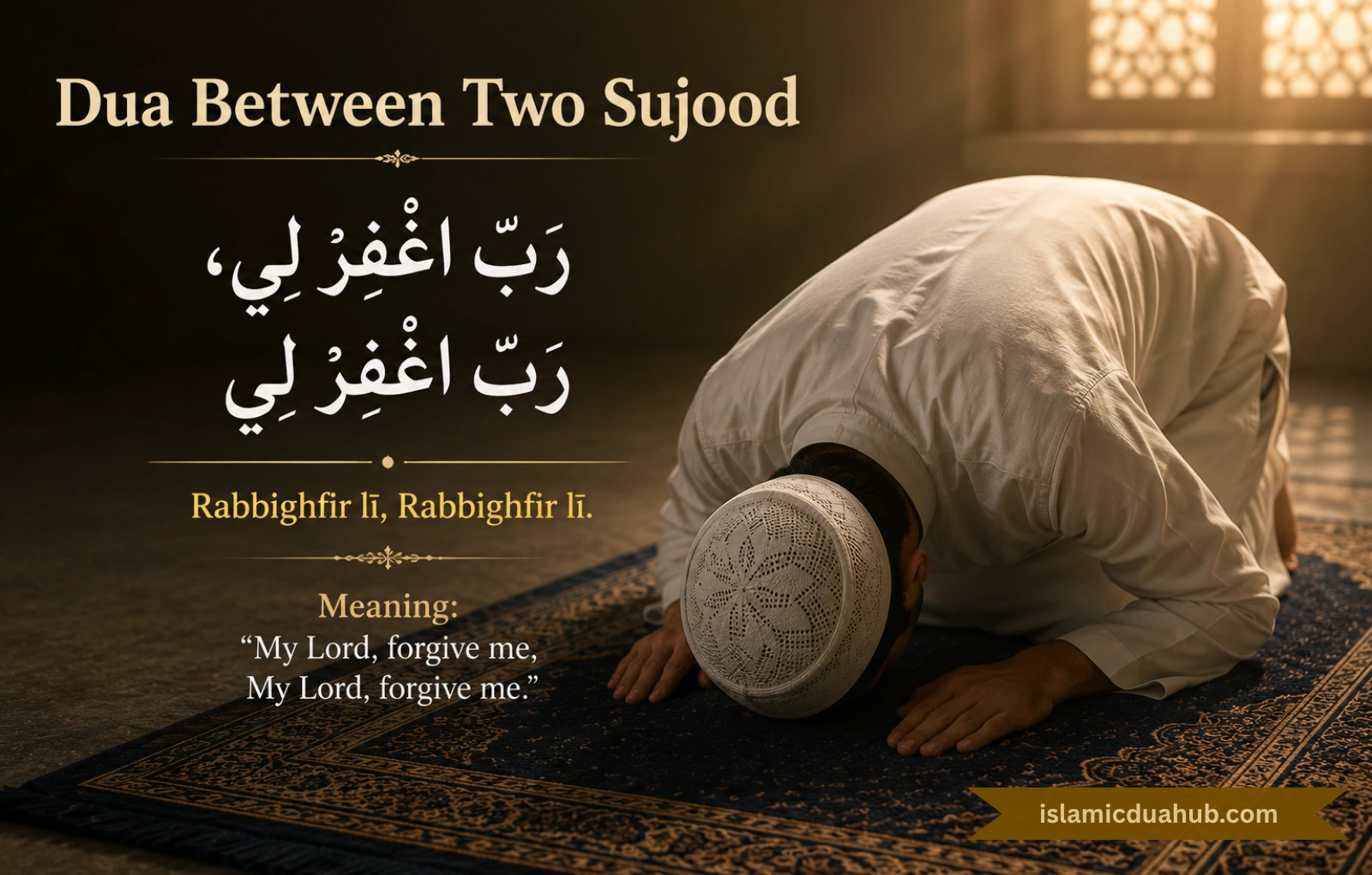
Salah is the second pillar of Islam and the most direct connection between a Muslim and Allah (SWT). Every moment inside Salah carries immense weight, and each position holds its own purpose and supplication.
One such moment that many Muslims overlook is the short sitting between the two prostrations. This position is called the Jalsa, and the supplication recited during it is known as the Dua Between Two Sujood.
This dua is recited in every rakah of Salah, making it one of the most repeated supplications in a Muslim’s day. Yet many people either rush through it or do not know its full meaning. This short but powerful supplication carries a beautiful collection of requests to Allah forgiveness, mercy, guidance, provision, good health, and elevation of rank.
What Is the Dua Between Two Sujood?
The Dua Between Two Sujood is the supplication recited while sitting between the first and second prostration (Sajdah) in every rakah of Salah. After completing the first Sajdah, the worshipper rises and sits briefly in a position called the Jalsa. During this sitting, a specific dua is recited before going down for the second Sajdah.
The Dua Between Two Sajdah comes directly from the practice and teaching of Prophet Muhammad (peace and blessings be upon him). It is narrated from Ibn Abbas (may Allah be pleased with him) that the Prophet (PBUH) recited this dua regularly between the two prostrations.
There are two authentic versions of this supplication a shorter version and a more comprehensive one. Both are valid, and a Muslim may choose either one based on what they have memorized.
Dua Between Two Sujood in Arabic
Short Version
This is the easier version, especially suited for beginners and children who are just starting to learn Salah.
Arabic:
رَبِّ اغْفِرْ لِي، رَبِّ اغْفِرْ لِي
Comprehensive Version
This is the fuller version narrated from the Prophet (PBUH) and is the more preferred recitation. It covers seven beautiful requests in one supplication.
Arabic:
اللَّهُمَّ اغْفِرْ لِي، وَارْحَمْنِي، وَاهْدِنِي، وَاجْبُرْنِي، وَعَافِنِي، وَارْزُقْنِي، وَارْفَعْنِي
Dua Between Two Sujood in English
Short Version
Rabbighfir lee, Rabbighfir lee.
Comprehensive Version
Allaahum-maghfir lee, war-hamnee, wah-dinee, waj-burnee, wa ‘aafinee, war-zuqnee, war-fa’nee.
Reading the transliteration carefully and practicing it slowly helps build confidence until the Arabic pronunciation becomes natural.
Dua Between Two Sujood Meaning in English
Short Version Meaning
“My Lord, forgive me. My Lord, forgive me.”
A simple yet powerful plea to Allah asking for His forgiveness repeated twice for emphasis.
Comprehensive Version Meaning
“O Allah, forgive me, have mercy upon me, guide me, restore me, give me good health, grant me sustenance, and elevate my rank.”
Each phrase in the Dua Between 2 Sujood carries a deep meaning:
| Arabic Phrase | Meaning |
|---|---|
| Allaahum-maghfir lee | O Allah, forgive me |
| War-hamnee | Have mercy upon me |
| Wah-dinee | Guide me |
| Waj-burnee | Restore me / Enrich me / Mend my brokenness |
| Wa ‘aafinee | Give me good health and well-being |
| War-zuqnee | Grant me sustenance (wealth, knowledge, good character) |
| War-fa’nee | Raise my rank (in this world and the Hereafter) |
The word “Waj-burnee” deserves special attention. It is from the root word jabr, which means to mend something that is broken and restore it. When a Muslim says this in Salah, they are asking Allah to fix whatever is broken in their life their heart, their affairs, their sadness. It is one of the most beautiful phrases in the entire dua.
Dua Between Two Sujood Hadith Reference
The Dua Between Two Sujood is established from authentic narrations of the Prophet Muhammad (peace and blessings be upon him).
Ibn Abbas (may Allah be pleased with him) narrated that the Prophet (PBUH) used to say between the two prostrations:
Arabic (from the Hadith):
عَنْ ابْنِ عَبَّاسٍ أَنَّ النَّبِيَّ صَلَّى اللَّهُ عَلَيْهِ وَسَلَّمَ كَانَ يَقُولُ بَيْنَ السَّجْدَتَيْنِ: اللَّهُمَّ اغْفِرْ لِي وَارْحَمْنِي وَاجْبُرْنِي وَاهْدِنِي وَارْزُقْنِي
This hadith is recorded in the collections of Abu Dawud, Ibn Majah, and At-Tirmidhi. The shorter version “Rabbighfir lee, Rabbighfir lee” has also been narrated by An-Nasa’i and Ibn Majah.
When to Read This Dua
The Dua Between Sujood is recited during a very specific and brief moment in Salah.
After completing the first Sajdah, rise from the prostration saying “Allahu Akbar,” sit upright in the Jalsa position, and then recite this dua before lowering for the second Sajdah.
This happens in every rakah of Salah. So in a four-rakah prayer like Dhuhr or Asr, this dua is recited four times. In a two-rakah prayer like Fajr, it is recited twice. This makes the Dua Between Two Sujood one of the most frequently recited duas in a Muslim’s daily worship.
The sitting should be calm and unhurried. The Prophet (PBUH) used to sit in the Jalsa long enough for all his joints to settle in their proper positions before going down for the second Sajdah. Rushing through this moment is discouraged.
The Correct Sitting Position (Jalsa)
Along with the dua, the posture during the Jalsa is also important. The Sunnah manner of sitting between the two prostrations is as follows:
The left foot is placed flat on the ground, and the worshipper sits upon it. The right foot remains upright with the toes pointing toward the Qibla. Both hands rest gently on the thighs or knees with fingers held naturally together.
This position should be held with composure, not rushed. When the body settles and the dua is recited, one then says “Allahu Akbar” and moves into the second Sajdah.
Is This Dua Sunnah or Obligatory?
Scholars have discussed the ruling on reciting the Dua Between Two Sujood, and there are two main positions:
The Majority of Scholars: Most scholars consider this dua to be a confirmed Sunnah (Sunnah Muakkadah). This means if a person forgets to recite it, their prayer remains valid. However, they miss out on significant reward.
The Hanbali View: Some scholars consider it to be Wajib (obligatory). According to this view, intentionally leaving it may affect the prayer, and if forgotten, the worshipper should perform Sujood as-Sahw (Prostration of Forgetfulness) at the end of the prayer.
In all cases, the best practice is to make sincere effort to memorize and recite this dua in every Salah.
What If You Do Not Know the Arabic Yet?
Someone new to Islam or a child learning Salah for the first time may not have memorized the Arabic text immediately. In such a case, they may ask Allah for forgiveness and good in whatever words they can, while sincerely working to memorize the correct Arabic wording as soon as possible.
The best and most rewarding practice is to recite the exact words narrated from the Prophet (PBUH). So it is strongly encouraged to give this dua priority in one’s memorization journey.
Starting with the short version “Rabbighfir lee, Rabbighfir lee” is an easy and excellent first step.
Benefits of Reading the Dua Between Two Sujood
The benefits of this supplication are spiritual, practical, and deeply connected to a believer’s relationship with Allah.
Complete Reliance on Allah: By reciting this dua multiple times every day, a Muslim trains their heart to turn to Allah for all their needs forgiveness, health, provision, and guidance instead of depending only on themselves or others.
Comprehensive Supplication: The comprehensive version covers the most important needs of a human being in both this world and the Hereafter. In just a few words, a Muslim asks for forgiveness of sins, mercy from Allah, guidance on the right path, healing of broken circumstances, good health, daily sustenance, and elevation in rank before Allah.
Khushu in Prayer: Knowing the meaning of the words being recited brings greater focus and heartfelt presence in Salah. Instead of mechanical movements, each moment becomes a conscious conversation with Allah.
Constant Remembrance: Because this dua is recited in every rakah, it ensures that the worshipper is regularly turning to Allah throughout the prayer. This repeated connection strengthens the bond between the servant and their Creator.
Following the Sunnah: One of the greatest acts of worship is to follow the example of Prophet Muhammad (peace and blessings be upon him). Reciting exactly what he taught his companions is a way of honoring his Sunnah and drawing closer to Allah.
Tips to Memorize the Dua Between Two Sujood
Memorizing this dua does not take long with a little consistency.
Begin with the short version. “Rabbighfir lee” is simple and can be memorized within minutes. Once it feels natural in Salah, move on to the comprehensive version.
Break the comprehensive version into phrases. Memorize two phrases a day while understanding their meanings. Connecting the words to their meanings makes retention much easier.
Recite it during non-prayer times as well. Repeating it during the day while walking, resting, or before sleep helps cement it in memory faster.
Practice slowly before speeding up. Getting the pronunciation right is more important than reciting quickly.
 See More Reliable Islamic Duas:
- Zina Se Bachne Ki Dua
- Rabbana Atina Dua
- Allahummaghfirli Dua
- Masjid Me Dakhil Hone Ki Dua
- So Kar Uthne Ki Dua
- Sir Dard Ki Dua In Quran
- Naya Chand Dekhne Ki Dua
- Hadsat Se Bachne Ki Dua
- Hazrat Yunus Dua
- Musibat Ki Dua in Hindi
Conclusion
The Dua Between Two Sujood is a small yet deeply meaningful supplication that sits at the heart of every Muslim’s daily Salah. Recited between the two prostrations in each rakah, this dua is one of the most frequent conversations a believer has with Allah throughout the day.
Whether one recites the short version asking simply for forgiveness or the comprehensive version that covers seven profound requests, each word carries sincerity, humility, and complete reliance on Allah’s mercy and care.
Taking a few moments to truly memorize this dua, understand its meaning, and recite it with presence of heart transforms Salah from routine motions into a heartfelt act of worship. The Dua Between Sujood is a reminder that every position in prayer is a gift a chance to ask the Most Merciful for everything one’s heart needs.
May Allah accept our prayers, grant us His forgiveness, and fill our hearts with true Khushu in every Salah. Ameen.
? FAQs About Dua Between Two Sujood
Q: What is the Dua Between Two Sujood?
A: It is the supplication recited while sitting between the two prostrations in Salah.
Q: What is the Arabic text of the Dua Between Two Sujood?
A: The short version is: رَبِّ اغْفِرْ لِي، رَبِّ اغْفِرْ لِي.
The comprehensive version is: اللَّهُمَّ اغْفِرْ لِي، وَارْحَمْنِي، وَاهْدِنِي، وَاجْبُرْنِي، وَعَافِنِي، وَارْزُقْنِي، وَارْفَعْنِي.
Q: Is the Dua Between Two Sujood obligatory or Sunnah?
A: It is a confirmed Sunnah according to the majority of scholars. Some Hanbali scholars consider it obligatory.
Q: What if I forget to say the Dua Between Two Sujood?
A: Your prayer remains valid. There is no need to repeat it.
Q: Can I say this dua in English during Salah?
A: No. Arabic is required in formal Salah. New Muslims should work toward memorizing the Arabic as soon as possible.
Q: Which version should I recite, short or comprehensive?
A: Both are valid. Beginners may start with the short version and move to the comprehensive one later.
Written by: Ahmad Raza
Credentials: Islamic Studies Content Writer
Read More duas for daily life at Instant Dua