Surah Kausar, also written as Surah Al Kausar or Surah Al-Kawthar (سُورَةُ الْكَوْثَر), is the 108th chapter of the Holy Quran. It is the shortest Surah in the entire Quran, made up of only three verses, ten words, and forty-two letters. Despite its brief length, it carries a message of immense depth and divine promise.
The word “Kausar” (كَوْثَر) is derived from the Arabic root meaning abundance, plentifulness, and overflowing goodness. It refers both to the countless blessings Allah bestowed upon the Prophet Muhammad ﷺ and to a special river in Jannah (Paradise).
Surah Kausar is found in the 30th Para (Juz) of the Quran and is classified as a Makki Surah, meaning it was revealed in Makkah. It came down at a deeply painful time in the Prophet’s ﷺ life, when his enemies were mocking him for the deaths of his sons and calling him “abtar,” meaning one who has no legacy or posterity. Allah responded with this Surah as a divine declaration of honor and comfort for His beloved Prophet ﷺ.
This Surah is recited in daily prayers across the Muslim world. Its Surah Kausar translation in English, Hindi (सूरह कौसर), Urdu, and Bengali helps Muslims everywhere connect with its profound meaning.
Surah Kausar Quick Reference
| Detail | Information |
|---|---|
| Surah Number | 108 |
| Total Verses | 3 |
| Total Words | 10 |
| Total Letters | 42 |
| Revelation | Makkah (Makki Surah) |
| Para / Juz | 30 |
| Surah Name Meaning | Abundance / Plentifulness |
| Also Known As | Surah Al-Kawthar, Surah Kausar, Surah Kawthar, Surah Nahar |
| Key Theme | Divine Blessings, Sincere Worship, Gratitude |
Surah Kausar In Arabic
Below is the complete Surah Al Kausar in Arabic:
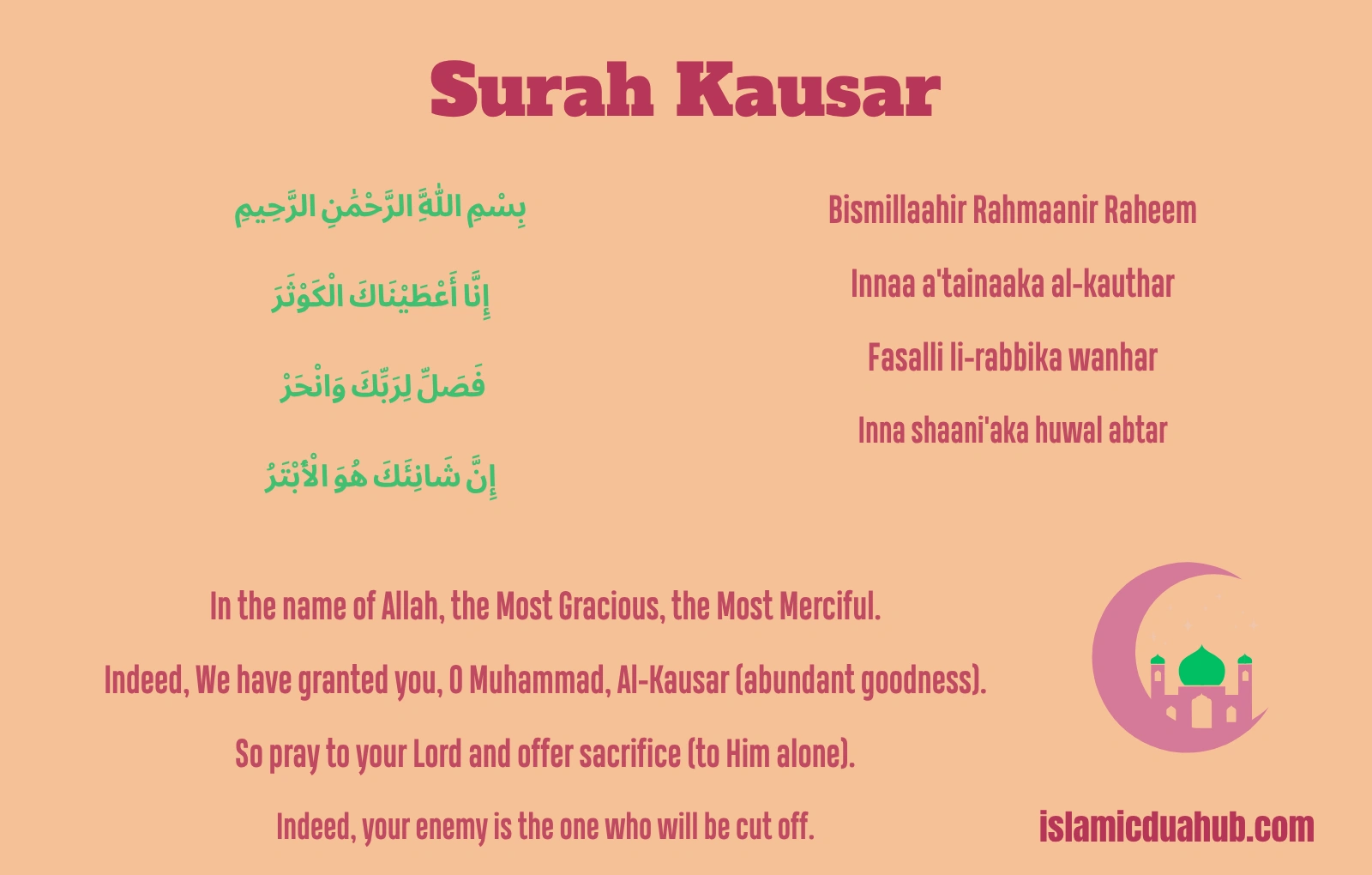
بِسْمِ اللَّهِ الرَّحْمَٰنِ الرَّحِيمِ
1. إِنَّا أَعْطَيْنَاكَ الْكَوْثَرَ
2. فَصَلِّ لِرَبِّكَ وَانْحَرْ
3. إِنَّ شَانِئَكَ هُوَ الْأَبْتَرُ
Surah Kausar Transliteration (Roman English)
For those who want to read Surah Al Kausar without knowing Arabic script, here is the easy Roman transliteration:
Bismillaahir Rahmaanir Raheem
1. Innaa a’tainaaka al-kauthar
2. Fasalli li-rabbika wanhar
3. Inna shaani’aka huwal abtar
Surah Kausar Translation In English
In the name of Allah, the Most Gracious, the Most Merciful.
1. Indeed, We have granted you, O Muhammad, Al-Kausar (abundant goodness).
2. So pray to your Lord and offer sacrifice (to Him alone).
3. Indeed, your enemy is the one who will be cut off.
This Surah Kausar translation in English comes from reliable Quranic scholarship and reflects the meaning upheld by major translators including Abdullah Yusuf Ali, who rendered the first verse as: “To thee have We granted the Fount of Abundance.”
Surah Kausar In Hindi (सूरह कौसर हिंदी में)
सूरह कौसर अरबी उच्चारण (Hindi Transliteration):
बिस्मिल्लाह-हिर्रहमान-निर्रहीम
1. इन्ना आतय ना कल कौसर
2. फसल्लि लिरब्बिका वन्हर
3. इन्ना शानिअका हुवल अब्तर
सूरह कौसर का हिंदी अनुवाद (Surah Kausar Meaning In Hindi):
अल्लाह के नाम से, जो अत्यन्त कृपाशील तथा दयावान है।
1. (हे नबी!) हमने तुम्हें कौसर प्रदान किया है।
2. तो तुम अपने पालनहार के लिए नमाज़ पढ़ो तथा बलि दो।
3. निःसंदेह तुम्हारा शत्रु ही बेनाम-निशान है।
सूरह कौसर का मतलब (Surah Kausar Meaning In Hindi) बहुत स्पष्ट है: अल्लाह ने अपने नबी ﷺ को हर किसी से बढ़कर नेमतें दी हैं, और जो दुश्मन उनका मज़ाक उड़ाते थे, वही असल में बे-नाम-ओ-निशान हो जाएंगे।
Surah Kausar With Urdu Translation (سورہ کوثر اردو ترجمہ)
اردو ترجمہ:
بِسْمِ اللّٰهِ الرَّحْمٰنِ الرَّحِيْمِ
1. بے شک ہم نے آپ کو کوثر عطا فرمائی ہے۔
2. پس آپ اپنے رب کے لیے نماز پڑھیں اور قربانی کریں۔
3. بے شک آپ کا دشمن ہی بے نام و نشان ہے۔
Surah Kausar in Urdu tarjuma (Surah Kausar Tarjuma) shows the deep promise Allah made to Prophet Muhammad ﷺ: that the one with no future is not the Prophet, but rather those who opposed him.
Surah Kausar In Bengali (সূরা কাউসার বাংলা অনুবাদ)
বাংলা উচ্চারণ:
বিসমিল্লাহির রাহমানির রাহিম
1. ইন্না আ’ত্বায়না-কাল কাওছার
2. ফাছাল্লে লি রাব্বিকা ওয়ান্হার
3. ইন্না শানিয়াকা হুওয়াল আবতার
বাংলা অনুবাদ:
পরম করুণাময় অসীম দয়ালু আল্লাহর নামে।
1. নিশ্চয়ই আমরা আপনাকে কাউসার দান করেছি।
2. অতএব আপনার পালনকর্তার উদ্দেশ্যে নামায পড়ুন এবং কুরবানী করুন।
3. নিশ্চয়ই আপনার শত্রুই নির্বংশ।
Explanation Of Surah Kausar
Verse 1: The Gift of Al-Kausar
The opening verse, “Innaa a’tainaaka al-kauthar,” is a direct address from Allah to the Prophet ﷺ. The word “Inna” (Indeed We) carries absolute certainty and divine authority. The word “Al-Kausar” is an intensive form of “kathrat,” which means great abundance in every sense.
Ibn Abbas (رضي الله عنه) explained in Sahih Bukhari (No. 4966) that Al-Kausar refers to the abundant goodness Allah gave the Prophet ﷺ. This includes prophethood, the Quran, wisdom, countless followers, honor in this world and the Hereafter, and a special river in Jannah. The Prophet ﷺ himself described this river in a narration recorded in Sahih Muslim, saying that its water is whiter than milk and sweeter than honey, and that birds drink from it with necks like camels.
This verse came as a direct answer to those who claimed the Prophet ﷺ would be forgotten. Allah declared: the real abundance, the real legacy, belongs to His Messenger ﷺ.
Verse 2: The Command to Pray and Sacrifice
The second verse, “Fasalli li-rabbika wanhar,” commands the Prophet ﷺ, and through him all believers, to offer salah (prayer) and qurbani (sacrifice) exclusively for Allah. At a time when the polytheists of Arabia offered prayers and sacrifices to their idols, this verse established clearly: all worship belongs to Allah alone. This is the same teaching mentioned in Surah Al-Anam (6:162) where it is said that one’s prayer, sacrifice, life, and death are all for Allah, the Lord of the worlds.
Verse 3: The Enemy Is Cut Off
The final verse, “Inna shaani’aka huwal abtar,” turned the taunt of the Prophet’s ﷺ enemies back on themselves. The pagan leaders, particularly As ibn Wa’il, used to say the Prophet ﷺ was “abtar,” meaning without male descendants and therefore without a lasting legacy. Allah declared the complete opposite: it is the enemy of the Prophet ﷺ who is truly abtar, cut off from honor, from lasting memory, and from all goodness. History has proven this completely. Those men have been forgotten, while the Prophet Muhammad ﷺ is remembered, loved, and followed by over a billion Muslims across the world.
Background Of Surah Kausar: Reason For Revelation (Shan-e-Nuzul)
It is reported by Ibn Abi Hatim, on the authority of Suddi, and by Baihaqi in Dala’il-un-Nubuwwah, on the authority of Muhammad ibn Ali ibn Husain (رضي الله عنه), that in Arab culture the loss of male offspring was a social stigma. When the Prophet’s ﷺ young son Qasim, and later Ibrahim, passed away in childhood, the leaders of the Quraysh began mocking him. As ibn Wa’il was especially harsh, saying that the Prophet ﷺ would be forgotten after his death because he had no male heir.
Allah sent down Surah Al Kausar to console the Prophet ﷺ and to declare with absolute certainty that the enemy’s claim was false. The Surah is therefore not just a comfort to the Prophet ﷺ personally, but a timeless declaration that the truth can never be erased, and that those who mock it will fade into obscurity.
When To Read Surah Kausar
In The Daily Five Prayers
Surah Kausar can be recited in any rakat of any salah after Surah Fatiha. Because of its very short length, it is commonly recited by Muslims in Fajr and Maghrib Sunnah prayers and in the last rakats of voluntary prayers.
During Qurbani (Sacrifice)
Because verse two specifically mentions offering sacrifice for Allah, some Muslims recite Surah Kausar before or during the act of Qurbani to remember the intention of sincerity for Allah alone.
In Tarawih and Tahajjud
Surah Al Kausar is also frequently recited in Tarawih prayers during Ramadan and in Tahajjud prayers at night, where shorter surahs are often used in additional rakats.
As A Daily Recitation
Many Muslims memorize and recite Surah Kausar regularly as part of their daily Quran reading, given how easy it is to memorize. Its short length makes it accessible for children and new Muslims as well.
How To Recite Surah Kausar Step By Step
Step 1: Make Wudu (Ablution) Before Recitation
Before reciting any portion of the Quran, it is necessary to be in a state of purity. Perform wudu properly by washing the hands, rinsing the mouth, cleaning the nose, washing the face, arms up to the elbows, wiping the head, and washing the feet. Reciting Surah Al Kausar with wudu reflects the proper respect owed to the words of Allah.
Step 2: Face The Qibla And Set Your Intention
Sit or stand facing the direction of the Qibla (towards the Kaaba in Makkah). Make a clear intention in your heart that you are reciting this Surah for the sake of Allah alone, whether as part of salah, as a standalone recitation, or for reflection and remembrance.
Step 3: Begin With Bismillah
Always begin with:
بِسْمِ اللَّهِ الرَّحْمَٰنِ الرَّحِيمِ
Bismillaahir Rahmaanir Raheem
This is the proper way to open every Surah of the Quran (with the exception of Surah At-Tawbah). It affirms that the recitation is done in the name of Allah, the Most Gracious, the Most Merciful.
Step 4: Recite Verse By Verse With Correct Pronunciation
Read each verse clearly and carefully. Do not rush. The three verses of Surah Kausar in Arabic are:
إِنَّا أَعْطَيْنَاكَ الْكَوْثَرَ
Innaa a’tainaaka al-kauthar
فَصَلِّ لِرَبِّكَ وَانْحَرْ
Fasalli li-rabbika wanhar
إِنَّ شَانِئَكَ هُوَ الْأَبْتَرُ
Inna shaani’aka huwal abtar
Pay attention to the letters that have distinct Arabic sounds. The letter “ع” in “a’tainaaka” requires a slight throat sound. The “ن” at the end of “wanhar” carries a nasal sound. Listening to a qualified reciter before practicing helps greatly with correct tajweed.
Step 5: Reflect On The Meaning As You Recite
Recitation carries far greater reward and spiritual weight when the heart is engaged. As each verse is recited, recall its meaning. The first verse is a reminder of Allah’s endless gifts. The second is a call to pure and sincere worship. The third is a promise that truth always outlasts falsehood. This reflection transforms recitation from a mechanical act into a living conversation with the words of Allah.
Step 6: Recite Durood Before And After (For Non-Prayer Recitation)
When reciting Surah Al Kausar outside of salah, it is a beautiful practice to send Durood (salawat) upon the Prophet ﷺ before and after the recitation. This is especially meaningful given that Surah Kausar was revealed as a direct honor to the Prophet ﷺ himself. A simple Durood is:
اللَّهُمَّ صَلِّ عَلَى مُحَمَّدٍ وَعَلَى آلِ مُحَمَّدٍ
Allahumma salli ‘ala Muhammadin wa ‘ala aali Muhammad
Step 7: Make Dua After Recitation
After completing the Surah, raise your hands and make sincere dua to Allah. Ask for His blessings, for gratitude in your heart, and for the honor of drinking from Hauz-e-Kausar on the Day of Judgment. The moments after Quranic recitation are blessed moments, and duas made at such times carry special weight.
Benefits Of Surah Kausar
It is important to note that no specific verified hadith lists isolated benefits for reciting Surah Kausar a fixed number of times. Claims about Surah Kausar Ka Wazifa 129 times or similar fixed-number practices are popular in some communities but are not established by reliable narrations. Any such practice should be done as a general act of worship and hope in Allah’s mercy, not as a specific prescribed ritual.
That said, Surah Al Kausar carries immense spiritual benefits for those who reflect on it deeply.
A Source Of Spiritual Strength
The Surah was revealed as a comfort to the Prophet ﷺ at a time of real pain. Reading and reflecting on it reminds every believer that Allah’s promise is always greater than any hardship, mockery, or loss they may face. It builds tawakkul (trust in Allah).
A Reminder Of Gratitude And Worship
The second verse is a command to express gratitude through prayer and sacrifice. Reciting this Surah regularly keeps a Muslim focused on the purpose of worship: to honor and thank Allah alone for His countless blessings.
A Lesson In Divine Justice
The third verse teaches that those who oppose truth and mock believers will not endure. This brings peace of heart to those who face injustice or ridicule because of their faith. History is the best witness to this promise’s fulfillment.
A Connection To The Hereafter
The hadith about Hauz-e-Kausar (the blessed pool in the Hereafter) described in Sahih Muslim and Sahih Bukhari gives every Muslim a reason to look forward to meeting the Prophet ﷺ at that pool on the Day of Judgment. Reciting this Surah with that in mind strengthens one’s love for the Prophet ﷺ and one’s desire for the Hereafter.
Easy To Memorize For All Ages
Its three-verse structure makes Surah Kausar one of the first surahs every Muslim child memorizes, making it a bridge between young Muslims and deeper Quranic understanding from an early age.
Conclusion
Surah Kausar is a Surah of divine promise, timeless consolation, and powerful teaching. Though it contains only three verses, it speaks to some of the deepest human experiences: pain, mockery, loss, and the longing for a lasting legacy. Through its Surah Kausar translation in English, Hindi (सूरह कौसर), Urdu, and Bengali, Muslims across the world connect with a message that was first sent over fourteen hundred years ago and remains as powerful today as it was then.
Allah declared that He gave His Prophet ﷺ Al-Kausar, the greatest abundance. He commanded sincere prayer and sacrifice. And He assured every believer that truth is never erased, while falsehood and hatred leave no lasting trace.
Every Muslim who reads, memorizes, and reflects on Surah Al Kausar carries that promise in their heart. May Allah make us from those who drink from Hauz-e-Kausar on the Day of Judgment. Ameen.
🤲 Also, Check Out More Reliable Islamic Surahs:
? Frequently Asked Questions (FAQs)
What is the meaning of Surah Kausar?
It means “The Abundance.” It refers to the endless blessings Allah granted to the Prophet ﷺ, including a special river in Jannah.
What is Al-Kausar?
Al-Kausar means abundant goodness. It also refers to a blessed river (Hauz) in Jannah that the Prophet ﷺ will offer to his Ummah on the Day of Judgment.
Is Surah Kausar Makki or Madani?
It is a Makki Surah, revealed in Makkah before the Prophet’s ﷺ migration to Madinah.
What does “abtar” mean in Surah Kausar?
“Abtar” means cut off from all good, with no lasting legacy. Allah declared the Prophet’s ﷺ enemies as abtar, not the Prophet ﷺ himself.
What is Surah Kausar Ka Wazifa 129 Times?
It is a popular practice of reciting Surah Kausar 129 times for increase in rizq. It has no verified Prophetic basis and should be done only as a general act of worship.
Can Surah Kausar be recited in every prayer?
Yes. It can be recited in any rakat of any salah, whether fard or nafl, after Surah Fatiha.
How many words does Surah Kausar have?
It has 10 words and 42 letters, making it the shortest Surah in the Quran.
Written by: Ahmad Raza
Credentials: Islamic Studies Content Writer
 Read More duas for daily life at Instant Dua