
Taraweeh Ki Niyat is the intention made before starting the Taraweeh prayer during the blessed month of Ramadan. In Islam, every act of worship begins with a sincere intention from the heart. Niyat does not have to be spoken aloud but it is permissible to say it verbally for clarity and focus.
Taraweeh is a special Sunnah Mu’akkadah prayer offered every night after Isha during the holy month of Ramadan. The word “Taraweeh” comes from the Arabic root meaning rest, because worshippers traditionally rest after every four Rakats. This prayer holds a very high place in Ramadan because the Prophet Muhammad (peace be upon him) strongly encouraged believers to stand in prayer during this blessed month.
Making the correct niyat helps a Muslim align their heart and mind before starting the prayer. Whether you are praying behind an imam at the mosque or performing it alone at home, knowing the proper niyat is important.
Taraweeh Ki Niyat
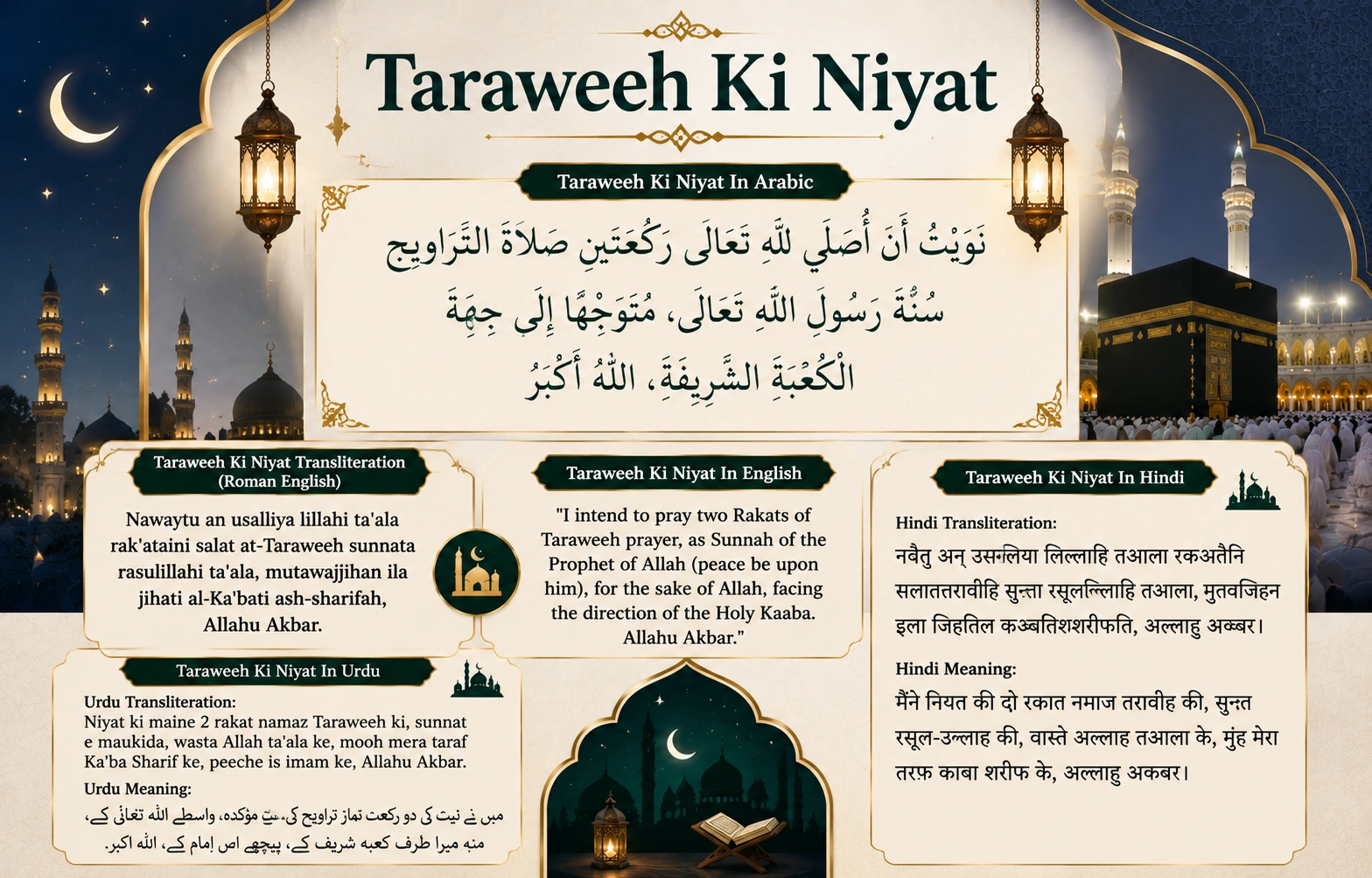
Taraweeh Ki Niyat In Arabic
نَوَيْتُ أَنْ أُصَلِّيَ لِلَّهِ تَعَالَى رَكْعَتَيْنِ صَلَاةَ التَّرَاوِيحِ سُنَّةَ رَسُولِ اللَّهِ تَعَالَى، مُتَوَجِّهًا إِلَى جِهَةِ الْكَعْبَةِ الشَّرِيفَةِ، اللَّهُ أَكْبَرُ
Taraweeh Ki Niyat Transliteration (Roman English)
Nawaytu an usalliya lillahi ta’ala rak’ataini salat at-Taraweeh sunnata rasulillahi ta’ala, mutawajjihan ila jihati al-Ka’bati ash-sharifah, Allahu Akbar.
Taraweeh Ki Niyat In English
“I intend to pray two Rakats of Taraweeh prayer, as Sunnah of the Prophet of Allah (peace be upon him), for the sake of Allah, facing the direction of the Holy Kaaba. Allahu Akbar.”
Taraweeh Ki Niyat In Hindi
Hindi Transliteration:
नवैतु अन् उसल्लिया लिल्लाहि तआला रक्अतैनि सलातत्तरावीहि सुन्नता रसूलिल्लाहि तआला, मुतवज्जिहन इला जिहतिल क़अ्बतिश्शरीफ़ति, अल्लाहु अक्बर।
Hindi Meaning:
मैंने नियत की दो रकात नमाज तरावीह की, सुन्नत रसूल-उल्लाह की, वास्ते अल्लाह तआला के, मुंह मेरा तरफ काबा शरीफ के, अल्लाहु अकबर।
Taraweeh Ki Niyat In Urdu
Urdu Transliteration:
Niyat ki maine 2 rakat namaz Taraweeh ki, sunnat e maukida, wasta Allah ta’ala ke, mooh mera taraf Ka’ba Sharif ke, peeche is imam ke, Allahu Akbar.
Urdu Meaning:
میں نے نیت کی دو رکعت نماز تراویح کی، سنتِ مؤکدہ، واسطے اللہ تعالیٰ کے، منہ میرا طرف کعبہ شریف کے، پیچھے اس امام کے، اللہ اکبر۔
Taraweeh Ki Niyat Kaise Kare
Taraweeh Ki Niyat Kaise Kare is one of the most asked questions during Ramadan. Below are the correct steps for making the niyat:
Step 1: Stand Facing the Qibla
Before beginning Taraweeh, stand facing the direction of the Ka’ba Sharif. This is called facing the Qibla and it is a basic condition for the validity of any Salah.
Step 2: Make the Intention in Your Heart
The niyat is primarily an act of the heart. You must have a clear intention in your heart that you are about to pray 2 Rakats of Taraweeh as Sunnah for the sake of Allah alone. The verbal expression is permissible and recommended for focus.
Step 3: Say the Intention Verbally (Optional But Recommended)
You may say the niyat softly in your own language or in Arabic. Both are correct. The intention spoken aloud should be sincere and not merely a mechanical recitation of words.
Step 4: Say Takbeer e Tehreema
After the intention, raise both hands to your earlobes and say “Allahu Akbar.” This formally begins the prayer.
Step 5: Continue the Prayer
After Takbeer e Tehreema, fold your hands and begin reciting Sana (Subhanakallahumma). Then recite Surah Al Fatiha followed by any other Surah and continue the Rakats as normal.
Taraweeh Ki Niyat For Ladies
Taraweeh Ki Niyat for ladies is exactly the same as for men. There is no difference in the words of the niyat. The only difference in the Taraweeh prayer for ladies is in the physical posture during Ruku and Sajdah, which is different for women as per Islamic rulings.
Niyat for Ladies (Roman English):
Niyat ki maine 2 rakat namaz Taraweeh ki, sunnat e maukida, wasta Allah ta’ala ke, mooh mera taraf Ka’ba Sharif ke, Allahu Akbar.
English Meaning:
“I intend to pray two Rakats of Taraweeh prayer as Sunnah Mu’akkadah for the sake of Allah, facing the direction of the Holy Kaaba. Allahu Akbar.”
Ladies may offer Taraweeh at home or at the mosque. Many scholars recommend that women pray Taraweeh at home for their comfort and safety, but attending the mosque is also permissible. The reward for performing Taraweeh is equal for men and women according to the Hadith.
Surah Taraweeh Ki Niyat
The term Surah Taraweeh Ki Niyat refers to the intention made specifically when the imam recites full Quranic Surahs during Taraweeh prayer. This is the standard Taraweeh practiced across mosques in South Asia, where the Quran is completed over the course of Ramadan.
When the imam is reciting Quranic portions during Taraweeh, the muqtadi (follower) makes the same niyat as described above. There is no separate niyat for Surah Taraweeh.
The niyat remains:
“I intend to pray 2 Rakats of Taraweeh, following the imam, for the sake of Allah, facing the Qibla.”
Tasbeeh e Taraweeh (Dua After Every 4 Rakats)
After every 4 Rakats of Taraweeh, worshippers traditionally sit for a moment of rest and recite the following Tasbeeh. This is a well-known practice in South Asian Muslim communities.
Arabic Text:
سُبْحَانَ ذِي الْمُلْكِ وَالْمَلَكُوتِ، سُبْحَانَ ذِي الْعِزَّةِ وَالْعَظَمَةِ وَالْهَيْبَةِ وَالْقُدْرَةِ وَالْكِبْرِيَاءِ وَالْجَبَرُوتِ، سُبْحَانَ الْمَلِكِ الْحَيِّ الَّذِي لَا يَنَامُ وَلَا يَمُوتُ، سُبُّوحٌ قُدُّوسٌ رَبُّنَا وَرَبُّ الْمَلَائِكَةِ وَالرُّوحِ، اللَّهُمَّ أَجِرْنَا مِنَ النَّارِ يَا مُجِيرُ يَا مُجِيرُ يَا مُجِيرُ
Roman Transliteration:
Subhana Zil Mulki Wal Malakoot. Subhana Zil Izzati Wal Azamati Wal Haybati Wal Qudrati Wal Kibriya’i Wal Jabaroot. Subhanal Malikil Hayyil Lazee La Yanaamu Wala Yamoot. Subboohun Quddoosun Rabbuna Wa Rabbul Mala’ikati War Rooh. Allahumma Ajirnaa Minan Naari Ya Mujeeru Ya Mujeeru Ya Mujeer.
English Meaning:
Pure is He, the Sovereign and Possessor of Kingdom and Majesty. Pure is He, the Possessor of Honor, Greatness, Awe, Power, Loftiness, and Supremacy. Pure is the True King who is Alive, does not sleep, and will never face death. And He is infinitely Pure and Sacred, our Lord and the Lord of the angels and the spirit. O Allah, save us from the fire of Hell, O Savior, O Savior, O Savior.
Hindi Meaning:
पाक है वो जो बादशाह और अजमत वाला है। पाक है वो जो इज्जत, अज़मत, हैबत, कुदरत और कबरियाई वाला है। पाक है वो सच्चा बादशाह जो जिंदा है, सोता नहीं और जिसे कभी मौत नहीं आएगी। वो बेइंतिहा पाक है, हमारा रब और फरिश्तों और रूह का रब। ऐ अल्लाह! हमें जहन्नम की आग से बचा, ऐ बचाने वाले, ऐ बचाने वाले, ऐ बचाने वाले।
Note: This Tasbeeh is a beloved practice but it is not a specific Sunnah from a Hadith. Scholars have noted that any form of zikr, Quran recitation, or Durood can be read during the break after every 4 Rakats. The goal is to remain occupied in the remembrance of Allah.
When To Read Taraweeh Ki Niyat
Taraweeh is offered after the Fardh and Sunnah of Isha prayer every night during Ramadan. The correct time for Taraweeh is from after Isha Salah until the time of Subh Sadiq (true dawn). It can be offered before or after Witr prayer.
The niyat for Taraweeh is made at the very beginning of each pair of 2 Rakats. A fresh niyat is required for each 2 Rakats since Taraweeh is offered in cycles of 2 Rakats with a Salaam at the end of every pair.
Benefits Of Taraweeh Prayer
Forgiveness of Past Sins: The Prophet Muhammad (peace be upon him) said that whoever stands in prayer during Ramadan with faith and seeking reward will have their previous sins forgiven. This Hadith is recorded in Sahih al-Bukhari and Sahih Muslim.
Closeness to Allah: Standing in Taraweeh every night of Ramadan, especially in the last ten nights, brings the believer closer to Allah and strengthens the bond of worship.
Completion of the Quran: Taraweeh gives every Muslim the opportunity to hear the entire Quran recited in one month, and the listener also earns the reward of its recitation.
Spiritual Discipline: Praying 20 Rakats every night of Ramadan builds a strong habit of regular worship and trains the heart to remain connected to Salah.
Reward of the Whole Night: Scholars have noted that whoever prays Taraweeh with the imam until the end receives the reward as though they prayed the entire night in Qiyam al-Layl.
Protection from Hellfire: The Tasbeeh recited after every 4 Rakats includes the supplication “Allahumma Ajirnaa Minan Naar,” which is a direct plea to Allah for protection from the fire of Hell.
Communal Unity: Offering Taraweeh in congregation at the mosque strengthens brotherhood among Muslims and brings the community together in worship during the holiest month of the year.
Important Rules of Taraweeh
Taraweeh is Sunnah Mu’akkadah for both men and women. Below are the key rulings every Muslim should know:
Number of Rakats
The well-known and widely practiced number is 20 Rakats. Many scholars of the Hanafi, Maliki, and Shafi’i schools hold this view based on the practice of the Companions. Some scholars accept 8 Rakats as well. Both positions have scholarly backing.
Offering Taraweeh at Home
A person who offers Taraweeh at home while the congregation is taking place at the mosque will not be sinful. However, scholars recommend joining the congregation at the mosque for men, as it carries greater reward. For women, offering at home is also rewarding.
Missing Rakats
If a person misses some Rakats of Taraweeh and the imam begins Witr, that person may join the Witr and then complete the remaining Taraweeh Rakats after the imam finishes.
Sitting During Taraweeh
It is disliked to sit during Taraweeh without a valid reason if a person has the ability to stand.
Conclusion
Taraweeh Ki Niyat is the starting point of one of the most beloved prayers of Ramadan. A sincere intention in the heart, combined with the verbal niyat, prepares the worshipper for this blessed Sunnah. Whether you are a man or a woman, praying at the mosque or at home, the niyat for Taraweeh remains the same.
Ramadan is a month of immense mercy and reward. Every night of Taraweeh is an opportunity to draw closer to Allah, seek forgiveness, and fill the heart with the light of the Quran. May Allah accept all our Taraweeh prayers and grant us the full reward of Ramadan. Ameen.
 Read These Other Islamic Supplications As Well:
- Sana Dua In Namaz Hindi
- Dua E Mujeer
- Lailatul Qadr Ki Dua
- Nazar Ki Dua By Prophet
- Hazrat Adam Ki Du
- Tawaf Ke 7 Chakkar Ki Dua
- Marriage Istikhara Dua
- Khana Khane Ke Baad Ki Dua
- Maa Baap Ke Liye Dua
- Safa Marwa Ki Dua
- Humbistari Ke Baad Ghusl Ki Dua
- Sehri Roza Rakhne Ki Niyat Ki Dua In English
- Iman E Mujmal
- Tahajjud Ki Dua
- Tahajjud Namaz Ki Niyat
? FAQs About Taraweeh Ki Niyat
Q1: Is it necessary to make the niyat in Arabic?
No, the niyat can be made in any language as long as the sincere intention is in the heart.
Q2: How many Rakats are in Taraweeh?
20 Rakats is the most widely practiced number, offered in pairs of 2 Rakats with a Salaam after every pair.
Q3: Can ladies offer Taraweeh at home?
Yes, ladies can offer Taraweeh at home and receive full reward equal to men.
Q4: Is the Tasbeeh e Taraweeh a Sunnah?
It is a widely followed recommended practice in South Asian communities but is not specifically proven as a Sunnah from the Prophet.
Q5: Can Taraweeh be offered individually without congregation?
Yes, Taraweeh can be offered alone at home and is fully valid.
Q6: What is the best thing to recite during the break after 4 Rakats?
Any zikr such as Durood Sharif, Kalima, Istighfar, or Quran recitation is appropriate during the rest period.
Q7: Does missing Taraweeh break the fast?
No, missing Taraweeh does not affect the fast in any way as it is a Sunnah prayer, not obligatory.
Q8: What is Surah Taraweeh Ki Niyat?
It is the same regular niyat made when the imam recites Quranic Surahs during the prayer.
Written by: Ahmad Raza
Credentials: Islamic Studies Content Writer
Read More duas for daily life at Instant Dua