
Barish ki dua is a masnoon supplication that every Muslim should recite when rain begins to fall. Rain is one of the greatest blessings that Allah Ta’ala sends down to the earth. It brings life, nourishment, and hope. The Quran mentions rain in many places, reminding believers that it is a sign of Allah’s mercy and power.
This supplication is not just a ritual recitation. It is a moment of connection between the servant and Allah. When drops of rain fall, the heart of a believer turns toward the Creator and expresses gratitude and hope.
The Prophet Muhammad (ﷺ) himself taught his companions specific duas to read during rain. These supplications have been preserved in the most reliable hadith collections, including Sahih Al-Bukhari and Sunan At-Tirmizi.
Rain is also one of the most accepted times for making dua. A hadith in Mustadrak Al-Hakim mentions two specific times when dua is not rejected: when the adhan is being called, and when it is raining. This alone shows how precious and spiritually powerful this moment is.
Barish Ki Dua In Arabic
The most widely recited supplication at the time of rain, narrated from Aishah (رضي الله عنها) and recorded in Sahih Al-Bukhari, is:
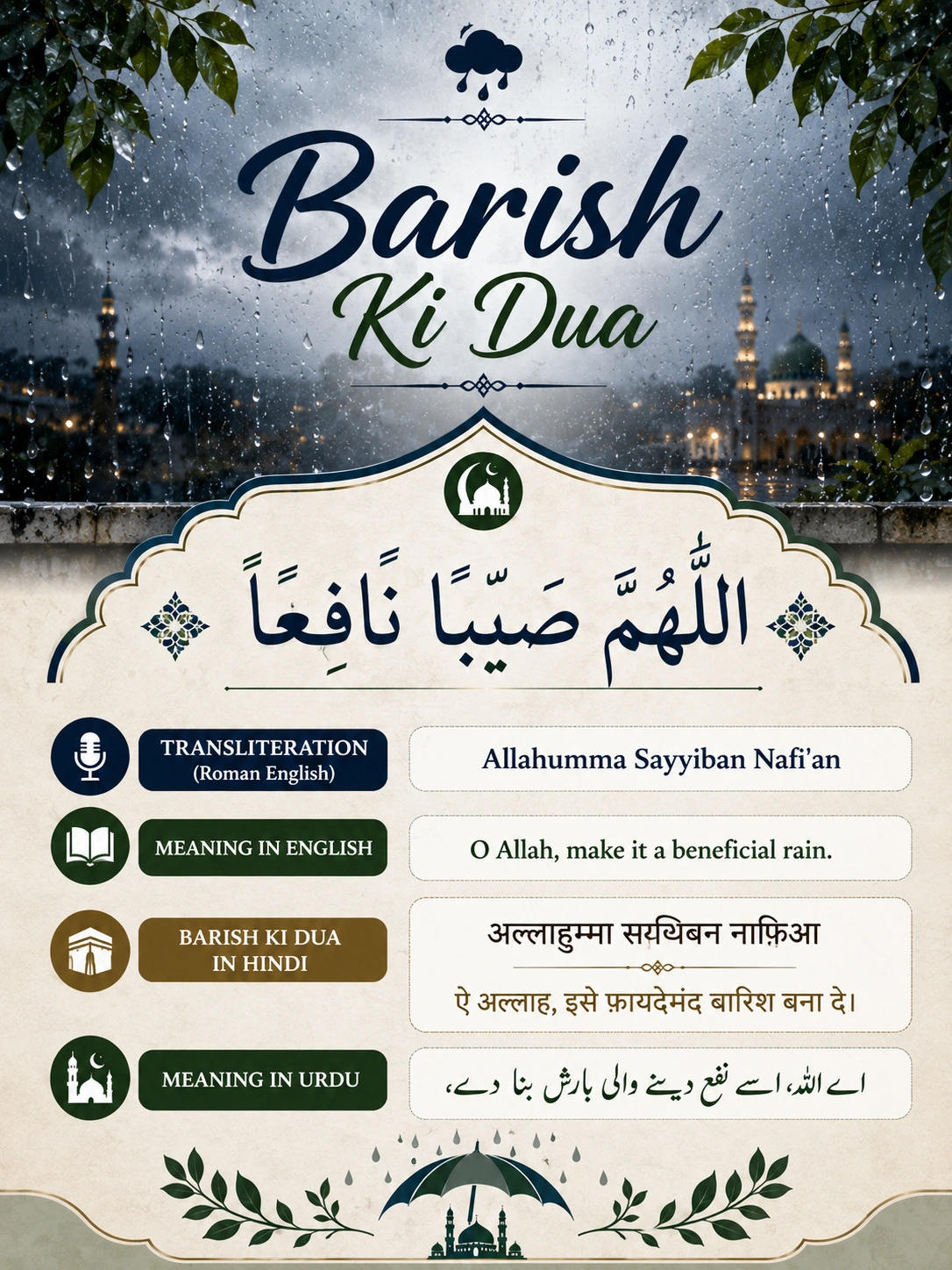
اللَّهُمَّ صَيِّبًا نَافِعًا
Dua Transliteration (Roman English)
Allahumma Sayyiban Nafi’an
Barish Ki Dua In English
“O Allah, make it a beneficial rain.”
Barish Ki Dua In Hindi
Arabic Text: اللَّهُمَّ صَيِّبًا نَافِعًا
Hindi Transliteration (Barish Ki Dua In Hindi): अल्लाहुम्मा सय्यिबन नाफ़िआ
Hindi Meaning: “ऐ अल्लाह, इसे फ़ायदेमंद बारिश बना दे।”
Urdu Meaning: “اے اللہ، اسے نفع دینے والی بارش بنا دے۔”
Source: Sahih Al-Bukhari
Barish Ki Dua Dawateislami Style (With Full Sequence)
Dawateislami teaches Muslims to recite this dua with proper adab and full sincerity. The recommended sequence when rain falls is:
Step 1: Begin with Bismillah in your heart and face the qibla if possible.
Step 2: Recite the main dua:
اللَّهُمَّ صَيِّبًا نَافِعًا
Allahumma Sayyiban Nafi’an
Meaning: O Allah, make it a beneficial rain.
Step 3: After rain stops, express gratitude by saying:
مُطِرْنَا بِفَضْلِ اللَّهِ وَرَحْمَتِهِ
Mutirna Bifadhlillahi Wa Rahmatihi
Meaning: We have received rain through Allah’s grace and mercy.
(Source: Sahih Al-Bukhari)
Dawateislami barish ki dua guidance also emphasizes making personal dua during rain because it is a time when Allah’s mercy is descending. Muslims are encouraged to use this moment for any sincere supplication, in addition to the masnoon duas.
Pehli Barish Ki Dua (Dua For The First Rain)
The dua for the first rainfall of the season holds great importance in Islamic tradition. When the first drops fall after a dry period, the believer sees it as a special gift from Allah and responds with gratitude.
Arabic:
اللَّهُمَّ صَيِّبًا نَافِعًا
Transliteration:
Allahumma Sayyiban Nafi’an
Meaning: O Allah, make it a beneficial rain.
Some scholars recommend that during the first rain of the season, one should also step outside briefly and allow the rain to touch the body. This is based on a narration recorded by Imam Muslim that the Prophet (ﷺ) once removed part of his garment so that the first rain could reach his skin, saying that this rain had just come from its Lord.
This moment of pehli barish is seen as spiritual renewal, and reciting this dua carries extra significance.
Tez Barish Ki Dua (Dua During Heavy Rain)
Sometimes rain becomes very intense, leading to flooding, damage, or difficulty. For such situations, the Prophet (ﷺ) taught a specific dua to ask Allah to keep the rain beneficial and remove any harm from it.
This incident is recorded in Sahih Al-Bukhari. During a Friday khutbah, the Prophet (ﷺ) was asked to pray for rain because there was a drought. After his dua, heavy rain continued for a full week. The following Friday, people asked him to pray for the rain to stop. He raised his hands and said:
Arabic:
اللَّهُمَّ حَوَالَيْنَا وَلاَ عَلَيْنَا
Transliteration:
Allahumma Hawalaina Wala ‘Alaina
Meaning in English:
Meaning: “O Allah, let it rain around us and not on us.”
Hindi Meaning:
“ऐ अल्लाह, हमारे आसपास बारिश कर, हम पर नहीं।”
Urdu Meaning:
“اے اللہ، ہمارے گرد بارش کر، ہم پر نہیں۔”
(Source: Sahih Al-Bukhari)
Tez barish ki dua is particularly relevant when heavy rain causes worry about flooding, travel, or danger. Reciting this dua shows full trust in Allah while asking Him to keep the situation safe.
Rehmat Ki Barish Ki Dua (Dua For Rain As Mercy)
Rain in Islam is not just water falling from the sky. It is a direct manifestation of Allah’s rahmat. Rehmat ki barish ki dua is the sincere expression that acknowledges this truth. When we say “Allahumma Sayyiban Nafi’an,” we are asking that this rain remain a mercy and not become a hardship.
Rain has been described in the Quran as a cause of life and as a reminder of how Allah can revive dead hearts just as He revives dead earth. This spiritual connection is why barish ki dua carries so much weight in the life of a believer.
Dua When Hearing Thunder During Rain
When thunder occurs during rain, a specific supplication is recommended, based on the practice of companions and the teaching of the Prophet (ﷺ).
Arabic:
اللَّهُمَّ لاَ تَقْتُلْنَا بِغَضَبِكَ وَلاَ تُهْلِكْنَا بِعَذَابِكَ وَعَافِنَا قَبْلَ ذَلِكَ
Transliteration:
Allahumma La Taqtulna Bi-Ghadabika Wa La Tuhlikna Bi-‘Adhabika Wa ‘Afina Qabla Dhalik
Meaning in English:
“O Allah, do not kill us with Your wrath, and do not destroy us with Your punishment, and pardon us before that.”
Hindi Meaning:
“ऐ अल्लाह, हमें अपने गुस्से से हलाक न कर, और अपने अज़ाब से बर्बाद न कर, और इससे पहले हमें माफ़ कर दे।”
(Source: Sunan At-Tirmizi)
It is also narrated that Abdullah Ibn Al-Zubair (رضي الله عنه) would stop speaking entirely when he heard thunder and would recite this verse from Surah Ar-Ra’d:
سُبْحَانَ الَّذِي يُسَبِّحُ الرَّعْدُ بِحَمْدِهِ وَالْمَلاَئِكَةُ مِنْ خِيفَتِهِ
Subhanal-Ladhi Yusabbihur-Ra’du Bihamdihi Wal-Mala’ikatu Min Khifatihi
Meaning: “Glory be to Him, whose praises the thunder glorifies, and so do the angels in awe of Him.”
(Source: Al-Adab Al-Mufrad, Imam Al-Bukhari)
Dua To Read After Rain Stops
After the rain ends, it is sunnah to express gratitude and acknowledge that rain is from Allah’s grace alone. The Prophet (ﷺ) taught this after leading the Fajr prayer at Hudaibiya, following a night of rain:
Arabic:
مُطِرْنَا بِفَضْلِ اللَّهِ وَرَحْمَتِهِ
Transliteration:
Mutirna Bifadhlillahi Wa Rahmatihi
Meaning in English:
“We have received rain through Allah’s bounty and mercy.”
Hindi Meaning:
“हम पर अल्लाह की फज़ल और रहमत से बारिश हुई।”
Urdu Meaning:
“ہم پر اللہ کے فضل اور رحمت سے بارش ہوئی۔”
(Source: Sahih Al-Bukhari)
When To Read Barish Ki Dua
At The Start Of Rain
The best time to recite barish ki dua is when rain first begins to fall. As soon as the first drops come down, the believer should raise their hands or remain in their current state and make the dua with sincerity.
During Continuous Rain
Throughout the duration of rain, a Muslim can continue to make dua. Since rain is one of the special times when supplications are accepted, any sincere prayer made during this period holds great value.
During Heavy Or Intense Rain
When the rain becomes very intense, the dua “Allahumma Hawalaina Wala ‘Alaina” should be recited. This asks Allah to protect people while keeping the rain beneficial in surrounding areas.
When Thunder Is Heard
The moment a person hears thunder, they should pause and recite the dua from Sunan At-Tirmizi or the verse from Surah Ar-Ra’d. This is a moment of mindfulness and acknowledgment of Allah’s majesty.
After Rain Ends
When the rain stops, one should recite “Mutirna Bifadhlillahi Wa Rahmatihi” as a way of thanking Allah and attributing the rain to His mercy rather than to natural phenomena alone.
Benefits Of Reading Barish Ki Dua
Dua Is Accepted During Rain
The hadith in Mustadrak Al-Hakim clearly states that dua made during rain is among those that are not rejected. This makes every supplication during rainfall a moment of immense spiritual opportunity.
A Sign Of Gratitude To Allah
Reciting dua during rain is an act of shukr. It reminds the believer that all blessings, including water and sustenance, come from Allah alone. This deepens faith and humility.
Protection From Harm
The duas for heavy rain and thunder are a form of spiritual protection. Asking Allah to keep rain beneficial and to pardon believers shows complete reliance on Him.
Following The Sunnah Of The Prophet (ﷺ)
Every supplication taught in this context comes directly from the Prophet (ﷺ). Reciting them means following his sunnah, which earns reward from Allah.
Spiritual Awareness During A Moment Of Divine Mercy
Rain is a physical reminder of divine care. When a Muslim reads barish ki dua, they enter a state of spiritual awareness where the heart connects with the reality that Allah controls all things and provides for all creation.
Summary Table: All Rain Duas At A Glance
| Situation | Dua (Transliteration) | Meaning |
|---|---|---|
| When rain starts | Allahumma Sayyiban Nafi’an | O Allah, make it a beneficial rain |
| During heavy rain | Allahumma Hawalaina Wala ‘Alaina | O Allah, let it rain around us, not on us |
| When thunder is heard | Allahumma La Taqtulna Bi-Ghadabika… | O Allah, pardon us before Your punishment |
| After rain ends | Mutirna Bifadhlillahi Wa Rahmatihi | Rain came through Allah’s bounty and mercy |
The Quran On Rain
Rain is mentioned in multiple places in the Quran. In Surah Ar-Rum (30:48), Allah explains how He sends winds that carry clouds and brings forth rain for His servants. In Surah An-Nur (24:43), the process of hail and rain is described in detail, showing it all takes place by Allah’s command.
These verses remind us that rain is a deliberate gift from Allah, to be received with dua and gratitude.
Conclusion
Barish ki dua is a beautiful sunnah that connects every raindrop to the remembrance of Allah. From the moment rain begins to fall, to the sound of thunder, to the time it stops, Islamic teachings provide a full set of supplications that keep the believer in a state of gratitude and closeness to Allah.
Reading barish ki dua in Arabic, along with its Hindi and English meanings, helps every Muslim of every background to participate in this sunnah fully. Whether it is the pehli barish ki dua after a dry season, the dua for heavy rain during a storm, or the gentle “Allahumma Sayyiban Nafi’an” when soft rain falls, each of these duas is a proven way to seek Allah’s mercy.
Rain is not just water. It is a reminder from Allah of His generosity and closeness to His servants. The barish ki dua in English meanings shared here make it easy for every Muslim to recite with full understanding. May Allah accept our duas and shower His mercy upon all believers.
 Read These Other Islamic Supplications As Well:
- Sana Dua In Namaz Hindi
- Dua E Mujeer
- Lailatul Qadr Ki Dua
- Nazar Ki Dua By Prophet
- Hazrat Adam Ki Du
- Tawaf Ke 7 Chakkar Ki Dua
- Marriage Istikhara Dua
- Khana Khane Ke Baad Ki Dua
- Maa Baap Ke Liye Dua
- Safa Marwa Ki Dua
- Humbistari Ke Baad Ghusl Ki Dua
- Sehri Roza Rakhne Ki Niyat Ki Dua In English
- Iman E Mujmal
- Tahajjud Ki Dua
- Tahajjud Namaz Ki Niyat
- Taraweeh Ki Niyat
? FAQs About Barish Ki Dua
Q1: What is the barish ki dua in Arabic?
The main dua is: اللَّهُمَّ صَيِّبًا نَافِعًا (Allahumma Sayyiban Nafi’an), meaning “O Allah, make it a beneficial rain.” It is recorded in Sahih Al-Bukhari.
Q2: When should barish ki dua be read?
It should be read when rain begins to fall. Rain is one of the most special times for dua, as duas made during rain are not rejected.
Q3: What is the dua for heavy or intense rain?
The tez barish ki dua is: Allahumma Hawalaina Wala ‘Alaina, meaning “O Allah, let it rain around us and not on us.” This is from Sahih Al-Bukhari.
Q4: Is there a special dua for the first rain of the season (pehli barish)?
Yes, the same dua “Allahumma Sayyiban Nafi’an” is recited for the first rain as well. The pehli barish ki dua is a moment to ask Allah for continued mercy throughout the season.
Q5: What dua is read when thunder is heard?
One should recite: Allahumma La Taqtulna Bi-Ghadabika Wa La Tuhlikna Bi-‘Adhabika Wa ‘Afina Qabla Dhalik. This is narrated in Sunan At-Tirmizi.
Q6: What does rehmat ki barish mean in Islamic context?
Rehmat ki barish ki dua refers to asking Allah to make rain a source of mercy. The main supplication “Allahumma Sayyiban Nafi’an” covers this intention fully.
Q7: Is barish ki dua mentioned in any hadith?
Yes, all the duas mentioned here are from reliable hadith collections including Sahih Al-Bukhari, Sunan At-Tirmizi, Al-Adab Al-Mufrad, and Mustadrak Al-Hakim.
Q8: Can I make any personal dua during rain?
Yes. The hadith confirms that dua made during rain is among those not rejected. Barish ki dua dawateislami scholars and others encourage any sincere supplication during this time alongside the masnoon duas.
Written by: Ahmad Raza
Credentials: Islamic Studies Content Writer
Read More duas for daily life at Instant Dua