
Fajar Ki Namaz is the first of the five daily prayers (Salah) in Islam. It is offered before sunrise, during the peaceful and blessed hours of early morning. It holds a very special rank in Islam because it is the time when the angels of the night and the angels of the day both gather as witnesses.
Allah Ta’ala has mentioned the Fajr prayer specifically and separately in the Quran — a distinction that scholars point to as a sign of its elevated importance:
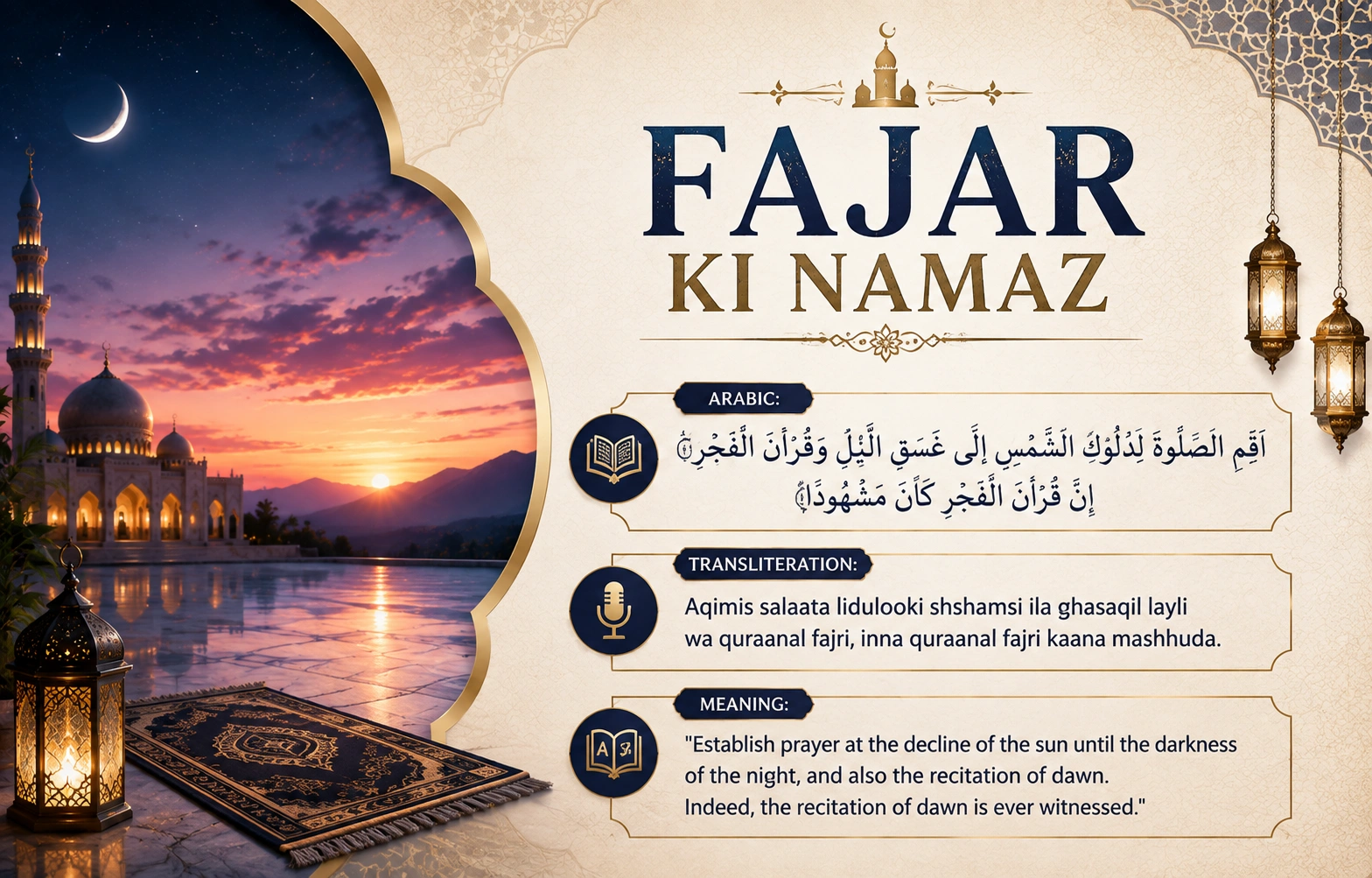
Arabic:
اَقِمِ الصَّلٰوةَ لِدُلُوۡكِ الشَّمۡسِ اِلٰى غَسَقِ الَّيۡلِ وَقُرۡاٰنَ الۡفَجۡرِ ؕ اِنَّ قُرۡاٰنَ الۡفَجۡرِ كَانَ مَشۡهُوۡدًا
Transliteration:
Aqimis salaata lidulooki shshamsi ila ghasaqil layli wa quraanal fajri, inna quraanal fajri kaana mashhuda.
Meaning:
“Establish prayer at the decline of the sun until the darkness of the night, and also the recitation of dawn. Indeed, the recitation of dawn is ever witnessed.” (Surah Al-Isra, 17:78)
The phrase “recitation of dawn” (Quran al-Fajr) refers directly to this prayer. Leading mufassireen — including Ibn Kathir and Al-Qurtubi — confirm this reading. The word “witnessed” (mashhud) tells us that both the departing angels of the night and the arriving angels of the day are present at this prayer, making it one of the most important acts of worship a Muslim can perform each day.
Waking up for Fajar Ki Namaz requires effort, but the reward from Allah is immeasurable. Every Muslim, man or woman, is required to offer it on time.
Fajar Ki Namaz Ka Waqt (Time of Fajr Prayer)
Fajr prayer begins at Subh-e-Sadiq (true dawn), when a horizontal light spreads across the horizon. This is called Fajr al-Sadiq in Arabic. The prayer time ends at sunrise (Shuruq).
Muslims should be careful not to confuse the false dawn (Fajr al-Kadhib) with true dawn. The false dawn appears as a vertical streak of light that fades quickly. Fajar Ki Namaz Timing only begins with the true dawn, when the light stretches horizontally and continues to grow brighter.
The window for Fajr generally lasts between 60 and 90 minutes, depending on your location and the season.
Fajar Ki Namaz Ka Time Today
Since Fajar Ki Namaz Ka Time Today changes every day based on the movement of the sun, Muslims must check a reliable prayer timetable daily. Below are approximate timings for major Indian cities. These shift slightly every day, so always confirm on a trusted Islamic prayer app or your local mosque calendar.
Major Indian Cities — Approximate Fajar Timing Reference
| City | Fajar Shuru (Approx.) | Sunrise / End of Window |
|---|---|---|
| Delhi | 4:00 AM – 4:32 AM | ~6:00 AM |
| Mumbai | 5:06 AM – 5:20 AM | ~6:22 AM |
| Kolkata | 3:45 AM – 4:10 AM | ~5:40 AM |
| Hyderabad | 4:45 AM – 5:05 AM | ~6:30 AM |
| Bangalore | 5:00 AM – 5:15 AM | ~6:40 AM |
| Chennai | 5:00 AM – 5:20 AM | ~6:35 AM |
| Jaipur | 4:10 AM – 4:40 AM | ~6:25 AM |
Note: These are seasonal reference ranges, not exact daily times. Always verify Fajar Ki Namaz Ka Time Today using a trusted prayer app (IslamicFinder, Muslim Pro, Aladhan) or your local mosque calendar.
Fajar Ki Namaz Ka Time Delhi
In New Delhi, the Fajr prayer currently begins around 4:26 AM to 4:32 AM and ends at sunrise, which falls around 6:00 AM. This gives a prayer window of approximately 1 hour and 30 minutes. Delhi’s prayer time shifts by a few minutes each day across the year, being earliest in summer and latest in winter.
Fajar Ki Namaz Time In Mumbai
In Mumbai, the Fajr prayer currently begins around 5:06 AM to 5:08 AM and ends at sunrise around 6:22 AM. This gives roughly a 1 hour and 15 minute window. Like all cities, The Fajr timing in Mumbai varies by season, so it is best to check your local mosque timetable for the exact time today.
Fajar Ki Namaz Ka Time In Asian And Muslim Countries
Fajar Ki Namaz Ka Time varies across the world because it is linked to the position of the sun at each specific location. The times below are approximate figures for major Muslim-majority cities across Asia, the Middle East, and Africa, sourced from IslamicFinder and other verified prayer time platforms. These are current reference times for late August 2026 and will shift by a few minutes each day throughout the year.
Always verify with your local mosque calendar or a trusted prayer app for the exact time in your city.
South Asia
South Asia is home to one of the largest Muslim populations on earth. Cities across this region share broadly similar Fajr windows, though they differ by city depending on longitude and latitude.
| City | Country | Fajr Begins | Sunrise (End of Fajr) |
|---|---|---|---|
| Delhi | India | ~4:26 AM to 4:32 AM | ~6:00 AM |
| Mumbai | India | ~5:06 AM to 5:08 AM | ~6:22 AM |
| Dhaka | Bangladesh | ~4:21 AM to 4:23 AM | ~5:39 AM |
| Karachi | Pakistan | ~4:28 AM to 4:51 AM | ~5:54 AM |
| Islamabad | Pakistan | ~3:45 AM to 4:00 AM | ~5:20 AM |
Dhaka’s Fajr window currently opens around 4:21 to 4:23 AM, giving Muslims roughly 1 hour and 15 minutes to pray before sunrise. Islamabad, being further north and at a higher latitude, sees some of the earliest Fajr times in South Asia during summer months.
Southeast Asia
Southeast Asian Muslim countries, including Indonesia and Malaysia, lie close to the equator. Because of this, prayer times remain relatively stable throughout the year with smaller seasonal shifts compared to northern regions.
| City | Country | Fajr Begins | Sunrise (End of Fajr) |
|---|---|---|---|
| Jakarta | Indonesia | ~4:39 AM to 4:44 AM | ~6:00 AM |
| Kuala Lumpur | Malaysia | ~6:00 AM | ~7:15 AM |
Indonesia has the world’s largest Muslim population, and Jakarta’s Fajr timing remains consistent close to 4:39 to 4:44 AM year-round. In Kuala Lumpur, the Fajr window begins later, around 6:00 AM, because Malaysia’s time zone is set ahead of its solar position.
Middle East
The Middle East, as the heartland of Islam, holds deep significance for every Muslim. Fajr times in this region vary by latitude, with Saudi Arabia, UAE, and other Gulf countries each following their own calculation standards.
| City | Country | Fajr Begins | Sunrise (End of Fajr) |
|---|---|---|---|
| Mecca (Makkah) | Saudi Arabia | ~4:38 AM | ~6:00 AM |
| Riyadh | Saudi Arabia | ~4:10 AM to 4:14 AM | ~5:31 AM |
| Dubai | UAE | ~4:39 AM | ~5:55 AM |
Mecca’s Fajr time carries special importance for Muslims worldwide. It serves as a reference point for many. Riyadh uses the Umm al-Qura calculation method, which is the official method of the Saudi Arabian government and is widely followed across the Gulf region.
North Africa
North Africa’s Muslim countries follow their own regional calculation standards. Egypt uses the Egyptian General Authority of Survey method, which is also followed in many other African and Middle Eastern countries.
| City | Country | Fajr Begins | Sunrise (End of Fajr) |
|---|---|---|---|
| Cairo | Egypt | ~5:00 AM to 5:01 AM | ~6:31 AM |
Cairo’s Fajr window is approximately 1 hour and 30 minutes, giving ample time for Muslims to wake up, perform wudu, and offer the prayer with calm and focus.
Why Do Fajr Times Differ Between Countries?
The variation in Fajr times across countries comes from three key factors:
Geographic Location (Latitude and Longitude)
Cities closer to the equator, such as Jakarta and Kuala Lumpur, experience smaller differences between the shortest and longest days. Cities further from the equator, such as Islamabad or Istanbul, can see Fajr as early as 2:00 AM in summer and as late as 6:00 AM in winter.
Calculation Method Used
Different countries and Islamic scholars follow different methods to calculate when true dawn begins. Saudi Arabia uses the Umm al-Qura method. Pakistan and India typically use the University of Islamic Sciences, Karachi method. Egypt uses its own national authority’s method. Malaysia uses JAKIM (Jabatan Kemajuan Islam Malaysia). These differences can cause Fajr times to vary by 10 to 20 minutes for the same city depending on which method is applied.
Time Zone Rules
Some countries set their clocks significantly ahead of their actual solar time. This is most visible in Malaysia, where the official time zone (UTC+8) is much ahead of the local solar time, which is why Fajr in Kuala Lumpur appears later on the clock compared to cities at similar latitudes.
Important Note: Prayer times differ slightly based on calculation method and exact coordinates. Always verify Fajar Ki Namaz Ka Time Today using a trusted local source or a verified Islamic prayer app such as IslamicFinder, Muslim Pro, or Aladhan.
Fajar Ki Namaz Ki Rakat (Number of Rakats)
Fajar Ki Namaz Ki Rakat has a fixed structure that is agreed upon by all major Islamic schools of thought. There is no difference of opinion on this.
2 Sunnah Mu’akkadah Rakats
The first part consists of 2 Sunnah Mu’akkadah rakats. These are very strongly emphasized by the Prophet Muhammad (PBUH). He said:
“The two rakats of Fajr are better than this world and all it contains.” (Sahih Muslim)
In another narration, the Prophet (PBUH) said:
“Do not leave the two rakats of Fajr, even if you are being chased by horsemen.” (Abu Dawud)
Both narrations show the enormous value of these 2 Sunnah rakats. Skipping them without a valid reason is a significant loss.
2 Fard (Obligatory) Rakats
After the Sunnah, 2 Fard rakats are performed. These are obligatory and compulsory for every Muslim. The prayer is not valid without these 2 rakats. They include all the essential actions of prayer: Qiyam (standing), Ruku (bowing), Sujood (prostration), and Tashahhud.
Total Rakats Summary:
| Rakat | Qism | Hukm |
|---|---|---|
| 2 Rakat | Sunnat Muakkadah | Qawi-taakeed |
| 2 Rakat | Fard | Farz |
| Kul: 4 Rakat |
Niyyah (Intention) for Fajar Ki Namaz
Before beginning, a Muslim must make the intention (Niyyah) in the heart. It does not have to be spoken aloud.
Niyyah for 2 Sunnah Rakats:
“Nawaytu an usalli rak’atayn sunnata Fajr lillahi ta’ala.”
Meaning: “I intend to offer 2 Sunnah rakats of Fajr for the sake of Allah.”
Niyyah for 2 Fard Rakats:
“Nawaytu an usalli rak’atayn farda Fajr lillahi ta’ala.”
Meaning: “I intend to offer 2 Fard rakats of Fajr for the sake of Allah.”
If praying in congregation, add: “…behind this imam” (muqtadiyan hadhal imaam).
Note on Jama’at and Sunnah: If you arrive at the mosque and the congregation (jama’at) for Fard has already started, the majority view among scholars is to join the Fard congregation first. The 2 Sunnah rakats can then be offered separately after the congregation, before sunrise. Always consult your local imam for guidance on this masala.
Dua After Fajar Ki Namaz
After completing Fajr prayer, the Prophet Muhammad (PBUH) recited specific duas and adhkar (remembrances). These are verified and recommended for every Muslim to make part of their morning routine.
Primary Dua After Fajr Salah
Arabic:
اللَّهُمَّ إِنِّي أَسْأَلُكَ عِلْمًا نَافِعًا، وَرِزْقًا طَيِّبًا، وَعَمَلًا مُتَقَبَّلًا
Transliteration: Allahumma inni as’aluka ‘ilman nafi’an, wa rizqan tayyiban, wa ‘amalan mutaqabbalan.
Hindi Transliteration: अल्लाहुम्मा इन्नी अस्अलुका इल्मन नाफिआन, व रिज़क़न तय्यिबन, व अमलन मुतकब्बलन।
Meaning (English): “O Allah, I ask You for beneficial knowledge, good and pure provision, and accepted deeds.”
Source: Reported by Imam Ahmad (verified source), recited after the Fajr prayer.
Morning Remembrance (Adhkar) After Fajar Ki Namaz
Arabic:
أَصْبَحْنَا وَأَصْبَحَ الْمُلْكُ لِلَّهِ رَبِّ الْعَالَمِينَ
Transliteration: Asbahna wa asbahal mulku lillahi Rabbil ‘alamin.
Hindi Transliteration: अस्बहना व अस्बहल मुल्कु लिल्लाहि रब्बिल आलमीन।
Meaning (English): “We have entered the morning and the whole dominion belongs to Allah, the Lord of all the worlds.”
Source: Tirmidhi
Tasbih After Fajar Ki Namaz
The Prophet (PBUH) taught us to recite the following after every Fard (obligatory) prayer, as narrated in Sahih Muslim (595):
SubhanAllah (سُبْحَانَ اللَّهِ) , 33 times
Alhamdulillah (الْحَمْدُ لِلَّهِ) , 33 times
Allahu Akbar (اللَّهُ أَكْبَرُ) , 34 times
These three phrases of glorification are among the most powerful acts of remembrance after the Fajr prayer.
Ayatul Kursi After Fajr
Reciting Ayatul Kursi (Surah Al-Baqarah, 2:255) after every obligatory prayer is a powerful Sunnah. The Prophet (PBUH) said:
“Whoever recites Ayatul Kursi after every obligatory prayer, nothing stands between him and Paradise except death.” (Al-Nasai, verified by Al-Albani)
Reciting it immediately after Fajr provides divine protection for the entire day.
The Two Dawns: An Important Distinction
Many Muslims are unaware that Islamic scholarship distinguishes between two types of dawn. Knowing this is important for correctly observing Fajar Ki Namaz Ka Waqt.
False Dawn (Fajr al-Kadhib)
A brief vertical glow that appears in the sky before true dawn. It quickly fades. The prayer is NOT permitted during this time. For those fasting, this is also not the time to stop eating during Suhoor.
True Dawn (Fajr al-Sadiq)
This is the horizontal light that spreads across the horizon, growing brighter and not fading. The prayer time truly begins here, and Suhoor time ends for those who are fasting.
Allah mentions this in the Quran:
Arabic:
أُحِلَّ لَكُمْ لَيْلَةَ الصِّيَامِ الرَّفَثُ إِلَىٰ نِسَائِكُمْ ۚ هُنَّ لِبَاسٌ لَّكُمْ وَأَنتُمْ لِبَاسٌ لَّهُنَّ ۗ عَلِمَ اللَّهُ أَنَّكُمْ كُنتُمْ تَخْتَانُونَ أَنفُسَكُمْ فَتَابَ عَلَيْكُمْ وَعَفَا عَنكُمْ ۖ فَالْآنَ بَاشِرُوهُنَّ وَابْتَغُوا مَا كَتَبَ اللَّهُ لَكُمْ ۚ وَكُلُوا وَاشْرَبُوا حَتَّىٰ يَتَبَيَّنَ لَكُمُ الْخَيْطُ الْأَبْيَضُ مِنَ الْخَيْطِ الْأَسْوَدِ مِنَ الْفَجْرِ ۖ ثُمَّ أَتِمُّوا الصِّيَامَ إِلَى اللَّيْلِ ۚ وَلَا تُبَاشِرُوهُنَّ وَأَنتُمْ عَاكِفُونَ فِي الْمَسَاجِدِ ۗ تِلْكَ حُدُودُ اللَّهِ فَلَا تَقْرَبُوهَا ۗ كَذَٰلِكَ يُبَيِّنُ اللَّهُ آيَاتِهِ لِلنَّاسِ لَعَلَّهُمْ يَتَّقُونَ
Transliteration:
Uhilla lakum laylata al-siyami al-rafathu ila nisaikum hunna libasun lakum wa antum libasun lahunna alima Allahu annakum kuntum takhtanuna anfusakum fataba alaykum wa afa ankum fal-ana bashiruhunna wabtaghu ma kataba Allahu lakum wa kulu wa ishrabu hatta yatabayyana lakumu al-khaytu al-abyadu mina al-khayti al-aswadi mina al-fajri thumma atimmu al-siyama ila al-layli wa la tubashiruhunna wa antum akifuna fi al-masajidi tilka hududu Allahi fala taqrabuha kadhalika yubayyinu Allahu ayatihi lil-nasi laallahum yattaqun.
Meaning:
It has been made permissible for you the night preceding fasting to go to your wives [for sexual relations]. They are a clothing for you and you are a clothing for them. Allah knows that you used to deceive yourselves, so He accepted your repentance and forgave you. So now, have relations with them and seek that which Allah has decreed for you [i.e., offspring]. And eat and drink until the white thread of dawn becomes distinct to you from the black thread [of night]. Then complete the fast until the night [i.e., sunset]. And do not have relations with them as long as you are staying for worship in the mosques. These are the limits [set by] Allah, so do not approach them. Thus does Allah make clear His verses [i.e., ordinances] to the people that they may become righteous.
(Surah Al-Baqarah, 2:187)
The “white thread” refers to the true dawn. This is the reliable marker for Fajr prayer time.
When Does Fajar Ki Namaz Time End?
The Fajr prayer time ends at sunrise (Shuruq). The moment the sun appears on the horizon, the prayer window closes. If a person misses it within its time, they must still perform it as a Qada (make-up) prayer as soon as they remember. The Prophet (PBUH) said:
“Whoever forgets a prayer should perform it as soon as he remembers it. There is no expiation for it except that.” (Sahih Bukhari and Muslim)
Missing Fajr due to oversleeping is not a sin, but it must be made up without delay. A believer should never feel despair, only the desire to return to Allah quickly.
Benefits of Fajar Ki Namaz
Protected by Allah Throughout the Day
The Prophet (PBUH) said: “Whoever prays Fajr is under the protection of Allah.” (Sahih Muslim)
Starting the day under this protection is one of the greatest blessings a Muslim can receive.
Witness of the Angels
As mentioned in Surah Al-Isra, the Fajr prayer is “witnessed.” The angels of the night and the angels of the day both attend and bear witness to those who pray Fajar Ki Namaz on time. This divine witnessing elevates the prayer above most other acts of worship.
Light on the Day of Judgment
The Prophet (PBUH) said: “Give glad tidings to those who walk to the mosques in the darkness, of complete light on the Day of Judgment.” (Abu Dawud, Ibn Majah)
This hadith applies to those who make the effort to wake up for Fajr, especially in congregation.
Blessings in the Early Morning
The Prophet (PBUH) made dua: “O Allah, bless my Ummah in its early mornings.” (Tirmidhi)
The time of Fajr is filled with barakah (blessings). Work, health, and provisions can all be increased by waking up for this prayer.
Equivalent Reward of Hajj and Umrah
The Prophet (PBUH) said that sitting in the place of prayer after Fajr, engaging in dhikr (remembrance of Allah) until sunrise, and then praying two rakats carries a reward equivalent to a complete Hajj and Umrah. (Tirmidhi)
Recommended Acts After Fajar Ki Namaz
After completing the prayer and the post-prayer adhkar, it is Sunnah to remain seated facing the Qibla until sunrise. During this time:
- Recite Ayatul Kursi
- Recite Surah Al-Ikhlas, Surah Al-Falaq, and Surah An-Nas three times each
- Engage in tasbih (SubhanAllah, Alhamdulillah, Allahu Akbar)
- Make personal dua to Allah for the day ahead
- Recite morning adhkar from verified collections such as Hisnul Muslim
After sunrise, offering 2 rakats of Duha (Ishraq) prayer is a beautiful additional Sunnah to complete this blessed morning routine.
How to Check Fajar Ki Namaz Ka Time Today
Since the Fajr time changes every day, Muslims should use the following methods to stay on time:
- Local Mosque Calendar: The most reliable source for your specific area.
- Verified Prayer Apps: Apps like Muslim Pro or IslamicFinder provide location-based times adjusted for your city.
- Azan (Call to Prayer): In many Muslim-majority areas, the Azan for Fajr is broadcast, making it easy to know when the prayer time has begun.
- Sunrise Charts: Always remember that Fajr ends at sunrise. Knowing your local sunrise time helps you calculate the prayer window.
Always apply a 10 to 15 minute safety margin after the app-calculated time to ensure the true dawn (Fajr al-Sadiq) has properly entered.
Conclusion
Fajar Ki Namaz is not just the first prayer of the day. It is a declaration that a Muslim begins each morning with the remembrance of Allah before anything else. This time is blessed, protected, and witnessed by the angels. Every Muslim who wakes up and performs this prayer on time earns a reward that no worldly achievement can match.
Whether you are in Delhi, Mumbai, Karachi, Dhaka, Dubai, Mecca, Cairo, Jakarta, or Kuala Lumpur, the principle is the same: Fajr begins at true dawn and ends at sunrise. The exact minute differs by city, but the call is universal. Keeping track of the correct Fajar Ki Namaz Ka Time Today and offering the prayer on time is one of the most important habits a Muslim can build. Along with the prayer itself, the duas and adhkar read after Fajar Ki Namaz bring protection, provision, and peace for the entire day.
May Allah make it easy for all of us to wake up for this prayer every single day, and may He accept it from us. Ameen.
🤲 Read These Other Islamic Supplications As Well:
- Iman E Mujmal
- Tahajjud Ki Dua
- Tahajjud Namaz Ki Niyat
- Taraweeh Ki Niyat
- Barish Ki Dua
- Subha Ki Dua
- Dusra Kalma Shahadat
- Pehla Kalma Tayyab
- Teesra Kalma
- Shab E Barat Namaz
- Shab E Meraj Ki Namaz
? FAQs About Fajar Ki Namaz
Q1. What is Fajar Ki Namaz Ka Time?
It begins at true dawn (Subh-e-Sadiq) and ends at sunrise. In Delhi it is approximately 4:00–4:32 AM; in Mumbai approximately 5:06–5:20 AM. Check a reliable app or local mosque for the exact time each day.
Q2. Fajar Ki Namaz Ki Rakat kitni hoti hain?
4 rakats in total: 2 Sunnah Mu’akkadah followed by 2 Fard.
Q3. What happens if I miss Fajar Ki Namaz?
Perform it as Qada (make-up) as soon as you wake or remember. Do not delay it further. Missing due to oversleeping is forgiven, but the prayer still must be made up.
Q4. Fajar Ki Namaz Ka Time Delhi mein kya hai?
Approximately 4:00–4:32 AM, with the window closing at sunrise around 6:00 AM. Always confirm with a local source for the exact time today.
Q458. Is it necessary to read Sunnah rakats of Fajar Ki Namaz?
They are Sunnah Mu’akkadah — very strongly recommended. The Prophet (PBUH) called them better than this world and everything in it. Skipping without a valid reason is a significant loss.
Q5. Fajar Ki Namaz Time In Mumbai kya hai?
Approximately 5:06–5:20 AM, ending at sunrise around 6:22 AM. Confirm daily with a reliable app or mosque calendar.
Q6. What is Fajr time in Karachi today?
Approximately 4:28–4:51 AM, ending at sunrise around 5:54 AM. Calculated using the University of Islamic Sciences, Karachi method; shifts slightly each day.
Q7. What is Fajr time in Mecca today?
Approximately 4:38 AM based on the Umm al-Qura method. The window closes at sunrise around 6:00 AM.
Written by: Ahmad Raza
Credentials: Islamic Studies Content Writer
🤲 Read More duas for daily life at Instant Dua