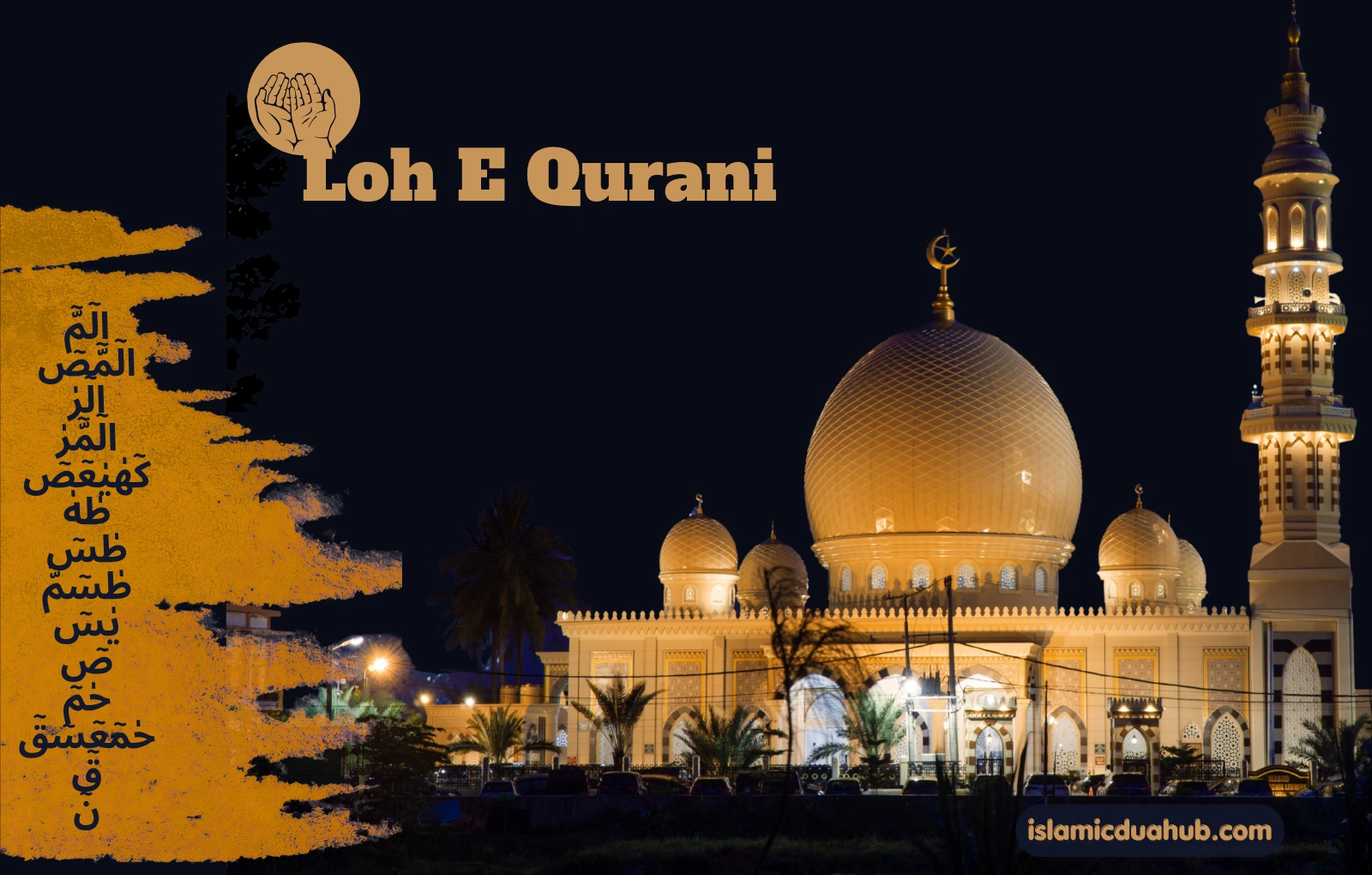
The Loh E Qurani (لوح قرآنی) holds a deeply respected place in the hearts of Muslims across the world. These are the sacred letters known as Haroof-e-Muqatta’at, which appear at the very beginning of 29 Surahs in the Holy Quran, right after Bismillah. The word “Loh” means tablet or slate, and “Qurani” refers to the Quran. Together, Loh E Qurani means the Tablet of the Quran.
These letters are not ordinary words. Each letter is pronounced separately, such as Alif, Laam, Meem (الم), and their complete meaning remains a divine secret known only to Allah (SWT). For centuries, Islamic scholars have reflected on their significance, and the majority agree that their true wisdom belongs exclusively to Allah.
Muslims across South Asia, the Middle East, and beyond hold the Lohe Qurani in great reverence. It appears in homes as calligraphy, in hearts as remembrance, and on the tongues of believers as a part of Quran recitation.
What Is Loh E Qurani?
The Loh E Qurani is a collection of the Huroof-e-Muqatta’at, which translates to “the disjointed letters” or “the abbreviated letters.” These are specific Arabic letters that appear at the start of certain Surahs in the Quran. They are not typical words or phrases in the Arabic language. Instead, each letter stands on its own and carries a meaning that is hidden in divine knowledge.
There are 14 unique letters in the Loh E Qurani, appearing in various combinations across 29 Surahs. These letters are also known as Rumooz, meaning codes or signals in Arabic, as their precise meanings were never explicitly explained to us.
Five Surahs are even named after these letters: Surah Taha, Surah Ya Sin, Surah Sad, Surah Fussilat, and Surah Qaf.
Full Loh E Qurani in Arabic
The following is the complete Full Loh E Qurani in Arabic as it appears across the 29 Surahs:
الٓمّٓ
الٓمّٓصٓ
الٓرٰ
الٓمّٓرٰ
كٓهٰیٰعٓصٓ
طٰهٰ
طٰسٓ
طٰسٓمّٓ
یٰسٓ
صٓ
حٰمٓ
حٰمٓعٓسٓقٓ
قٓ
نٓ
Lohe Qurani In English (Transliteration)
For those who want to recite the Lohe Qurani in English transliteration, here is each set of letters pronounced separately:
Alif Lam Meem (الم)
Alif Lam Meem Sad (المص)
Alif Lam Ra (الر)
Alif Lam Meem Ra (المر)
Kaf Ha Ya Ain Sad (كهيعص)
Ta Ha (طه)
Ta Seen (طس)
Ta Seen Meem (طسم)
Ya Seen (يس)
Sad (ص)
Ha Meem (حم)
Ha Meem Ain Seen Qaf (حمعسق)
Qaf (ق)
Noon (ن)
Loh E Qurani in Hindi (हिंदी उच्चारण)
नीचे लोह-ए-क़ुरानी के सभी 14 अक्षरों का हिंदी उच्चारण दिया गया है ताकि हिंदी पढ़ने वाले मुसलमान भाई-बहन इन्हें आसानी से पढ़ सकें:
अलिफ़ लाम मीम (الم)
अलिफ़ लाम मीम साद (المص)
अलिफ़ लाम रा (الر)
अलिफ़ लाम मीम रा (المر)
काफ़ हा या ऐन साद (كهيعص)
ता हा (طه)
ता सीन (طس)
ता सीन मीम (طسم)
या सीन (يس)
साद (ص)
हा मीम (حم)
हा मीम ऐन सीन क़ाफ़ (حمعسق)
क़ाफ़ (ق)
नून (ن)
इन अक्षरों को तजवीद के नियमों के अनुसार पढ़ा जाना चाहिए। हर अक्षर को अलग-अलग उच्चारित किया जाता है।
Loh E Qurani Meaning in English
The phrase Loh E Qurani translates to “Tablet of the Quran” in English. Each individual letter carries its own name from the Arabic alphabet, but together as a collection they represent something far greater than their letters alone.
The meaning of these letters as divine speech goes beyond human language. Scholars across centuries have proposed different views. Some believe these letters are abbreviations of the attributes of Allah (SWT) or the names of the Surahs themselves. Others hold that they serve as a challenge to those who doubted the divine origin of the Quran, showing that this miraculous Book is composed of the same letters humans use, yet no human can produce anything like it.
The majority view, however, is that their exact meaning is known only to Allah (SWT) and His Prophet (peace be upon him), and Muslims accept this with full faith.
Lohe Qurani In Hindi (लोहे क़ुरानी का अर्थ)
लोहे क़ुरानी (Lohe Qurani) का अर्थ है “क़ुरान की तख़्ती”। यह वे पवित्र अक्षर हैं जो क़ुरान की 29 सूरतों के शुरू में आते हैं। इन्हें हुरूफ़-ए-मुक़त्तआत कहा जाता है। इन अक्षरों का असली अर्थ केवल अल्लाह (SWT) को ही पता है। हर मुसलमान इनका सम्मान करता है और इनकी तिलावत को नेकी का काम मानता है।
Loh E Qurani Calligraphy

Lohe Qurani calligraphy is one of the most recognized forms of Islamic art in the world. The beautiful arrangement of the Haroof-e-Muqatta’at in artistic calligraphic style has been produced by skilled artists for centuries. The Islamic Lohe Qurani tradition of calligraphy spans many centuries and cultures. This art form is popular across Pakistan, India, the Middle East, and among Muslim communities in the West.
The letters are typically written in traditional Arabic styles such as Naskh, Thuluth, and Nastaliq. The result is a deeply spiritual and visually beautiful composition that adorns homes and mosques.
Those who search for a Lohe Qurani Pic often wish to use these images for respectful display or as a reminder of Quranic words. It is worth noting that scholarly opinion differs on the practice of displaying Quranic calligraphy in homes for the purpose of seeking blessings or protection. The majority of scholars advise that the true benefit comes from reciting the Quran and reflecting on its meanings, rather than treating calligraphic art as a source of spiritual protection on its own. If calligraphy is displayed purely out of love and respect for the Quran, with no belief that the physical object itself brings protection, many scholars consider this permissible.
When to Read the Loh E Qurani
The Lohe Qurani letters are part of the Quran itself, so any time spent in their recitation is an act of worship. They are read:
- During daily Quran recitation when a believer starts one of the 29 Surahs that begin with these letters.
- As part of morning and evening dhikr (remembrance of Allah) by those who wish to stay connected to the Quranic words.
- During times of difficulty, worry, or illness, when a believer recites Quranic words seeking comfort from Allah (SWT).
- As a form of reflection and spiritual closeness to the Quran throughout the day.
There is no specific narration prescribing a fixed number of times for reciting these letters alone. The safest and most rewarding practice is to recite them as part of their complete Surahs.
How To Read Loh E Qurani Step By Step
Reading the Loh E Qurani correctly is an act of worship that requires care, sincerity, and proper pronunciation. Each letter is a word of Allah (SWT), so it must be approached with full attention and respect. The following steps will help every Muslim recite the Lohe Qurani in the proper manner.
Begin With Wudu (Ablution)
Before reciting any part of the Quran, including the Loh E Qurani, it is important to be in a state of purity. Perform wudu as you would before Salah. This shows respect for the words of Allah (SWT) and prepares the heart and body for recitation.
Sit in a Clean and Quiet Place
Choose a clean, quiet space free from distractions. Face the Qibla if possible. Sit with dignity and focus, as you are about to recite the blessed words of the Quran.
Recite Taawwuz and Tasmiyah First
Begin by saying:
أَعُوذُ بِاللَّهِ مِنَ الشَّيْطَانِ الرَّجِيمِ
Auzu Billahi Minash Shaitanir Rajeem
(I seek refuge in Allah from the rejected Satan)
Then recite:
بِسْمِ اللَّهِ الرَّحْمَٰنِ الرَّحِيمِ
Bismillahir Rahmanir Raheem
(In the name of Allah, the Most Gracious, the Most Merciful)
This is the correct Islamic way to begin any Quranic recitation.
Pronounce Each Letter Separately
The letters of the Loh E Qurani are not read as connected words. Each letter is pronounced on its own, with its full name. For example:
الم is not read as “Alim” but as three separate letters: Alif, Lam, Meem.
حم is read as: Ha, Meem (not as one word “Hum”).
يس is read as: Ya, Seen (not as “Yass”).
This is the correct way established by the recitation tradition of the Quran.
Follow Basic Tajweed Rules
Tajweed means reciting each letter from its correct point of articulation with its proper qualities. For the Loh E Qurani, the key Tajweed points are:
Each letter is stretched (Madd) where applicable. For example, Alif (ا), Ya (ي), and Waw (و) carry natural elongation when they appear as Madd letters.
The letter Noon (ن) carries a clear nasal sound (Ghunnah) in certain combinations.
Letters like Ain (ع) and Qaf (ق) must be pronounced from deep in the throat, not replaced with lighter sounds.
If you are not yet confident with Tajweed, recite slowly and carefully. Allah (SWT) rewards the effort of the one who struggles to recite the Quran correctly.
Recite in Order
Begin from the first combination and go through each set in sequence:
الم then الٓمّٓصٓ then الٓرٰ and so on, until النون.
Reciting in order helps the mind stay focused and ensures no combination is skipped.
Reflect After Recitation
After completing the recitation, pause for a moment of reflection. These are the words of Allah (SWT). Even though their full meaning is a divine secret, a believer can sit in quiet gratitude, make dua, and ask Allah to grant knowledge and closeness to the Quran.
Make Dua at the End
Close your recitation with a sincere dua. Ask Allah (SWT) to accept your recitation, grant you knowledge of His Book, and keep your heart connected to the Quran. This is a complete and rewarding way to engage with the Loh E Qurani.
Loh E Qurani Benefits
The Lohe Qurani, being verses from the Quran, carries the general blessings that come with all Quranic recitation. The Prophet Muhammad (peace be upon him) said:
“Whoever reads a letter from the Book of Allah will receive a Hasanah (good deed) from it, and the Hasanah is multiplied by ten.” (Tirmidhi, graded Hasan Sahih)
Based on this verified narration, every letter of the Loh E Qurani read with sincerity and faith earns immense reward from Allah (SWT).
Spiritual Connection to Allah
Reciting the letters of the Lohe Qurani strengthens a Muslim’s bond with the Quran. Even when the meaning is not fully understood, the act of recitation with faith and reverence draws a person closer to Allah (SWT). It serves as a constant reminder that divine wisdom exists beyond what our minds can fully hold.
Reflection on the Miracle of the Quran
The presence of these mysterious letters in the Quran invites believers to reflect on its miraculous nature. The Quran is composed of the same Arabic letters humans have always known, yet no human being has ever been able to produce anything resembling it. Reading the Lohe Qurani deepens this appreciation.
Source of Spiritual Peace
Many Muslims report that reciting Quranic words, including the Loh E Qurani, brings a sense of calm and peace to the heart. This is in line with what Allah (SWT) says in the Quran: “Verily, in the remembrance of Allah do hearts come to rest.” (Surah Ar-Ra’d 13:28)
Reward for Every Letter
As established in the hadith of Tirmidhi mentioned above, every letter of the Quran recited with sincerity brings ten good deeds. Since the Loh E Qurani contains these Quranic letters, their recitation earns significant reward with Allah (SWT).
Encouragement for Quranic Study
Reading and reflecting on the Lohe Qurani naturally encourages believers to study the Surahs they open. This leads to a deeper engagement with Quranic tafseer, which benefits a Muslim’s entire life.
Surahs That Begin With Loh E Qurani Letters
The following Surahs open with the Huroof-e-Muqatta’at letters:
| Letter Combination | Surahs |
|---|---|
| Alif Lam Meem | Al-Baqarah, Al-Imran, Al-Ankabut, Al-Rum, Luqman, As-Sajdah |
| Alif Lam Ra | Yunus, Hud, Yusuf, Ibrahim, Al-Hijr |
| Alif Lam Meem Ra | Ar-Ra’d |
| Alif Lam Meem Sad | Al-A’raf |
| Kaf Ha Ya Ain Sad | Maryam |
| Ta Ha | Taha |
| Ta Seen | An-Naml |
| Ta Seen Meem | Ash-Shu’ara, Al-Qasas |
| Ya Seen | Ya Sin |
| Sad | Sad |
| Ha Meem | Ghafir, Fussilat, Az-Zukhruf, Ad-Dukhan, Al-Jathiyah, Al-Ahqaf |
| Ha Meem Ain Seen Qaf | Ash-Shura |
| Qaf | Qaf |
| Noon | Al-Qalam |
Important Note on Using Loh E Qurani as Amulets
Some people use a Lohe Qurani Pic or calligraphy as a talisman, wearing it to ward off evil. Islamic scholars advise that placing trust in physical objects, even if they carry Quranic words, is not the correct approach. Protection and blessings come from Allah (SWT) alone, through sincere dua, regular Quran recitation, and reliance on Him.
Using a Lohe Qurani image purely as a reminder of Allah’s words, without the belief that the object itself has protective power, is considered permissible by many scholars.
Conclusion
The Loh E Qurani stands as one of the most unique aspects of the Holy Quran. These 14 Arabic letters, appearing in combinations at the opening of 29 Surahs, have drawn the reflection of scholars and believers for centuries.
Their meaning remains a divine secret, and this itself is a lesson in humility and faith. Muslims are invited to recite them with sincerity, reflect on the miraculous nature of the Quran, and draw closer to Allah (SWT) through consistent engagement with His Book.
Whether encountering the Lohe Qurani through calligraphy in a home or through recitation in Salah, every meeting with these sacred letters is an opportunity to strengthen one’s connection to the words of Allah.
May Allah (SWT) grant us the ability to recite, reflect upon, and act upon the teachings of the Quran. Ameen.
 Also, Check Out Reliable Islamic Surahs:
- Surah Ikhlas In Hindi
- Surah Kafirun In Hindi
- Inna Anzalna Surah (Surah Al Qadr)
- Tabbat Yada Surah
- Surah Alam Nashrah
- Surah Quraish
- Surah Qadr In Hindi
- Surah Kausar Translation
? FAQs About Loh E Qurani
What is Loh E Qurani meaning in English?
Loh E Qurani means “Tablet of the Quran” in English. It refers to the collection of the Haroof-e-Muqatta’at, the mysterious Arabic letters that appear at the beginning of 29 Surahs in the Holy Quran.
How many letters are in the Full Loh E Qurani?
There are 14 unique letters in the Loh E Qurani, appearing in 29 different combinations across 29 Surahs of the Quran.
What is the meaning of the Lohe Qurani letters?
The true meaning of these letters is known only to Allah (SWT). Islamic scholars consider them part of the mutashabihat, the allegorical or ambiguous portions of the Quran, and the vast majority agree that their complete wisdom remains a divine secret.
Is it permissible to hang Lohe Qurani calligraphy at home?
Scholars have different opinions. Most agree it is acceptable if done out of love for the Quran and without the belief that the physical calligraphy itself provides protection. True protection comes only from Allah through recitation, dua, and worship.
What is the difference between Loh E Qurani and Loh E Mehfooz?
Loh E Qurani refers to the Haroof-e-Muqatta’at, the mysterious letters at the start of 29 Surahs. Loh E Mehfooz, on the other hand, refers to the Preserved Tablet mentioned in the Quran (Al-Buruj 85:22), on which all of Allah’s decrees are recorded.
Can reciting Loh E Qurani bring rewards?
Yes. Since these letters are part of the Quran, reciting them brings the reward of Quranic recitation. As established in the narration of Tirmidhi, every letter of Allah’s Book earns a good deed, multiplied by ten.
Written by: Ahmad Raza
Credentials: Islamic Studies Content Writer
Read More duas for daily life at Instant Dua