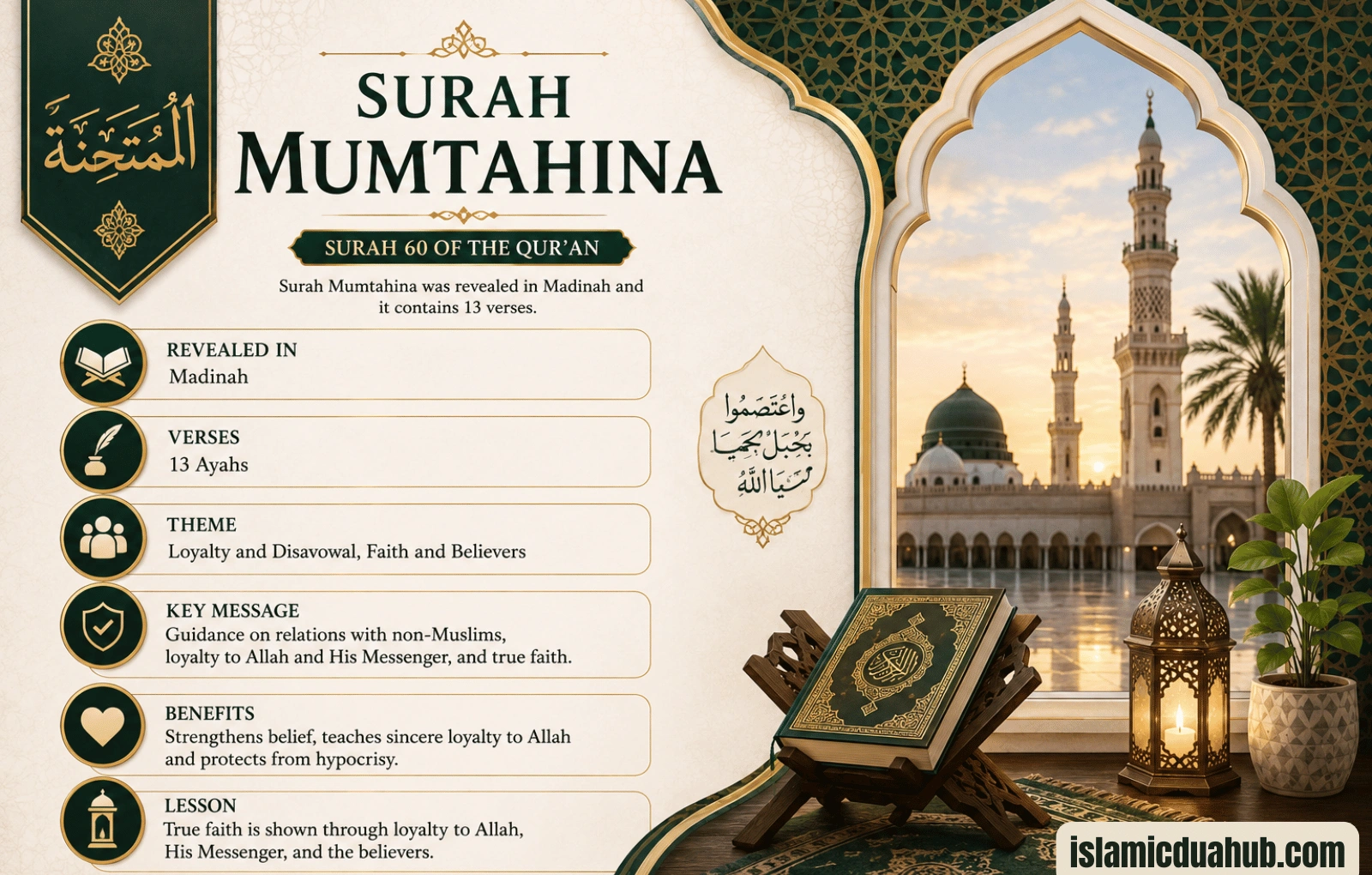
Surah Mumtahina is the 60th chapter of the Holy Quran. It is a Madani Surah, meaning it was revealed in Madinah. The Surah consists of 13 ayat and is placed in the 28th Para (Juz) of the Quran. Its name comes from the Arabic root meaning “to examine” or “to test,” referring to the examination of believing women mentioned in verse 10.
The full name is Surah Al-Mumtahanah (الممتحنة). It is also known as “She That Is to Be Examined.” Surah Mumtahina in which para: it belongs to Juz 28, appearing after Surah Al-Hashr and before Surah As-Saff.
The Surah carries deep guidance about loyalty to Allah, maintaining faith under pressure, dealing with those who oppose Islam, and the rules of marriage between Muslims and non-Muslims. It presents Prophet Ibrahim (عليه السلام) as a model of firm belief and complete trust in Allah.
Regular recitation is considered a means of seeking Allah’s mercy, strengthening Iman, and gaining blessings in this life and the Hereafter.
Surah Mumtahina Complete Arabic Text
Below is the complete Surah Mumtahina in Arabic with full diacritical marks:
بِسْمِ اللّٰهِ الرَّحْمٰنِ الرَّحِيْمِ
Ayat 1:
يٰٓاَيُّهَا الَّذِيْنَ اٰمَنُوْا لَا تَتَّخِذُوْا عَدُوِّيْ وَعَدُوَّكُمْ اَوْلِيَآءَ تُلْقُوْنَ اِلَيْهِمْ بِالْمَوَدَّةِ وَقَدْ كَفَرُوْا بِمَا جَآءَكُمْ مِّنَ الْحَقِّ يُخْرِجُوْنَ الرَّسُوْلَ وَاِيَّاكُمْ اَنْ تُؤْمِنُوْا بِاللّٰهِ رَبِّكُمْ ۗاِنْ كُنْتُمْ خَرَجْتُمْ جِهَادًا فِيْ سَبِيْلِيْ وَابْتِغَآءَ مَرْضَاتِيْ ۚتُسِرُّوْنَ اِلَيْهِمْ بِالْمَوَدَّةِ وَاَنَا۠ اَعْلَمُ بِمَآ اَخْفَيْتُمْ وَمَآ اَعْلَنْتُمْ ۗوَمَنْ يَّفْعَلْهُ مِنْكُمْ فَقَدْ ضَلَّ سَوَآءَ السَّبِيْلِ
Ayat 2:
اِنْ يَّثْقَفُوْكُمْ يَكُوْنُوْا لَكُمْ اَعْدَآءً وَّيَبْسُطُوْٓا اِلَيْكُمْ اَيْدِيَهُمْ وَاَلْسِنَتَهُمْ بِالسُّوْٓءِ وَوَدُّوْا لَوْ تَكْفُرُوْنَ
Ayat 3:
لَنْ تَنْفَعَكُمْ اَرْحَامُكُمْ وَلَآ اَوْلَادُكُمْ ۚيَوْمَ الْقِيٰمَةِ يَفْصِلُ بَيْنَكُمْ ۗوَاللّٰهُ بِمَا تَعْمَلُوْنَ بَصِيْرٌ
Ayat 4:
قَدْ كَانَتْ لَكُمْ اُسْوَةٌ حَسَنَةٌ فِيْٓ اِبْرٰهِيْمَ وَالَّذِيْنَ مَعَهٗٓ اِذْ قَالُوْا لِقَوْمِهِمْ اِنَّا بُرَءٰٓؤُا مِنْكُمْ وَمِمَّا تَعْبُدُوْنَ مِنْ دُوْنِ اللّٰهِ ۡكَفَرْنَا بِكُمْ وَبَدَا بَيْنَنَا وَبَيْنَكُمُ الْعَدَاوَةُ وَالْبَغْضَآءُ اَبَدًا حَتّٰى تُؤْمِنُوْا بِاللّٰهِ وَحْدَهٗٓ اِلَّا قَوْلَ اِبْرٰهِيْمَ لِاَبِيْهِ لَاَسْتَغْفِرَنَّ لَكَ وَمَآ اَمْلِكُ لَكَ مِنَ اللّٰهِ مِنْ شَيْءٍ ۗ رَبَّنَا عَلَيْكَ تَوَكَّلْنَا وَاِلَيْكَ اَنَبْنَا وَاِلَيْكَ الْمَصِيْرُ
Ayat 5:
رَبَّنَا لَا تَجْعَلْنَا فِتْنَةً لِّلَّذِيْنَ كَفَرُوْا وَاغْفِرْ لَنَا رَبَّنَا ۚاِنَّكَ اَنْتَ الْعَزِيْزُ الْحَكِيْمُ
Ayat 6:
لَقَدْ كَانَ لَكُمْ فِيْهِمْ اُسْوَةٌ حَسَنَةٌ لِّمَنْ كَانَ يَرْجُوا اللّٰهَ وَالْيَوْمَ الْاٰخِرَ ۗوَمَنْ يَّتَوَلَّ فَاِنَّ اللّٰهَ هُوَ الْغَنِيُّ الْحَمِيْدُ
Ayat 7:
عَسَى اللّٰهُ اَنْ يَّجْعَلَ بَيْنَكُمْ وَبَيْنَ الَّذِيْنَ عَادَيْتُمْ مِّنْهُمْ مَّوَدَّةً ۗوَاللّٰهُ قَدِيْرٌ ۗوَاللّٰهُ غَفُوْرٌ رَّحِيْمٌ
Ayat 8:
لَا يَنْهٰىكُمُ اللّٰهُ عَنِ الَّذِيْنَ لَمْ يُقَاتِلُوْكُمْ فِى الدِّيْنِ وَلَمْ يُخْرِجُوْكُمْ مِّنْ دِيَارِكُمْ اَنْ تَبَرُّوْهُمْ وَتُقْسِطُوْٓا اِلَيْهِمْ ۗاِنَّ اللّٰهَ يُحِبُّ الْمُقْسِطِيْنَ
Ayat 9:
اِنَّمَا يَنْهٰىكُمُ اللّٰهُ عَنِ الَّذِيْنَ قٰتَلُوْكُمْ فِى الدِّيْنِ وَاَخْرَجُوْكُمْ مِّنْ دِيَارِكُمْ وَظٰهَرُوْا عَلٰٓى اِخْرَاجِكُمْ اَنْ تَوَلَّوْهُمْ ۚوَمَنْ يَّتَوَلَّهُمْ فَاُولٰٓئِكَ هُمُ الظّٰلِمُوْنَ
Ayat 10:
يٰٓاَيُّهَا الَّذِيْنَ اٰمَنُوْٓا اِذَا جَآءَكُمُ الْمُؤْمِنٰتُ مُهٰجِرٰتٍ فَامْتَحِنُوْهُنَّ ۗاَللّٰهُ اَعْلَمُ بِاِيْمَانِهِنَّ ۚفَاِنْ عَلِمْتُمُوْهُنَّ مُؤْمِنٰتٍ فَلَا تَرْجِعُوْهُنَّ اِلَى الْكُفَّارِ ۗلَا هُنَّ حِلٌّ لَّهُمْ وَلَا هُمْ يَحِلُّوْنَ لَهُنَّ ۗوَاٰتُوْهُمْ مَّآ اَنْفَقُوْا ۗوَلَا جُنَاحَ عَلَيْكُمْ اَنْ تَنْكِحُوْهُنَّ اِذَآ اٰتَيْتُمُوْهُنَّ اُجُوْرَهُنَّ ۗوَلَا تُمْسِكُوْا بِعِصَمِ الْكَوَافِرِ وَسْـَٔلُوْا مَآ اَنْفَقْتُمْ وَلْيَسْـَٔلُوْا مَآ اَنْفَقُوْا ۗذٰلِكُمْ حُكْمُ اللّٰهِ يَحْكُمُ بَيْنَكُمْ ۗوَاللّٰهُ عَلِيْمٌ حَكِيْمٌ
Ayat 11:
وَاِنْ فَاتَكُمْ شَيْءٌ مِّنْ اَزْوَاجِكُمْ اِلَى الْكُفَّارِ فَعَاقَبْتُمْ فَاٰتُوا الَّذِيْنَ ذَهَبَتْ اَزْوَاجُهُمْ مِّثْلَ مَآ اَنْفَقُوْا ۗوَاتَّقُوا اللّٰهَ الَّذِيْٓ اَنْتُمْ بِهٖ مُؤْمِنُوْنَ
Ayat 12:
يٰٓاَيُّهَا النَّبِيُّ اِذَا جَآءَكَ الْمُؤْمِنٰتُ يُبَايِعْنَكَ عَلٰٓى اَنْ لَّا يُشْرِكْنَ بِاللّٰهِ شَيْـًٔا وَّلَا يَسْرِقْنَ وَلَا يَزْنِيْنَ وَلَا يَقْتُلْنَ اَوْلَادَهُنَّ وَلَا يَأْتِيْنَ بِبُهْتَانٍ يَّفْتَرِيْنَهٗ بَيْنَ اَيْدِيْهِنَّ وَاَرْجُلِهِنَّ وَلَا يَعْصِيْنَكَ فِيْ مَعْرُوْفٍ فَبَايِعْهُنَّ وَاسْتَغْفِرْ لَهُنَّ اللّٰهَ ۗاِنَّ اللّٰهَ غَفُوْرٌ رَّحِيْمٌ
Ayat 13:
يٰٓاَيُّهَا الَّذِيْنَ اٰمَنُوْا لَا تَتَوَلَّوْا قَوْمًا غَضِبَ اللّٰهُ عَلَيْهِمْ قَدْ يَئِسُوْا مِنَ الْاٰخِرَةِ كَمَا يَئِسَ الْكُفَّارُ مِنْ اَصْحٰبِ الْقُبُوْرِ
Surah Mumtahina In Roman English
Below is the Surah Mumtahina in Roman English for easy reading:
Bismillah hir-Rahman nir-Raheem
Ayat 1:
Yaa ayyuhal-lazeena aamanoo laa tattakhizoo ‘aduwwee wa ‘aduwwakum awliyaa’a tulqoona ilayhim bil-mawaddati wa qad kafaroo bimaa jaa’akum minal-haqq, yukhrijoonar-Rasoola wa iyyaakum an tu’minoo billaahi rabbikum, in kuntum kharajtum jihaadan fee sabeeli wabtighaaa’a mardaatee; tusirroona ilayhim bil-mawaddati wa ana a’lamu bimaa akhfaytum wa maa a’lantum; wa man yaf’alhu minkum faqad dalla sawaaa’as-sabeel.
Ayat 2:
In yathqafookum yakoonoo lakum a’daaa’an wa yabsutooo ilaykum aydiyahum wa alsinatahum bis-soo’i wa waddoo law takfuroon.
Ayat 3:
Lan tanfa’akum arhaamukum wa laaa awlaadukum; yawmal-qiyaamati yafsilu baynakum; wallaahu bimaa ta’maloona baseer.
Ayat 4:
Qad kaanat lakum uswatun hasanatun fee Ibraaheema wallazeena ma’ahoo iz qaaloo liqawmihim innaa burao’aa’u minkum wa mimmaa ta’budoona min doonil-laahi kafarnaa bikum wa badaa baynana wa baynakumul-‘adaawatu wal-baghdaaa’u abadan hattaa tu’minoo billaahi wahdahoo illaa qawla Ibraaheema li-abeehi la-astaghfiranna laka wa maaa amliku laka minal-laahi min shay’; rabbanaa ‘alayka tawakkalnaa wa ilayka anabnaa wa ilaykal-maseer.
Ayat 5:
Rabbanaa laa taj’alnaa fitnatal-lillazeena kafaroo waghfir lanaa rabbanaa; innaka antal-‘azeezul-hakeem.
Ayat 6:
Laqad kaana lakum feehim uswatun hasanatun liman kaana yarjul-laaha wal-yawmal-aakhir; wa man yatawalla fa-innal-laaha huwal-ghaniyyul-hameed.
Ayat 7:
‘Asallaahu any-yaj’ala baynakum wa baynal-lazeena ‘aadaytum minhum mawaddah; wallaahu qadeer; wallaahu ghafoorur-raheem.
Ayat 8:
Laa yanhaakumul-laahu ‘anil-lazeena lam yuqaatilookum fid-deeni wa lam yukhrijookum min diyaarikum an tabarroohum wa tuqsitoo ilayhim; innal-laaha yuhibbul-muqsiteen.
Ayat 9:
Innamaa yanhaakumul-laahu ‘anil-lazeena qaatalookum fid-deeni wa akhrajookum min diyaarikum wa zaaharo ‘alaa ikhraajikum an tatawallawhum; wa man yatawallaahum fa-ulaa’ika humuz-zaalimoon.
Ayat 10:
Yaa ayyuhal-lazeena aamanoo izaa jaa’akumul-mu’minaatu muhaajaraatin famtahinoohunna; Allaahu a’lamu bi-eemaanikumm; fa-in ‘alimtumoohunna mu’minaatin falaa tarji’oohunna ilal-kuffaar; laa hunna hillul-lahum wa laa hum yahilloona lahunna wa aatoohum maa anfaqoo; wa laa junaaha ‘alaykum an tankihoohunna izaa aatoytumoohunn ujoorahunna; wa laa tumsikoo bi’isamil-kawaafir; was’aloo maa anfaqtum walyas’aloo maa anfaqoo; dhaalikum hukmul-laahi yahkumu baynakum; wallaahu ‘aleemun hakeem.
Ayat 11:
Wa in faatakum shay’un min azwaajikum ilal-kuffaari fa-‘aaqabtum fa-aatul-lazeena zahabat azwaajuhum mitla maa anfaqoo; wattaqul-laahal-lazeee antum bihee mu’minoon.
Ayat 12:
Yaa ayyuhan-nabiyyu izaa jaa’akal-mu’minaatu yubaayi’naka ‘alaa an laa yushrikna billaahi shay’an wa laa yasriqna wa laa yazneena wa laa yaqtulna awlaadahunna wa laa ya’teena bibuhtaanin yaftareenaholbaynat aydihinna wa arjulihinna wa laa ya’seenaka fee ma’roofin fabaayi’hunna wastaghfir lahunnallaah; innal-laaha ghafoorur-raheem.
Ayat 13:
Yaa ayyuhal-lazeena aamanoo laa tatawallaw qawman ghadaballaahu ‘alayhim qad ya’isoo minal-aakhirati kamaa ya’isal-kuffaaru min as-haabil-quboor.
Surah Mumtahina In English (Meaning)
Bismillah: In the name of Allah, the Most Gracious, the Most Merciful
Ayat 1:
O believers! Do not take My enemies and yours as trusted allies, showing them affection even though they deny what has come to you of the truth. They drove the Messenger and yourselves out simply for your belief in Allah, your Lord. If you truly emigrated to struggle in My cause and seek My pleasure, do not take them as allies, disclosing secrets of the believers to them. I know best whatever you conceal and whatever you reveal. And whoever of you does this has truly strayed from the right way.
Ayat 2:
If they gain the upper hand over you, they will be your open enemies, unleashing their hands and tongues to harm you, and wishing that you may abandon faith.
Ayat 3:
Neither your relatives nor your children will benefit you on the Day of Judgment. He will decide between you all. And Allah is All-Seeing of what you do.
Ayat 4:
You have an excellent example in Ibrahim (عليه السلام) and those with him, when they said to their people: We totally dissociate ourselves from you and whatever you worship besides Allah. We reject you. The enmity and hatred between us will last until you believe in Allah alone. The only exception is when Ibrahim said to his father: I will seek forgiveness for you, yet I cannot protect you from Allah at all. They prayed: Our Lord! In You we trust. To You we always turn. And to You is the final return.
Ayat 5:
Our Lord! Do not subject us to the persecution of the disbelievers. Forgive us, our Lord! You alone are truly the Almighty, the All-Wise.
Ayat 6:
There is certainly a good example for you in them, for anyone whose hope is in Allah and the Last Day. And whoever turns away, indeed Allah is the Self-Sufficient, the Praiseworthy.
Ayat 7:
Perhaps Allah will bring about affection between you and those you now consider enemies. Allah is All-Powerful. And Allah is All-Forgiving, Most Merciful.
Ayat 8:
Allah does not forbid you from being kind and fair to those who have not fought you for your faith or driven you out of your homes. Truly Allah loves those who are just.
Ayat 9:
Allah only forbids you from taking as allies those who have fought you for your faith, expelled you from your homes, or helped others to do so. Whoever takes them as allies, those are the wrongdoers.
Ayat 10:
O believers! When believing women come to you as emigrants, examine them. Allah knows best about their faith. If you confirm them to be true believers, do not return them to the disbelievers. They are not lawful wives for the disbelievers, nor are those disbelievers lawful husbands for them. Give back what those husbands spent on their mahr. There is no blame on you if you marry these women after paying their mahr. And do not hold on to your marriages with disbelieving women. Ask for the return of what you spent, and let the disbelievers ask for what they spent. That is the judgment of Allah. He judges between you. And Allah is All-Knowing, All-Wise.
Ayat 11:
If any of your wives go over to the disbelievers and you later gain recompense, then give those whose wives have left them the equivalent of what they spent. And remain mindful of Allah, in Whom you believe.
Ayat 12:
O Prophet! When believing women come to you and pledge that they will not associate anything with Allah, will not steal, will not commit adultery, will not kill their children, will not fabricate any falsehood, and will not disobey you in any righteous matter, then accept their pledge and ask Allah to forgive them. Truly Allah is All-Forgiving, Most Merciful.
Ayat 13:
O believers! Do not make allies of those who have earned Allah’s wrath. They have despaired of the Hereafter just as the disbelievers have despaired of those in the graves.
Surah Mumtahina In Hindi (Transliteration)
बिस्मिल्लाह हिर्र-रहमान निर्-रहीम
आयत 1:
या अय्युहल्लज़ीना आमनू ला तत्तख़िज़ू ‘अदुव्वी व ‘अदुव्वकुम औलियाआ तुल्क़ूना इलयहिम बिल्मवद्दति वक़द कफ़रू बिमा जाअकुम मिनल हक़्क़, युख्रिजूनर्रसूला व इय्याकुम अन तुअमिनू बिल्लाहि रब्बिकुम, इन कुन्तुम ख़रजतुम जिहादन फी सबीली वब्तिग़ाआ मर्ज़ाती; तुसिर्रूना इलयहिम बिल्मवद्दति व अना अ’लमु बिमा अख्फ़यतुम व मा अ’लन्तुम; व मन यफ’अलहु मिन्कुम फ़क़द ज़ल्ल सवाअस्सबील।
आयत 2:
इन यस्क़फ़ूकुम यकूनू लकुम अ’दाअन व यब्सुतू इलयकुम अयदियहुम व अल्सिनतहुम बिस्सूइ व वद्दू लौ तकफुरून।
आयत 3:
लन तन्फ़’अकुम अर्हामुकुम व ला औलादुकुम; यौमल क़ियामति यफ्सिलु बयनकुम; वल्लाहु बिमा त’अमलूना बसीर।
आयत 4:
क़द कानत लकुम उस्वतुन हसनतुन फ़ी इब्राहीम वल्लज़ीना म’अहू इज़ क़ालू लिक़ौमिहिम इन्ना बुरआउ मिन्कुम व मिम्मा त’अबुदूना मिन दूनिल्लाहि कफ़रना बिकुम व बदा बयनना व बयनकुमुल ‘अदावतु वल बग़्ज़ाउ अबदन हत्ता तुअमिनू बिल्लाहि वह्दहू इल्ला क़ौला इब्राहीम लिअबीहि ल’अस्तग़फिरन्न लक व मा अम्लिकु लक मिनल्लाहि मिन शय’इन; रब्बना ‘अलयक तवक्कल्ना व इलयक अनब्ना व इलयकल मसीर।
आयत 5:
रब्बना ला तज’अलना फित्नतल् लिल्लज़ीना कफ़रू वग़्फिर लना रब्बना; इन्नक अन्तल ‘अज़ीज़ुल हकीम।
आयत 6:
लक़द कान लकुम फीहिम उस्वतुन हसनतुन लिमन कान यर्जुल्लाह वल्यौमल आख़िर; व मन यतवल्ल फ़इन्नल्लाह हुवल ग़निय्युल हमीद।
आयत 7:
‘असल्लाहु अन यज’अल बयनकुम व बयनल्लज़ीना ‘आदयतुम मिन्हुम मवद्दह; वल्लाहु क़दीर; वल्लाहु ग़फूरुर्रहीम।
आयत 8:
ला यन्हाकुमुल्लाहु ‘अनिल्लज़ीना लम युक़ातिलूकुम फिद्दीनि व लम युख्रिजूकुम मिन दियारिकुम अन तबर्रूहुम व तुक़्सितू इलयहिम; इन्नल्लाह युहिब्बुल मुक़्सितीन।
आयत 9:
इन्नमा यन्हाकुमुल्लाहु ‘अनिल्लज़ीना क़ातलूकुम फिद्दीनि व अख्रजूकुम मिन दियारिकुम व ज़ाहरू ‘अला इख्राजिकुम अन तवल्लौहुम; व मन यतवल्लहुम फ़उलाइक हुमुज़्ज़ालिमून।
आयत 10:
या अय्युहल्लज़ीना आमनू इज़ा जाअकुमुल मुअ’मिनातु मुहाजिरातिन फ़म्तहिनूहुन्न; अल्लाहु अ’लमु बि-ईमानिहिन्न; फ़इन ‘अलिम्तुमूहुन्न मुअ’मिनातिन फ़ला तर्जिऊहुन्न इलल कुफ्फार; ला हुन्न हिल्लुल्लहुम व ला हुम यहिल्लूना लहुन्न; व आतूहुम मा अनफ़क़ू; व ला जुनाह ‘अलयकुम अन तन्किहूहुन्न इज़ा आतयतुमूहुन्न उजूरहुन्न; व ला तुम्सिकू बि’इसमिल कवाफ़िर; वस्अलू मा अनफ़क़तुम वल्यस्अलू मा अनफ़क़ू; ज़ालिकुम हुक्मुल्लाहि यह्कुमु बयनकुम; वल्लाहु ‘अलीमुन हकीम।
आयत 11:
व इन फातकुम शय’उन मिन अज़्वाजिकुम इलल कुफ्फारि फ़’आक़ब्तुम फ़आतुल्लज़ीना ज़हबत अज़्वाजुहुम मिस्ल मा अनफ़क़ू; वत्तक़ुल्लाहल्लज़ी अन्तुम बिही मुअ’मिनून।
आयत 12:
या अय्युहन्नबिय्यु इज़ा जाअकल मुअ’मिनातु युबाय’इनक ‘अला अन ला युश्रिकन बिल्लाहि शय’अन व ला यस्रिक़न व ला यज़्नीन व ला यक़्तुलन औलादहुन्न व ला यअ’तीन बिबुह्तानिन यफ्तरीनहू बयन अयदीहिन्न व अर्जुलिहिन्न व ला य’असीनक फी म’अरूफ़िन फ़बाय’हुन्न वस्तग़्फिर लहुन्नल्लाह; इन्नल्लाह ग़फूरुर्रहीम।
आयत 13:
या अय्युहल्लज़ीना आमनू ला ततवल्लौ क़ौमन ग़दिबल्लाहु ‘अलयहिम क़द यइसू मिनल आख़िरति कमा यइसल कुफ्फारु मिन अस्हाबिल क़ुबूर।
When To Read Surah Mumtahina
Surah Mumtahina is part of the Quran and can be recited at any time as part of a believer’s daily tilawat (recitation). There is no specific time or prayer restricted to it.
Many people recite Surah Mumtahina as part of their general Quranic reading after Fajr or after the Isha prayer when the mind is quiet and focused.
Those who want to reflect on the meaning and spiritual guidance of Surah Mumtahina often read it during times of difficulty in relationships, when seeking a righteous marriage partner, or when facing pressure to compromise their faith.
Reciting any portion of the Quran, including Surah Mumtahina, with sincerity and reflection is a complete act of worship and a means of drawing closer to Allah.
How To Recite Surah Mumtahina
Make Wudu (Ablution) First
Before reciting any portion of the Quran, it is strongly recommended to be in a state of wudu. Wudu purifies the body and prepares the heart for the remembrance of Allah. While it is permissible to recite from memory without wudu, touching the Mushaf (physical Quran) requires purification.
Sit in a Clean and Quiet Place
Choose a clean spot free from distractions. Facing the Qibla while reciting is a Sunnah-recommended practice that adds to the spiritual focus of your recitation. Remove any noise around you so your heart can be fully present.
Begin With Taawwuz and Tasmiyah
Start by saying:
اَعُوْذُ بِاللّٰهِ مِنَ الشَّيْطٰنِ الرَّجِيْمِ
Transliteration: A’uzu billahi minash-shaytanir-rajeem
Meaning: I seek refuge in Allah from the accursed Shaytan.
Then recite:
بِسْمِ اللّٰهِ الرَّحْمٰنِ الرَّحِيْمِ
Transliteration: Bismillahir-rahmanir-raheem
Meaning: In the name of Allah, the Most Gracious, the Most Merciful.
This opening is required before every Surah of the Quran except Surah At-Tawbah.
Recite With Tajweed
Tajweed refers to the set of rules that govern the correct pronunciation of Quranic Arabic. Reciting Surah Mumtahina with proper Tajweed means giving each letter its correct sound, applying the rules of madd (elongation), ghunna (nasalization), and idgham (merging of letters) where they apply.
If you are new to Tajweed, begin by listening to a reciter such as Sheikh Mishary Rashid Alafasy or Sheikh Abdul Rahman Al-Sudais and repeat after them. The Roman transliteration provided above can also help with basic pronunciation.
Recite Slowly and With Reflection
Allah commands in the Quran to recite it with tarteel, meaning slowly and distinctly (Surah Al-Muzzammil, verse 4). Do not rush through the ayat. Pause at the appropriate stopping marks (waqf signs) within the Surah. As you recite each verse of Surah Mumtahina, take a moment to connect with its meaning.
End With Dua
After completing the recitation, raise your hands and make sincere dua to Allah. Ask for whatever is in your heart, whether it is ease in marriage, forgiveness, protection, or strength of faith. The time right after Quranic recitation is a blessed moment for supplication.
Surah Mumtahina Benefits
The recitation of Surah Mumtahina carries numerous spiritual and moral rewards for the believer.
Strengthening of Iman
Regular recitation deepens a person’s connection with Allah. The Surah constantly reminds the heart to place all trust in Allah, which builds a strong and stable Iman over time.
Forgiveness from Allah
The angels are reported to seek forgiveness on behalf of the person who recites this Surah. This points to the great mercy that can be obtained through consistent recitation. Verse 12 itself contains a direct instruction to seek Allah’s forgiveness for believers.
Guidance in Decision-Making
This Surah teaches believers how to choose their companions, allies, and close relationships wisely. Reflecting on its verses helps a person make decisions aligned with faith and taqwa, whether in personal life, business, or marriage.
Surah Mumtahina For Marriage Benefits
Surah Mumtahina holds special relevance for matters of marriage. Verse 10 of Surah Mumtahina addresses the relationship between faith and marriage directly, making it a chapter deeply connected to marital guidance.
The verse establishes that true compatibility in marriage begins with shared faith and sincere commitment to Allah. This principle forms the foundation of a strong and blessed marital bond.
Many Muslims recite Surah Mumtahina with the intention of seeking Allah’s help in finding a righteous spouse, removing obstacles in their path to marriage, and bringing peace and harmony to their married life. The Surah’s emphasis on loyalty, fairness, and trust in Allah makes it a fitting companion for anyone walking through marriage-related challenges.
Verse 7 is particularly powerful in this context: it reminds that Allah alone has the ability to replace enmity with love. For those facing conflict in their marriage or family disagreements over marriage proposals, this ayah carries deep comfort and hope.
Consistent recitation with sincerity and proper intention, combined with dua, is a means through which believers seek barakah in their marriages.
Peace of Heart and Protection
Reading and reflecting on these verses regularly brings inner peace to the heart. The Surah consistently redirects attention toward Allah as the sole protector and guardian. For those going through trials, this reminder offers genuine comfort and spiritual protection.
A Strong Character
The lessons within this chapter shape a Muslim’s character. It teaches honesty in relationships, care for justice, and courage in standing firm in faith. A person who regularly recites and reflects on this Surah naturally develops these qualities in their daily life.
Surah Mumtahina PDF
The complete Surah Mumtahina PDF is available below on this page. It includes the full Arabic text of all 13 ayat, Roman English transliteration, and the English meaning, all in a clean and easy-to-read format.
You can save it to your device, print it for personal use, or share it with family and friends. Having the Surah Mumtahina PDF on hand makes it easy to read at any time, whether at home, while travelling, or during Islamic study circles, without needing an internet connection.
The PDF is a practical resource for students, teachers, parents, and anyone who wants to keep the complete Surah Mumtahina within easy reach.
Conclusion
Surah Mumtahina is a chapter of profound guidance for every believer. It addresses one of the most fundamental questions of faith: where does our true loyalty lie?
Through its 13 verses, the Surah directs believers toward Allah as their only source of trust and protection. It presents Ibrahim (عليه السلام) as a timeless example of faith over family and principle over convenience. It draws a balanced picture of how Muslims should relate to others, firm in faith, yet just and kind to those who live in peace.
The complete Surah Mumtahina in Arabic contains verses that speak directly to the soul, reminding the reader of the Day of Judgment, the limits of worldly bonds, and the unlimited mercy of Allah.
For anyone seeking blessings in marriage, Surah Mumtahina for marriage benefits are grounded in the Surah’s core teaching: that faith and sincerity are the foundations of a lasting bond. A marriage built on these qualities, with tawakkul in Allah, is a marriage filled with barakah.
May Allah grant every Muslim the ability to recite, reflect upon, and act upon the teachings of Surah Mumtahina. Ameen.
 Also, Check Out More Reliable Islamic Surahs:
- Surah Ikhlas In Hindi
- Surah Kafirun In Hindi
- Inna Anzalna Surah (Surah Al Qadr)
- Tabbat Yada Surah
- Surah Alam Nashrah
- Surah Quraish
- Surah Qadr In Hindi
- Surah Kausar Translation
- Surah Baqra Last Two Ayat
- Surah Juma Read Online
? Frequently Asked Questions (FAQs)
Q1: Surah Mumtahina in which para?
Surah Mumtahina is in Para 28 (Juz 28) of the Holy Quran.
Q2: How many verses does Surah Mumtahina have?
Surah Mumtahina has 13 verses (ayat). It is a Madani Surah, revealed in Madinah.
Q3: What is the meaning of Surah Mumtahina?
The Surah Mumtahina meaning is “She That Is to Be Examined” or “The Woman Who Is Tested,” referring to the examination of believing women who emigrated to Madinah, as mentioned in verse 10.
Q4: Is Surah Mumtahina good for marriage?
Yes. Surah Mumtahina for marriage benefits are widely recognized among Muslims. The Surah addresses the role of faith in marriage, the importance of choosing a righteous partner, and Allah’s power to bring love and harmony. Reciting it with sincerity while making dua to Allah is a spiritually meaningful practice for those seeking good marriage proposals or peace in their married life.
Q5: What is Surah Mumtahina in Roman English called for easy reading?
The Surah Mumtahina in Roman English transliteration begins with “Yaa ayyuhal-lazeena aamanoo laa tattakhizoo ‘aduwwee…” This Roman form helps non-Arabic speakers pronounce and recite the Surah correctly.
Q6: Can I recite Surah Mumtahina daily?
Yes. Like any Surah of the Quran, Surah Mumtahina can be recited at any time as part of daily tilawat. Regular recitation with reflection on its meaning brings spiritual benefit and closeness to Allah.
Q7: Who is mentioned as an example in Surah Mumtahina?
Prophet Ibrahim (عليه السلام) is mentioned in Surah Mumtahina as the best example for believers. His unwavering commitment to Allah and his clear separation from idol worshippers is presented as a model for the Muslim community.
Written by: Ahmad Raza
Credentials: Islamic Studies Content Writer
Read More duas for daily life at Instant Dua