
The Riaz Ul Jannah Dua is recited by Muslims who visit one of the most sacred places on earth, a blessed area inside Masjid an-Nabawi in Madinah Munawwarah. Before stepping inside, it helps to know where you are standing and why this place holds such a special place in Islamic tradition.
Riaz Ul Jannah is one of the most blessed places on earth for Muslims. It is a sacred area inside Masjid an-Nabawi in Madinah Munawwarah, located between the blessed pulpit (Minbar) of the Prophet Muhammad (ﷺ) and his noble chamber where he rests.
The name Riaz Ul Jannah comes from the Arabic words “Riyad” meaning gardens and “Jannah” meaning Paradise. Together it means “the Garden of Paradise.” This place is not just a physical space inside a mosque. It is a spot that the Prophet Muhammad (ﷺ) himself described as part of Jannah.
The Prophet (ﷺ) said:
مَا بَيْنَ بَيْتِي وَمِنْبَرِي رَوْضَةٌ مِنْ رِيَاضِ الْجَنَّةِ
“Ma bayna bayti wa minbari rawdatun min riyad il-jannah.”
“Between my house and my pulpit there is a garden from the gardens of Paradise.”
(Sahih al-Bukhari, 1195; Sahih Muslim, 1391)
This hadith is the foundation of everything that makes Riaz Ul Jannah special. Because the Prophet (ﷺ) gave this description himself, Muslims across all centuries have treated this area with deep love and reverence.
Riaz Ul Jannah History
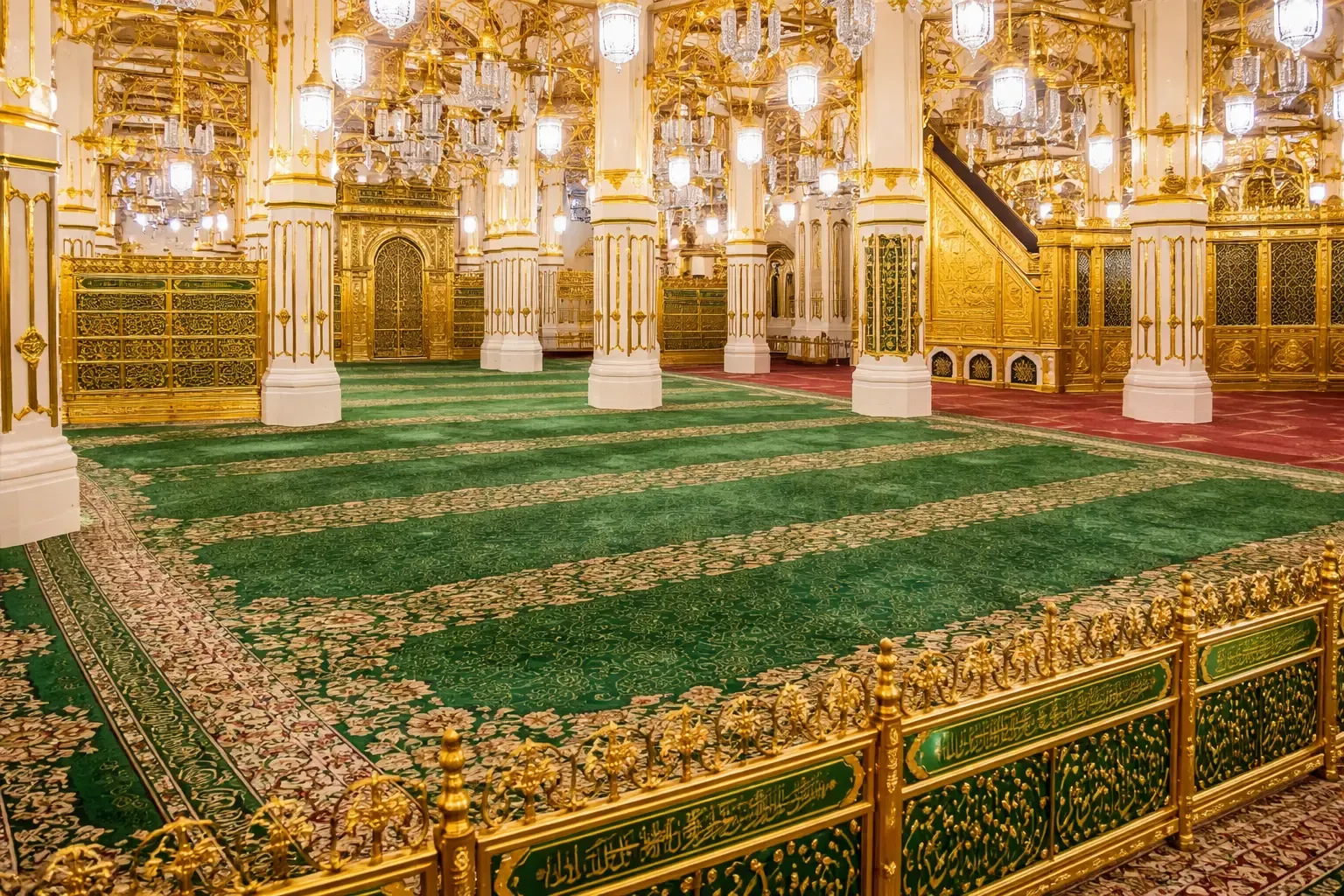
The Riaz Ul Jannah history begins with the earliest days of Islam. When the Prophet Muhammad (ﷺ) migrated from Makkah to Madinah after the Hijrah, he established a simple mosque made from palm leaves and date trunks. This modest structure became the center of the early Muslim community.
The area now known as Riaz Ul Jannah was directly connected to the Prophet’s daily life. He led prayers here, delivered sermons, taught companions, and settled matters of the community. The space between his home and the Minbar was where he and the Sahabah (companions) would sit, pray, and remember Allah.
As Islam spread and the Muslim population grew, the mosque was expanded multiple times. However, scholars and caretakers through each era took great care to preserve the identity and boundaries of this original sacred zone.
The Rawdah, as it is also called, remained identifiable across centuries because Islamic scholars consistently documented its location based on the original landmarks: the Prophet’s house on one side and his Minbar on the other.
Today, the area measures approximately 22 by 15 meters. It sits at the very heart of Masjid an-Nabawi and remains unchanged in its historical identity even as the mosque around it has grown into one of the largest in the world.
Riaz Ul Jannah Dua In Arabic
When a Muslim enters Riaz Ul Jannah, there is no single obligatory dua prescribed specifically for this place. However, scholars recommend offering heartfelt supplications for forgiveness, guidance, and entry into Paradise.
The following duas are highly recommended to recite during your time in Riaz Ul Jannah.
Dua 1: Dua For Jannah And Protection From The Fire
Arabic:
اَللَّهُمَّ إِنِّي أَسْأَلُكَ الْجَنَّةَ وَأَعُوْذُ بِكَ مِنَ النَّارِ
Transliteration:
Allahumma inni as’alukal-jannata wa a’udhu bika minan-naar.
Meaning In English:
“O Allah, I ask You for Paradise and I seek Your protection from the Fire.”
Urdu Meaning:
اے اللہ، میں تجھ سے جنت مانگتا ہوں اور جہنم سے تیری پناہ مانگتا ہوں۔
Reference: Sahih (Albani). Abu Dawud: 792; Ibn Majah: 3846
This is one of the most recommended duas to recite in Riaz Ul Jannah. The Prophet (ﷺ) approved of this supplication when a companion recited it in prayer, saying “our dua also carries meaning close to it.” It is short, powerful, and covers the greatest request a believer can make.
Dua 2: Dua For Jannah And All That Leads To It
Arabic:
اللَّهُمَّ إِنِّي أَسْأَلُكَ الْجَنَّةَ وَمَا قَرَّبَ إِلَيْهَا مِنْ قَوْلٍ أَوْ عَمَلٍ، وَأَعُوذُ بِكَ مِنَ النَّارِ وَمَا قَرَّبَ إِلَيْهَا مِنْ قَوْلٍ أَوْ عَمَلٍ
Transliteration:
Allahumma inni as’alukal-jannata wa ma qarraba ilayha min qawlin aw ‘amalin, wa a’udhu bika minan-nari wa ma qarraba ilayha min qawlin aw ‘amalin.
Meaning In English:
“O Allah, I ask You for Paradise and for everything that brings one closer to it in word and deed, and I seek refuge in You from the Fire and from everything that brings one closer to it in word and deed.”
Urdu Meaning:
اے اللہ، میں تجھ سے جنت اور ہر اس قول و عمل کا سوال کرتا ہوں جو جنت کے قریب کرے، اور جہنم سے اور ہر اس قول و عمل سے تیری پناہ مانگتا ہوں جو جہنم کے قریب کرے۔
Reference: Ibn Majah; narrated by Aisha (RA)
This dua is more complete in scope. It asks not just for the destination of Paradise, but for all the words and actions that lead a person there. For a visitor standing in Riaz Ul Jannah, this is a deeply meaningful request.
Dua 3: Hadith Dua Of Riaz Ul Jannah
The following is the actual hadith of Riaz Ul Jannah in Arabic, which many visitors recite upon entering the area as a form of remembrance and gratitude:
Arabic (Hadith of Riaz Ul Jannah In Arabic):
مَا بَيْنَ بَيْتِي وَمِنْبَرِي رَوْضَةٌ مِنْ رِيَاضِ الْجَنَّةِ وَمِنْبَرِي عَلَى حَوْضِي
Transliteration:
Ma bayna bayti wa minbari rawdatun min riyad il-jannati wa minbari ‘ala hawdi.
Meaning In English:
“Between my house and my pulpit there is a garden from the gardens of Paradise, and my pulpit is on my fountain tank (Al-Kauthar).”
Reference: Sahih al-Bukhari, 1196; narrated by Abu Hurairah (RA)
Reciting this hadith while standing in Riaz Ul Jannah connects the visitor to the words of the Prophet (ﷺ) and deepens the spiritual experience of the visit.
Riaz Ul Jannah Dua In Urdu
For Urdu-speaking visitors, here is the Riaz Ul Jannah Dua in Urdu meaning for the primary supplication:
اَللَّهُمَّ إِنِّي أَسْأَلُكَ الْجَنَّةَ وَأَعُوْذُ بِكَ مِنَ النَّارِ
رومن اردو: اللھم انی اسالک الجنۃ و اعوذ بک من النار
اردو ترجمہ: اے اللہ، میں تجھ سے جنت مانگتا ہوں اور جہنم کی آگ سے تیری پناہ مانگتا ہوں۔
This dua captures the complete longing of every believer. A Muslim visiting Riaz Ul Jannah stands in the Garden of Paradise itself and asks Allah for the full Paradise. There is no moment more fitting for this supplication.
Riaz Ul Jannah Namaz Ki Niyat
There is no separate or unique Niyat (intention) that must be made before praying in Riaz Ul Jannah. Scholars have confirmed that no specific intention is required beyond the standard intention for whichever prayer you are performing.
For nafl (voluntary) prayers in Riaz Ul Jannah, the intention is simply:
نیت: میں دو رکعت نفل نماز ادا کرتا ہوں، اللہ تعالیٰ کی رضا کے لیے، رخ میرا کعبہ شریف کی طرف ہے۔
Meaning: I intend to pray two rak’at nafl prayer, for the sake of Allah, facing the Qiblah.
The sincerity of the heart matters more than a specific worded formula. Scholars of the Hanafi, Maliki, Shafi’i, and Hanbali schools all agree that anyone praying in Riaz Ul Jannah will receive the full reward of prayer in Masjid an-Nabawi, which is 1,000 times the reward of prayer in any other mosque except Masjid al-Haram.
Riaz Ul Jannah Namaz Ka Tarika
The Riaz Ul Jannah Namaz Ka Tarika follows the standard method of performing nafl salah. There are no special rak’ats, recitations, or movements unique to this place. Most visitors perform two rak’at of nafl prayer.
How To Pray In Riaz Ul Jannah Step By Step
Step 1: Make Wudu Before Entering
Ensure you have a valid wudu (ablution) before entering Riaz Ul Jannah. The mosque authorities also require visitors to be in a state of purity at all times inside the Rawdah area.
Step 2: Enter With Humility And Right Foot
Enter the area with your right foot first and recite:
Bismillah, Allahumma salli ‘ala Muhammad. Allahumma iftah li abwaba rahmatik.
(In the name of Allah, O Allah send blessings upon Muhammad. O Allah, open for me the doors of Your mercy.)
Step 3: Locate A Space And Face The Qiblah
Move calmly and choose a space to pray without disturbing others. Face the direction of Qiblah (Makkah).
Step 4: Make Niyat
Make the intention in your heart to pray two rak’at nafl for the sake of Allah.
Step 5: Perform Two Rak’at Nafl Salah
Pray two rak’at following the standard method. Keep your prayer calm and focused. Recite Surah Al-Fatiha and any short surah in each rak’at.
Step 6: Recite Dua After Salah
After completing the prayer, raise your hands and make sincere dua. This is the most precious moment. Ask for forgiveness, guidance, Jannah, and protection from the fire.
Step 7: Send Durood Upon The Prophet (ﷺ)
Before leaving, recite Durood Ibrahim or any form of salawat (blessings) upon the Prophet (ﷺ):
Allahumma salli ‘ala Muhammadin wa ‘ala ali Muhammadin kama sallayta ‘ala Ibrahima wa ‘ala ali Ibrahim. Innaka Hamidum Majeed.
Step 8: Move Calmly And Make Room For Others
Time inside Riaz Ul Jannah is limited. After completing your prayer and dua, move calmly to allow others to enter. Do not sit for extended periods in a way that blocks other visitors.
Riaz Ul Jannah Pillars
The Riaz Ul Jannah Pillars are among the most historically significant markers inside Masjid an-Nabawi. There are eight notable pillars in total within the Rawdah area. These pillars are considered to stand on the exact spots where the original palm tree trunks were placed to support the roof of the very first mosque built by the Prophet (ﷺ) in 622 CE.
Each pillar carries a gold Arabic inscription on a large green circle marking its name. The columns are visually different from all other pillars inside the mosque. Their positions are also irregular compared to the uniform layout of the rest of the mosque, which further confirms their historical origin.
The names of the main pillars inside Riaz Ul Jannah include:
- Ustawana Mukhallaq (Pillar of the Perfume) where the Prophet (ﷺ) used to lean and offer prayer.
- Ustawana Aisha (Pillar of Aisha) where Aisha (RA) reported the Prophet would pray.
- Ustawana Abu Lubabah (Pillar of Repentance) where a companion tied himself in repentance.
- Ustawana Al-Wufood (Pillar of the Delegations) where delegations met the Prophet.
- Ustawana Al-Muhajjir (Pillar of the Guard) where companions would keep watch.
- Ustawana Sarieer (Pillar of the Bed) near where the Prophet (ﷺ) would rest at times.
- Ustawana Al-Tahajjud (Pillar of Night Prayer) associated with the Prophet’s night prayers.
- The Hannanah Pillar near the original trunk to which the Prophet (ﷺ) would lean before the Minbar was built.
These pillars were renovated during the Ottoman era but they still stand in their original positions, holding the memory of the earliest days of Islam.
Riaz Ul Jannah Permit
Due to the immense number of visitors who come to Masjid an-Nabawi, especially during Hajj and Umrah seasons, the Saudi authorities have introduced a Riaz Ul Jannah Permit system. This permit is now required to access the Rawdah area.
Key points about the permit system:
The permit is obtained through the official Nusuk app or the Saudi Ministry of Hajj and Umrah’s online portals. Separate time slots are allocated for men and women. Entry is limited to a fixed number of visitors per slot to prevent overcrowding.
Visitors are given a specific window of time to enter, perform their prayer and dua, and exit. Extended stays are not permitted. Mosque staff monitor movement inside the area at all times.
It is strongly advised to book your slot as early as possible, especially during peak seasons such as Ramadan, Dhul Hijjah, and other busy periods. Slots are often booked within minutes of opening.
If you are unable to get a permit or cannot enter on a given day, remember that prayer elsewhere in Masjid an-Nabawi still carries immense reward. The Prophet (ﷺ) said that one prayer in Masjid an-Nabawi equals 1,000 prayers in any other mosque except Masjid al-Haram. This reward applies to the entire mosque, not only to Riaz Ul Jannah.
Benefits Of Praying In Riaz Ul Jannah
Spiritual Connection To The Prophet (ﷺ)
Standing in Riaz Ul Jannah places you in the exact physical space where the Prophet Muhammad (ﷺ) prayed, taught, and spent his days. This connection is irreplaceable and deeply moving for any believer.
Reward Of Masjid An-Nabawi Multiplied
Praying one salah in Masjid an-Nabawi is equal to 1,000 salahs in any other mosque except Masjid al-Haram. Since Riaz Ul Jannah is part of Masjid an-Nabawi, this full reward applies.
Duas Are Accepted
There is a long-standing tradition among scholars that supplications made in Riaz Ul Jannah carry special weight. The area is described as part of Jannah itself, and the mercy of Allah descends upon it. Scholars such as Hafiz Ibn Hajar (d. 852 AH) explained that the special mercy of Allah descends upon this area, making it a powerful place for sincere dua.
Performing Good Deeds Leads To Jannah
Scholar Allamah Khattabi (d. 383 AH) and others explained that performing good deeds in Riaz Ul Jannah leads a person toward Jannah. The area is spiritually elevated because of its direct connection to the Prophet (ﷺ).
Closeness To Al-Kauthar
The hadith also mentions that the Prophet’s Minbar is upon Al-Kauthar, his blessed fountain in the Hereafter. Standing near this place connects the believer to the promised blessings of the next life.
When To Read The Riaz Ul Jannah Dua
The duas recommended for Riaz Ul Jannah can be recited:
After completing two rak’at of nafl salah inside Riaz Ul Jannah. During the moments of sitting in the area before or after prayer. At any time during your visit to Masjid an-Nabawi, even if you cannot enter Riaz Ul Jannah itself. After any obligatory prayer (fard) during your stay in Madinah. During tahajjud (night prayer) which the Prophet (ﷺ) himself would perform near the Rawdah.
There is no single fixed time. The key is sincerity and focus. Any moment of quiet, humble connection with Allah in Madinah is the right time.
Conclusion
Riaz Ul Jannah is one of the rarest gifts a Muslim can experience in this life. Standing in the Garden of Paradise, in the same space where the Prophet Muhammad (ﷺ) prayed and lived, is a moment no believer forgets.
The Riaz Ul Jannah Dua in Arabic and its Urdu meaning give you the words to carry into that sacred space. The prayer method and Riaz Ul Jannah Namaz Ki Niyat prepare you properly before stepping into the Rawdah. The history, the pillars, and the permit system all help you prepare well before your visit.
Make your intention sincere. Prepare your duas in advance. Pray with focus and humility. Ask Allah for Jannah, for forgiveness, and for His mercy. That is the true spirit of visiting Riaz Ul Jannah.
May Allah grant every Muslim the opportunity to pray in Riaz Ul Jannah and accept all duas made in that blessed space. Ameen.
🤲 Read These Other Islamic Supplications As Well:
- Iman E Mujmal
- Tahajjud Ki Dua
- Tahajjud Namaz Ki Niyat
- Taraweeh Ki Niyat
- Barish Ki Dua
- Subha Ki Dua
- Dusra Kalma Shahadat
- Pehla Kalma Tayyab
- Teesra Kalma
- Shab E Barat Namaz
- Shab E Meraj Ki Namaz
- Fajar Ki Namaz
? FAQs About Riaz Ul Jannah
What is Riaz Ul Jannah in Arabic?
The Arabic term is رَوْضَةٌ مِنْ رِيَاضِ الْجَنَّةِ (Rawdatun min riyad il-jannah), meaning “a garden from the gardens of Paradise.” The full hadith phrase for the area is: مَا بَيْنَ بَيْتِي وَمِنْبَرِي (Ma bayna bayti wa minbari), meaning “between my house and my pulpit.”
Is visiting Riaz Ul Jannah obligatory in Islam?
No, visiting Riaz Ul Jannah is not obligatory. It is a highly recommended and blessed act, but it is not a required part of Hajj or Umrah.
Can women visit Riaz Ul Jannah?
Yes, women can visit Riaz Ul Jannah. Separate time slots are designated for women through the permit system. The timings differ from men’s slots.
What is the Riaz Ul Jannah Namaz Ka Tarika?
The standard method of two rak’at nafl prayer is performed. There is no unique tarika specific to Riaz Ul Jannah. The steps are covered in the prayer section above.
How many pillars are in Riaz Ul Jannah?
There are eight notable pillars inside the Rawdah area, each marking the position of the original palm tree trunks from the first mosque of the Prophet (ﷺ).
How do I get a Riaz Ul Jannah Permit?
Entry permits are available through the official Nusuk application and the Saudi Ministry of Hajj and Umrah’s platform. Slots open periodically and should be booked as early as possible.
What dua should I read in Riaz Ul Jannah?
There is no mandatory dua. It is recommended to recite: Allahumma inni as’alukal-jannata wa a’udhu bika minan-naar and to ask sincerely for whatever is in your heart. Personal supplications in any language are fully accepted.
Written by: Ahmad Raza
Credentials: Islamic Studies Content Writer
🤲 Read More duas for daily life at Instant Dua