The Dusra Kalma Shahadat holds a very special place in Islam. It is the second of the six Kalimas that every Muslim is encouraged to memorize and recite with full belief in the heart.
The word “Shahadat” comes from the Arabic root meaning “to bear witness.” When a Muslim recites the Dusra Kalma, they are making a complete and sincere declaration of faith. They are proclaiming that Allah is One, that He has no partner, and that Prophet Muhammad (peace be upon him) is His servant and messenger.
This Kalima is not just a collection of words. It is the foundation of Islamic belief. It represents the concept of Tawheed, which is the absolute oneness of Allah. Every Muslim who recites it with awareness and sincerity is affirming the most central teaching of Islam.
The Dusra Kalma is also deeply connected to daily Islamic worship. It appears in the Adhan, which is the call to prayer that Muslims hear five times every day. This connection makes the Dusra Kalma one of the most frequently heard and recited phrases in the life of a Muslim.
Dusra Kalma Shahadat in Arabic
اَشْهَدُ اَنْ لَّآ اِلٰهَ اِلَّا اللهُ وَحْدَہٗ لَاشَرِيْكَ لَہٗ وَاَشْهَدُ اَنَّ مُحَمَّدًا عَبْدُهٗ وَرَسُولُہٗ
Dusra Kalma In Roman English (Transliteration)
Ash-hadu Allaa Ilaaha Illallaahu Wahdahu Laa Shareeka Lahu Wa Ash-hadu Anna Muhammadan Abduhu Wa Rasooluhu
Dusra Kalma In English (Meaning)
“I bear witness that there is none worthy of worship except Allah, the One alone, without partner, and I bear witness that Muhammad (peace be upon him) is His servant and Messenger.”
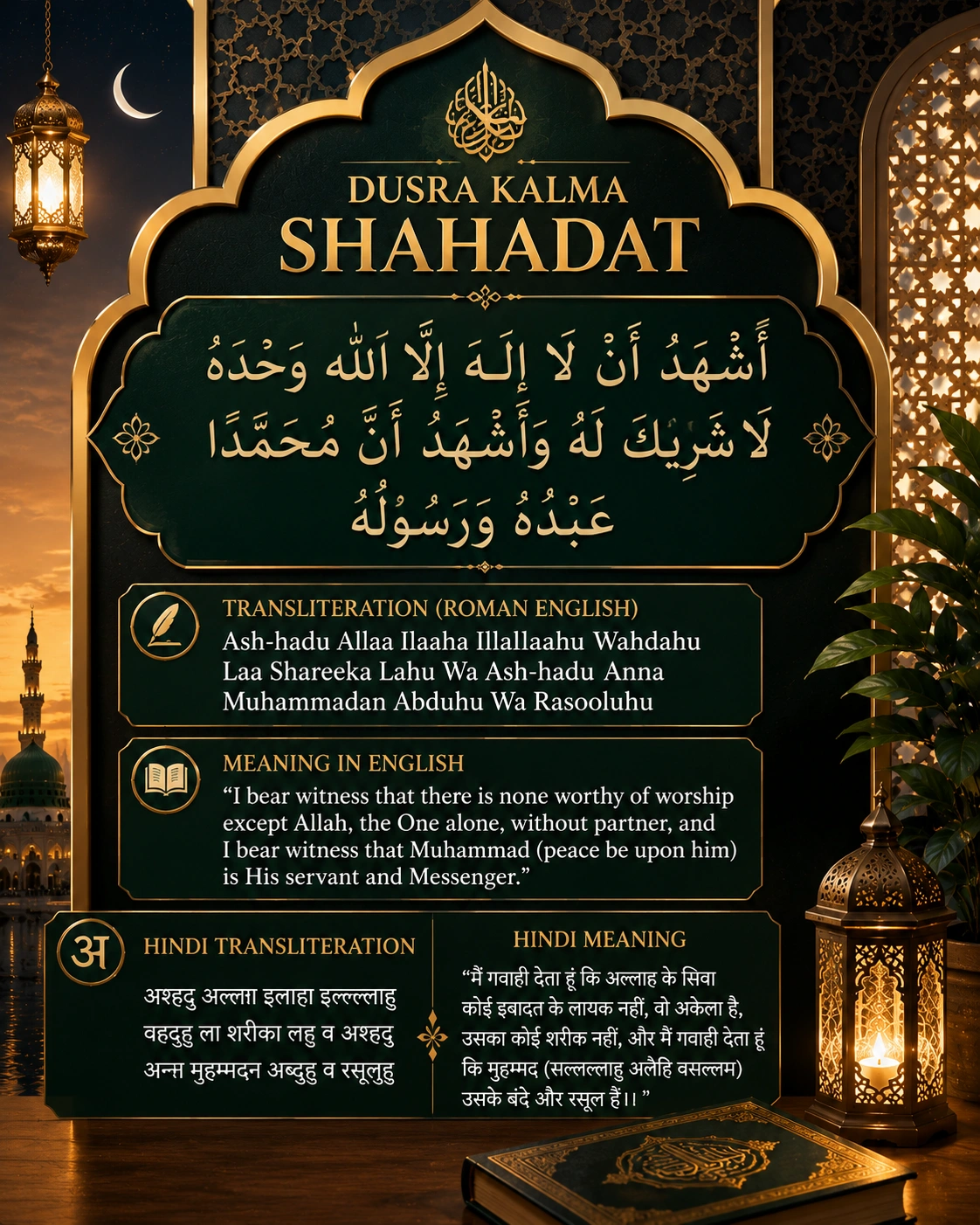
Dusra Kalma In Hindi (Transliteration and Meaning)
Hindi Transliteration
अश्हदु अल्लाा इलाहा इल्लल्लाहु वहदहु ला शरीका लहु व अश्हदु अन्न मुहम्मदन अब्दुहु व रसूलुहु
Dusra Kalma In Hindi Meaning
“मैं गवाही देता हूं कि अल्लाह के सिवा कोई इबादत के लायक नहीं, वो अकेला है, उसका कोई शरीक नहीं, और मैं गवाही देता हूं कि मुहम्मद (सल्लल्लाहु अलैहि वसल्लम) उसके बंदे और रसूल हैं।”
Dusra Kalma In Urdu (Transliteration and Meaning)
Urdu Transliteration
اشہد ان لا الٰہ الا اللہ وحدہ لاشریک لہ و اشہد ان محمدًا عبدہ و رسولہ
Dusra Kalma In Urdu Meaning
“میں گواہی دیتا ہوں کہ اللہ کے سوا کوئی عبادت کے لائق نہیں، وہ اکیلا ہے، اس کا کوئی شریک نہیں، اور میں گواہی دیتا ہوں کہ محمد صلی اللہ علیہ وسلم اس کے بندے اور رسول ہیں۔”
Dusra Kalma With Tarjuma (Full Breakdown)
Understanding each part of the Dusra Kalma Shahadat helps a Muslim recite it with greater conviction. Whether you are reading the Dusra Kalma In Arabic script or through transliteration, knowing what each word means makes every recitation more sincere. Below is a word-by-word breakdown:
| Arabic | Roman English | Meaning |
|---|---|---|
| اَشْهَدُ | Ash-hadu | I bear witness |
| اَنْ لَّآ اِلٰهَ | Allaa Ilaaha | That there is no god |
| اِلَّا اللهُ | Illallaahu | Except Allah |
| وَحْدَہٗ | Wahdahu | He is One alone |
| لَاشَرِيْكَ لَہٗ | Laa Shareeka Lahu | He has no partner |
| وَاَشْهَدُ | Wa Ash-hadu | And I bear witness |
| اَنَّ مُحَمَّدًا | Anna Muhammadan | That Muhammad |
| عَبْدُهٗ | Abduhu | Is His servant |
| وَرَسُولُہٗ | Wa Rasooluhu | And His Messenger |
This Dusra Kalma with tarjuma makes it easier for new Muslims and young learners to memorize and truly feel the meaning of every word they recite.
What Is the Dusra Kalma Shahadat
The six Kalimas are foundational statements of Islamic belief. Among them, the Dusra Kalma Shahadat is the declaration of faith in its most complete form. Muslims who recite the Dusra Kalma Shahadat regularly are actively affirming the core beliefs that Islam is built upon.
The first part of this Kalima affirms Tawheed, the oneness of Allah. It clearly states that Allah has no partner, no equal, and no associate. This is one of the most important beliefs a Muslim can hold.
The second part of this Kalima affirms Risalat, which is the acceptance of Prophet Muhammad (peace be upon him) as the final messenger of Allah. By calling him “Abduhu” (His servant), the Kalima also affirms the full humanity of the Prophet, while “Rasooluhu” (His Messenger) affirms his divine appointment.
Together, these two declarations make the Dusra Kalma one of the most complete expressions of Islamic faith.
When To Read Dusra Kalma Shahadat
After Performing Wudu (Ablution)
One of the most recommended times to recite the Dusra Kalma is immediately after completing wudu. A well-known hadith narrated by Umar ibn al-Khattab (may Allah be pleased with him) in Bulugh al-Maram (Hadith 57) states that the Prophet Muhammad (peace be upon him) said: whoever completes wudu and then recites the Shahadat, all eight gates of Paradise will be opened for him and he may enter through whichever gate he wishes.
This is one of the clearest and most motivating incentives to memorize and recite this Kalima regularly after every wudu.
During the Adhan (Call to Prayer)
The Dusra Kalma Shahadat forms a central part of the Adhan. Muslims hear and repeat it five times every single day. As narrated in Sunan Ibn Majah (Hadith 709), the Prophet Muhammad (peace be upon him) personally taught the Adhan, and the Shahadat phrases are repeated within it.
Repeating the Shahadat during the Adhan is a Sunnah practice that keeps the declaration of faith fresh and alive in the heart of every Muslim throughout the day.
At the Time of Accepting Islam
A person enters Islam by sincerely reciting the Shahadat. This makes the Dusra Kalma the gateway through which every new Muslim steps into the fold of Islam. It is the most important single act in the journey of conversion.
In Daily Remembrance and Dhikr
Many Muslims include the Dusra Kalma in their daily dhikr routines, reciting it morning and evening as a way of renewing their faith and staying connected to the core of their belief.
Benefits of Dusra Kalma Shahadat
Gates of Paradise Are Opened
The most significant benefit mentioned in a verified hadith is that reciting the Shahadat after wudu opens all eight gates of Paradise. This is narrated in Bulugh al-Maram (Hadith 57) and is one of the most powerful incentives for a Muslim to make this a daily habit.
Renewal of Faith
Every time a Muslim recites the Dusra Kalma with full awareness, they are renewing their commitment to the two most important beliefs in Islam: the oneness of Allah and the prophethood of Muhammad (peace be upon him). This constant renewal keeps the heart firm in faith.
Protection Through Remembrance of Tawheed
Reciting the Dusra Kalma regularly keeps a Muslim grounded in the concept of Tawheed. It serves as a continuous reminder that no one else deserves worship, and that all actions in life should be directed toward pleasing Allah alone.
Connection to the Adhan Five Times Daily
Since the Shahadat is part of the Adhan, a Muslim who listens attentively and repeats the phrases during the call to prayer recites this Kalima at least five times a day. This regular repetition creates a deep spiritual rhythm in the life of every Muslim.
Closeness to the Sunnah of the Prophet
Reciting the Dusra Kalma after wudu is a direct Sunnah of the Prophet Muhammad (peace be upon him). Practicing it regularly brings a Muslim closer to the way the Prophet lived, which is itself a great spiritual reward.
A Means of Guidance for New Muslims
The Dusra Kalma is one of the very first things taught to someone who is entering Islam. It plants the seed of correct belief from the very beginning. Parents who teach it to their young children are giving them a lifelong spiritual foundation.
Dusra Kalma and the Concept of Tawheed
The Dusra Kalma Shahadat is directly built on the concept of Tawheed, which means the absolute oneness of Allah. This is the most important belief in Islam.
The phrase “Wahdahu Laa Shareeka Lahu” which means “He is One, without partner” is one of the clearest statements of Tawheed in the entire Islamic tradition. It leaves no room for any form of association with Allah.
The Quran repeats this concept throughout its verses. Surah Al-Ikhlas (Chapter 112) is devoted entirely to expressing the oneness of Allah and is sometimes called the heart of Tawheed. Reciting the Dusra Kalma is a daily act of affirming what Surah Al-Ikhlas and dozens of other Quranic verses confirm.
A Muslim who truly grasps the meaning of the Dusra Kalma Shahadat will naturally avoid every form of shirk (associating partners with Allah), because the Kalima itself is a firm declaration against it.
Dusra Kalma in the Context of the Six Kalimas
The six Kalimas together form a complete picture of Islamic faith and practice. The Dusra Kalma Shahadat is the second among them and builds directly on the First Kalima Tayyib.
While the First Kalima establishes the basic declaration of faith (La ilaha illallah Muhammadur Rasulullah), the Dusra Kalma expands on this by adding the personal dimension of “I bear witness” (Ash-hadu). This personal witness makes the declaration more intimate and sincere.
The six Kalimas are taught to Muslim children from a young age in South Asian Muslim communities, particularly in India, Pakistan, Bangladesh, and across the world. They remain one of the most memorized collections of Islamic phrases among Muslims globally.
Importance of Teaching Dusra Kalma to Children
Parents and teachers in Muslim households recognise the value of teaching the Dusra Kalma Shahadat to children from an early age. When a child memorizes this Kalima, they are not just memorizing words. They are internalizing the central beliefs of their religion.
Children who grow up knowing the meaning of the Dusra Kalma are more likely to know why they pray, why they fast, and why they follow the teachings of Islam. The Kalima becomes a spiritual anchor for them throughout their lives.
Reciting the Dusra Kalma with children regularly, explaining its meaning in simple terms, and connecting it to daily worship like the Adhan and wudu are all excellent ways to nurture strong Islamic identity in the next generation.
Conclusion
The Dusra Kalma Shahadat is one of the most important statements in the life of a Muslim. It is the declaration of Tawheed and the acceptance of the Prophet Muhammad (peace be upon him) as the final messenger of Allah.
Reciting the Dusra Kalma with awareness and belief is an act that connects a Muslim to the very core of their faith. Whether it is recited after wudu, repeated during the Adhan, or taught to children as one of their first Islamic lessons, this Kalima carries deep meaning and great reward.
May Allah grant every Muslim the ability to recite the Dusra Kalma Shahadat with full sincerity, to know its meaning from the heart, and to live a life that reflects its beautiful message of Tawheed and devotion to Allah. Ameen
🤲 Read These Other Islamic Supplications As Well:
- Sana Dua In Namaz Hindi
- Dua E Mujeer
- Lailatul Qadr Ki Dua
- Nazar Ki Dua By Prophet
- Hazrat Adam Ki Du
- Tawaf Ke 7 Chakkar Ki Dua
- Marriage Istikhara Dua
- Khana Khane Ke Baad Ki Dua
- Maa Baap Ke Liye Dua
- Safa Marwa Ki Dua
- Humbistari Ke Baad Ghusl Ki Dua
- Sehri Roza Rakhne Ki Niyat Ki Dua In English
- Iman E Mujmal
- Tahajjud Ki Dua
- Tahajjud Namaz Ki Niyat
- Taraweeh Ki Niyat
- Barish Ki Dua
- Subha Ki Dua
? FAQs About Dusra Kalma Shahadat
Q1. What is the Dusra Kalma Shahadat?
It is the second of the six Kalimas in Islam, in which a Muslim bears witness that Allah is One and that Muhammad (peace be upon him) is His messenger.
Q2. What is the full Arabic text of Dusra Kalma?
اَشْهَدُ اَنْ لَّآ اِلٰهَ اِلَّا اللهُ وَحْدَہٗ لَاشَرِيْكَ لَہٗ وَاَشْهَدُ اَنَّ مُحَمَّدًا عَبْدُهٗ وَرَسُولُہٗ
Q3. What does Dusra Kalma in Hindi mean?
It means: “Main gawahi deta hun ke Allah ke siwa koi ibadat ke layak nahi aur Muhammad (SAW) uske bande aur rasool hain.”
Q4. What is the Roman English transliteration of the Dusra Kalma?
Ash-hadu Allaa Ilaaha Illallaahu Wahdahu Laa Shareeka Lahu Wa Ash-hadu Anna Muhammadan Abduhu Wa Rasooluhu.
Q5. When should the Dusra Kalma be recited?
It is especially recommended after completing wudu, during the Adhan, and as part of daily dhikr.
Q6. What is the benefit of reciting Dusra Kalma after wudu?
According to Bulugh al-Maram (Hadith 57), all eight gates of Paradise are opened for the one who recites it after wudu.
Q7. Is the Dusra Kalma the same as the Shahada?
Yes, it is the extended form of the Shahada, with the addition of “Wahdahu Laa Shareeka Lahu” affirming that Allah has no partner.
Q8. How is the Dusra Kalma connected to the Adhan?
The Shahadat phrases are part of the Adhan, so Muslims recite this Kalima at least five times every day.
Written by: Ahmad Raza
Credentials: Islamic Studies Content Writer
🤲 Read More duas for daily life at Instant Dua