
The Teesra Kalma, also known as Kalima Tamjeed, is the third of the six Kalimas that Muslims recite as part of their faith and daily worship. The word “Tamjeed” comes from Arabic and it means glorification or praise. This Kalima is a beautiful declaration of the greatness of Allah (SWT).
The Teesra Kalma is a powerful statement of Dhikr, the remembrance of Allah. It combines four of the most beloved phrases in Islam: Subhanallah, Alhamdulillah, La Ilaha Illallah, and Allahu Akbar. Along with these, it includes the phrase “La Hawla wa la Quwwata Illa Billah,” which is a recognition that no strength or power belongs to any creation except what Allah gives.
Muslims recite this Kalima to praise Allah, seek closeness to Him, and earn great spiritual rewards. The words of Kalima Tamjeed carry immense weight and have been praised directly in Hadith literature.
Teesra Kalma In Arabic
The Arabic text of Kalima Tamjeed is:
سُبْحَانَ اللّٰهِ وَالْحَمْدُ لِلّٰهِ وَلَآ اِلٰهَ اِلَّا اللّٰهُ وَاللّٰهُ اَكْبَرُ وَلَا حَوْلَ وَلَا قُوَّةَ اِلَّا بِاللّٰهِ الْعَلِيِّ الْعَظِيْمِ
Teesra Kalma In Roman English
Subhaanallahi Walhamdulillaahi Wa Laa Ilaaha Illallaahu Wallaahu Akbaru Wa Laa Hawla Wa Laa Quwwata Illaa Billaahil Aliyyil Azeem
Teesra Kalma In English
“Glory be to Allah, and all praise be to Allah, and there is none worthy of worship except Allah, and Allah is the Greatest. There is no might or power except from Allah, the Most High, the Most Great.”
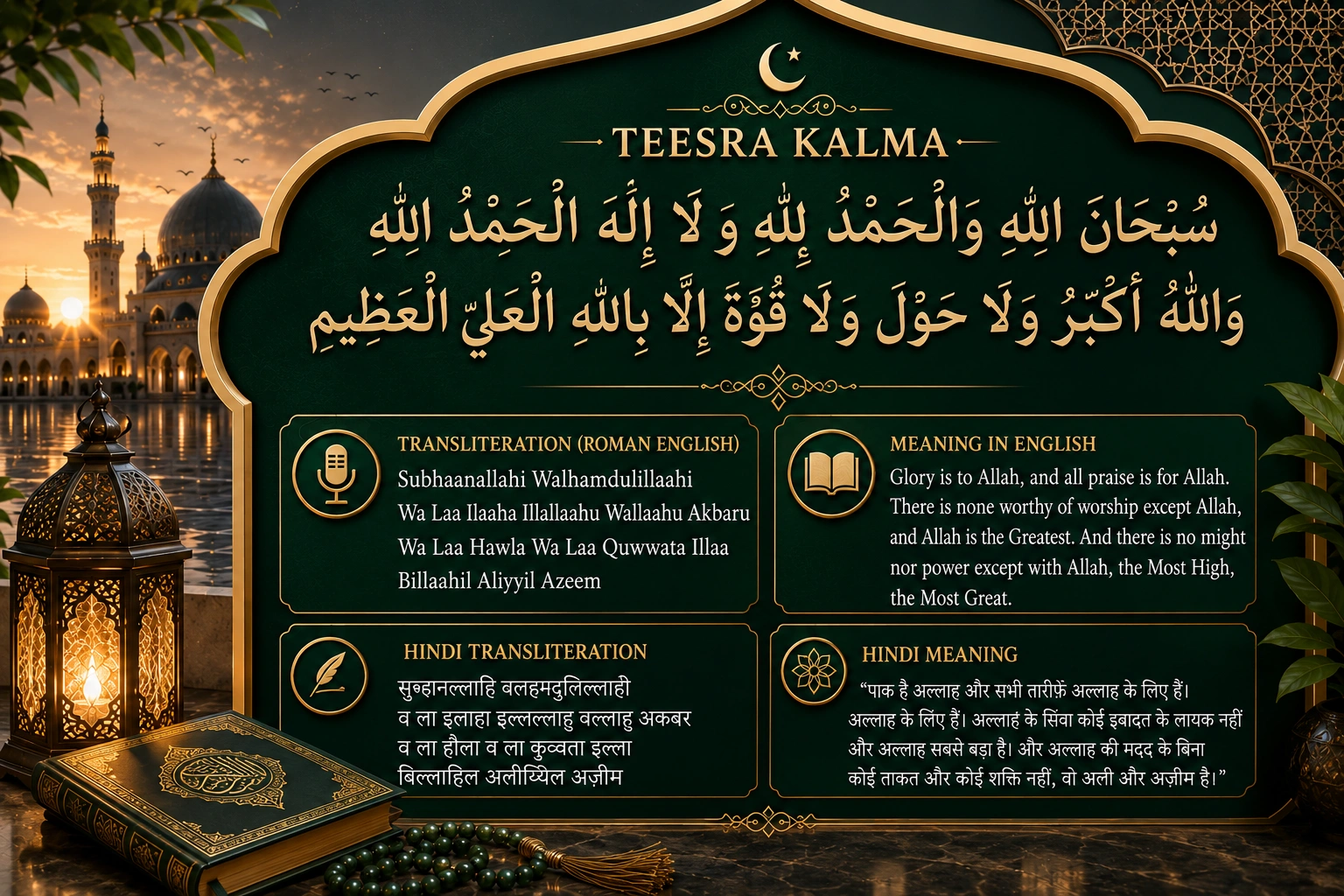
Teesra Kalma In Hindi Transliteration
सुब्हानल्लाहि वलहम्दुलिल्लाहि व ला इलाहा इल्लल्लाहु वल्लाहु अकबरु वला हौला वला कुव्वता इल्ला बिल्लाहिल अलिय्यिल अज़ीम
Teesra Kalma With Tarjuma In Hindi
अनुवाद (Tarjuma): “अल्लाह पाक है, और तमाम तारीफें अल्लाह के लिए हैं, और अल्लाह के सिवा कोई इबादत के लायक नहीं, और अल्लाह सबसे बड़ा है। न कोई ताकत है और न कोई कुव्वत, सिवाय अल्लाह के जो बुलंद है और बहुत बड़ा है।”
Teesra Kalma In Urdu With Meaning
اردو تلفظ: سُبحان اللہ والحمد للہ ولا الہ الا اللہ واللہ اکبر ولا حول ولا قوۃ الا باللہ العلی العظیم
اردو ترجمہ: “اللہ پاک ہے، اور تمام تعریفیں اللہ کے لیے ہیں، اور اللہ کے سوا کوئی معبود نہیں، اور اللہ سب سے بڑا ہے۔ نہ کوئی طاقت ہے اور نہ کوئی قوت مگر اللہ کی طرف سے جو بلند اور عظیم ہے۔”
Meaning Of Each Phrase In Teesra Kalma Tamjeed
This Kalima is made up of five powerful phrases. Each phrase carries deep meaning on its own.
Subhanallah
“Subhanallah” means “Glory be to Allah.” It is a declaration that Allah is completely free from all imperfections. He is above any weakness, fault, or limitation. When a Muslim says Subhanallah, they are affirming that Allah is perfect in every way.
Alhamdulillah
“Alhamdulillah” means “All praise be to Allah.” Every blessing a person enjoys, every breath they take, every moment of peace and health, all of it comes from Allah. This phrase is a way to acknowledge that gratitude belongs to Allah alone.
La Ilaha Illallah
“La Ilaha Illallah” means “There is none worthy of worship except Allah.” This is the foundation of Islamic belief and the heart of Tawheed. It is a complete rejection of all false gods and a firm declaration that only Allah deserves worship and obedience.
Allahu Akbar
“Allahu Akbar” means “Allah is the Greatest.” He is greater than any problem, any fear, any worldly power, and anything the human mind can imagine. This phrase instills trust and certainty in the heart of every believer.
La Hawla Wala Quwwata Illa Billah
“La Hawla Wala Quwwata Illa Billah il Aliyyil Azeem” means “There is no might and no power except with Allah, the Most High, the Most Great.” This phrase is known in Islamic tradition as a treasure of Paradise. It is a recognition that every ability, every strength, and every capacity comes from Allah alone. No human being can do anything except through the power and will of Allah.
Teesra Kalma Tamjeed Meaning: Spiritual Significance
Kalima Tamjeed is not just a set of words. It is a complete expression of the Islamic worldview. Every phrase in this Kalima connects the heart of a believer directly to Allah.
When a person recites “Subhanallah,” they are freeing their mind from false ideas about Allah and affirming His absolute perfection. When they say “Alhamdulillah,” they are training their soul to be grateful in every situation. The phrase “La Ilaha Illallah” renews the central commitment of faith. “Allahu Akbar” removes fear of everything other than Allah. And “La Hawla Wala Quwwata Illa Billah” brings humility and complete reliance on Allah.
Together, these phrases create a comprehensive act of worship that touches belief, gratitude, devotion, and trust all at once.
When To Read Teesra Kalma
This Kalima can be recited at any time of the day or night. There is no specific restriction on when it may be read. However, certain times and situations are especially recommended for reciting it.
After Every Salah
Many Muslims recite it as part of their post-Salah Dhikr. After completing the five daily prayers, reciting Subhanallah, Alhamdulillah, and Allahu Akbar brings great rewards. All these phrases are present in this Kalima together.
In The Morning And Evening
The morning and evening are especially blessed times for Dhikr. Reciting it during these times keeps the heart connected to Allah throughout the day and night.
During Difficulty Or Worry
The phrase “La Hawla Wala Quwwata Illa Billah” is particularly powerful during times of stress, hardship, or worry. The Prophet (ﷺ) described this phrase as a treasure from the treasures of Paradise (Sahih Bukhari, 7386). When a person feels overwhelmed or helpless, reciting this Kalima brings peace and a reminder that all power belongs to Allah.
During Travel
Reciting Dhikr including the phrases of this Kalima during travel is a Sunnah practice and a source of protection and blessing.
Before Sleeping
Reciting Dhikr before sleeping is a recommended practice. It can be included in the nightly routine of remembrance to close the day with the praise and glorification of Allah.
Benefits Of Teesra Kalma Tamjeed
It Is A Treasure Of Paradise
The Prophet Muhammad (ﷺ) said regarding “La Hawla Wala Quwwata Illa Billah” that it is one of the treasures of Paradise (Sahih Bukhari, 7386). Since this phrase is a central part of the Teesra Kalma, reciting this Kalima connects a believer to one of the great rewards of the next life.
It Fulfills The Purpose Of Dhikr
The Quran says in Surah Al-Baqarah (2:152): “So remember Me; I will remember you. And be grateful to Me and do not deny Me.” This Kalima is an act of Dhikr that fulfills this divine instruction. When a Muslim recites it, Allah remembers that person in a way that is even greater.
It Replaces Quran Recitation When One Cannot Read
A Hasan Hadith recorded in Sunan An-Nasai (924) mentions that a man came to the Prophet (ﷺ) and said he was unable to read from the Quran and asked for something to say instead. The Prophet (ﷺ) instructed him to recite: Subhanallah, Alhamdulillah, La Ilaha Illallah, Allahu Akbar, and La Hawla Wala Quwwata Illa Billah. This shows that these words carry an exceptional status in the sight of Allah.
It Brings Closeness To Allah
Reciting this Kalima is one of the most direct ways to feel the presence of Allah in one’s life. In a Hadith Qudsi reported in Sahih Bukhari and Muslim, Allah (SWT) says: “I am as my slave expects me to be, and I am with him when he remembers Me. If he remembers Me inwardly, I will remember him inwardly, and if he remembers Me in an assembly, I will remember him in a better assembly.”
It Removes Pride And Builds Reliance On Allah
The phrase “La Hawla Wala Quwwata Illa Billah” teaches humility. It reminds a person that no success or achievement in this world is truly their own. Everything happens through the will and power of Allah. This removes arrogance from the heart and builds a deep and lasting trust in Allah.
It Rewards With Spiritual Weight On The Scales
The Prophet (ﷺ) said that certain phrases are light for the tongue but heavy on the scales of deeds. Subhanallah, Alhamdulillah, and Allahu Akbar are among the most beloved phrases to Allah, and they are all present in Kalima Tamjeed. Reciting it regularly builds a spiritual record of tremendous weight.
The Teesra Kalma And Dhikr In Daily Life
Dhikr is not only for special moments or formal occasions. The Sunnah teaches that a Muslim should remember Allah at all times. As mentioned in Sunan Abi Dawud (Hadith 19), the Prophet (ﷺ) used to remember Allah at all moments of his day.
It is ideal for this kind of constant remembrance. Its phrases are easy to memorize and meaningful to recite. A person can say these words while walking, working, resting, or waiting. The heart benefits from this continuous remembrance even when the body is engaged in other tasks.
Making it a regular part of daily life is one of the most practical ways to bring Barakah, peace, and Allah’s nearness into every moment.
Conclusion
Kalima Tamjeed is one of the most complete and beautiful acts of Dhikr in Islam. Its five phrases cover the full range of how a believer should relate to Allah: through glorification, gratitude, declaration of faith, acknowledgment of His greatness, and total reliance on His power.
Reciting this Kalima regularly brings a Muslim closer to Allah, earns great rewards both in this world and the next, and fills the heart with peace, purpose, and spiritual strength. It is a practice rooted in verified Hadith and beloved to the Prophet (ﷺ).
Whether recited after Salah, during difficult moments, or simply as a habit throughout the day, It is a gift that every Muslim should make a part of their daily worship. May Allah (SWT) grant us the ability to remember Him with sincere hearts. Ameen.
 Read These Other Islamic Supplications As Well:
- Sana Dua In Namaz Hindi
- Dua E Mujeer
- Lailatul Qadr Ki Dua
- Nazar Ki Dua By Prophet
- Hazrat Adam Ki Du
- Tawaf Ke 7 Chakkar Ki Dua
- Marriage Istikhara Dua
- Khana Khane Ke Baad Ki Dua
- Maa Baap Ke Liye Dua
- Safa Marwa Ki Dua
- Humbistari Ke Baad Ghusl Ki Dua
- Sehri Roza Rakhne Ki Niyat Ki Dua In English
- Iman E Mujmal
- Tahajjud Ki Dua
- Tahajjud Namaz Ki Niyat
- Taraweeh Ki Niyat
- Barish Ki Dua
- Subha Ki Dua
- Dusra Kalma Shahadat
- Pehla Kalma Tayyab
? Frequently Asked Questions (FAQs)
Q1. What is the Teesra Kalma?
The third Kalima, also known as Tamjeed, is the third of the six Kalimas in Islam. It is a declaration of Allah’s glory, praise, greatness, and exclusive power, ending with the affirmation that all strength comes from Allah alone.
Q2. What is the Teesra Kalma Tamjeed meaning in English?
It means: “Glory be to Allah, and all praise be to Allah, and there is none worthy of worship except Allah, and Allah is the Greatest. There is no might or power except from Allah, the Most High, the Most Great.”
Q3. Is the Teesra Kalma mentioned in Hadith?
Yes. Its phrases are mentioned in several verified Hadith, including in Sahih Bukhari, Muslim, Sunan An-Nasai, and Sunan Abi Dawud. The Prophet (ﷺ) himself prescribed these words for a man who could not recite the Quran.
Q4. When should one recite the Teesra Kalma?
It can be recited at any time. Especially recommended times include after Salah, in the morning and evening, during hardship, before sleeping, and during travel.
Q5. What is the importance of “La Hawla Wala Quwwata Illa Billah” in the Teesra Kalma?
This phrase is described in Sahih Bukhari as a treasure from the treasures of Paradise. It acknowledges that no strength or ability belongs to any creation except through Allah’s will, and it brings peace and humility to the heart.
Q6. How many Kalimas are there in Islam?
There are six Kalimas in Islamic tradition: Kalima Tayyib (first), Kalima Shahadat (second), Kalima Tamjeed (third), Kalima Tauheed (fourth), Kalima Astaghfar (fifth), and Kalima Radde Kufr (sixth).
Q7. Can the Teesra Kalma be recited in place of Quran recitation?
A Hasan Hadith in Sunan An-Nasai (924) indicates that the Prophet (ﷺ) taught a man who could not read the Quran to recite these phrases. This shows the special weight these words carry in Islamic worship.
Written by: Ahmad Raza
Credentials: Islamic Studies Content Writer
Read More duas for daily life at Instant Dua